
Accounts Receivable to Sales Ratio: Definition & Analysis
The Accounts Receivable to Sales Ratio is a business liquidity ratio that measures how much of a company’s sales occur on credit. When a company has a larger percentage of its sales happening on a credit basisCredit SalesCredit sales refer to a sale in which the amount owed will be paid at a later date. In other words, credit sales are purchases made by, it may run into short-term liquidity problems. Such a scenario may happen if a company is running low on cash due to a lack of cash sales in the business cycleBusiness CycleA business cycle is a cycle of fluctuations in the Gross Domestic Product (GDP) around its long-term natural growth rate. It explains the.
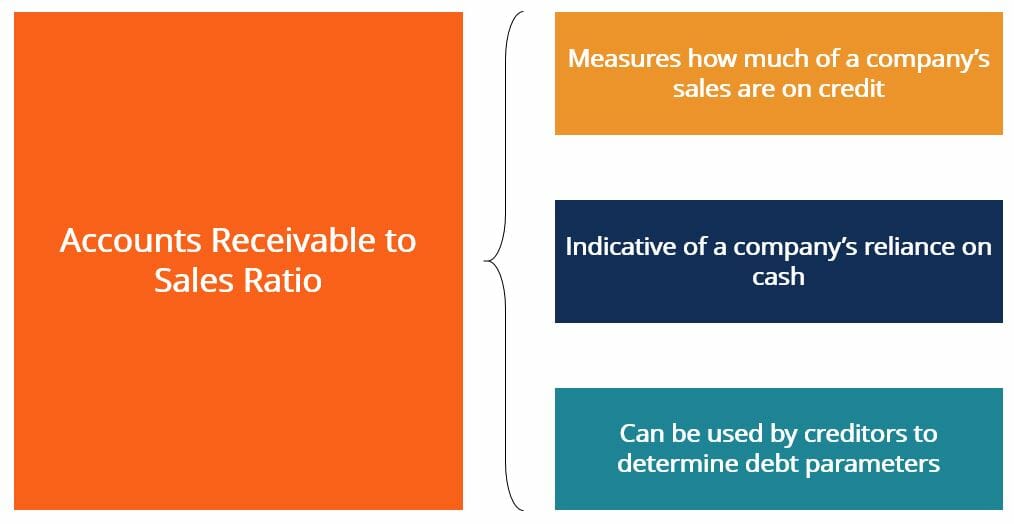
The Accounts Receivable to Sales Ratio is useful in evaluating how inclined a company is to conduct business on a credit basis. This can provide insight into its operational structure. A company that is able to run fine with little cash may have very small fixed costs or a low amount of debt in its capital structureCapital StructureCapital structure refers to the amount of debt and/or equity employed by a firm to fund its operations and finance its assets. A firm's capital structure.
Having a very high AR to Sales ratio can be a negative indicator to debt providers, since high credit sales may compromise a company’s ability to make periodic interest payments. Furthermore, a very high ratio indicates that a company may not have much of a cash cushion to rely on during difficult economic times or slow sales cycles.
How can we calculate the Accounts Receivable to Sales Ratio?
The Accounts Receivable to Sales Ratio is calculated by dividing the company’s sales for a given accounting period by its accounts receivables for the same period. The formula to calculate this ratio is as follows:
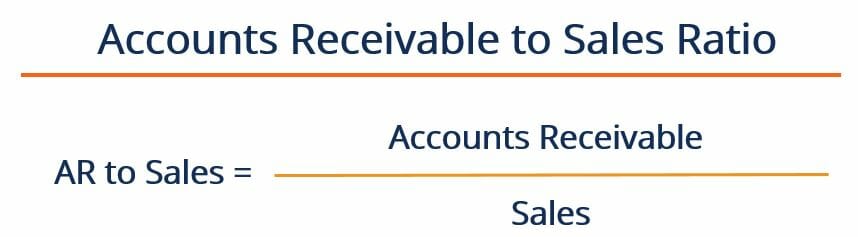
Where:
Accounts Receivable – refers to sales that have occurred on credit, meaning that the company has not yet collected the cash proceeds from these sales. Found in the “current assets” section of the balance sheetBalance SheetThe balance sheet is one of the three fundamental financial statements. The financial statements are key to both financial modeling and accounting..
Sales – refers to all sales that the company has realized over the given accounting period, including sales on credit and cash sales. Found on the income statementIncome StatementThe Income Statement is one of a company's core financial statements that shows their profit and loss over a period of time. The profit or.
Generally speaking, a low Accounts Receivable to Sales ratio is almost always favorable, as it means that the company’s cash collection cycle does not represent a great liquidity risk. The bulk of the company’s sales go into its cash account, which can then be used to finance the business. A low AR to Sales ratio also means that the business is generating fairly large cash flows from its operations. It relies less on its investing and financing activities for liquidity.
However, a company can see some benefit to having mostly credit sales in the form of accrued interest. Businesses can incentivize purchasers to pay within a certain time frame by treating accounts receivable as debt and charging interest beyond a certain time.
Accounts Receivables to Sales Example
Jim’s Burgers wants to calculate its Accounts Receivables to Sales ratio for the past few years in order to get a better understanding of its probable future liquidity. Below are snippets from Jim’s financial statements:
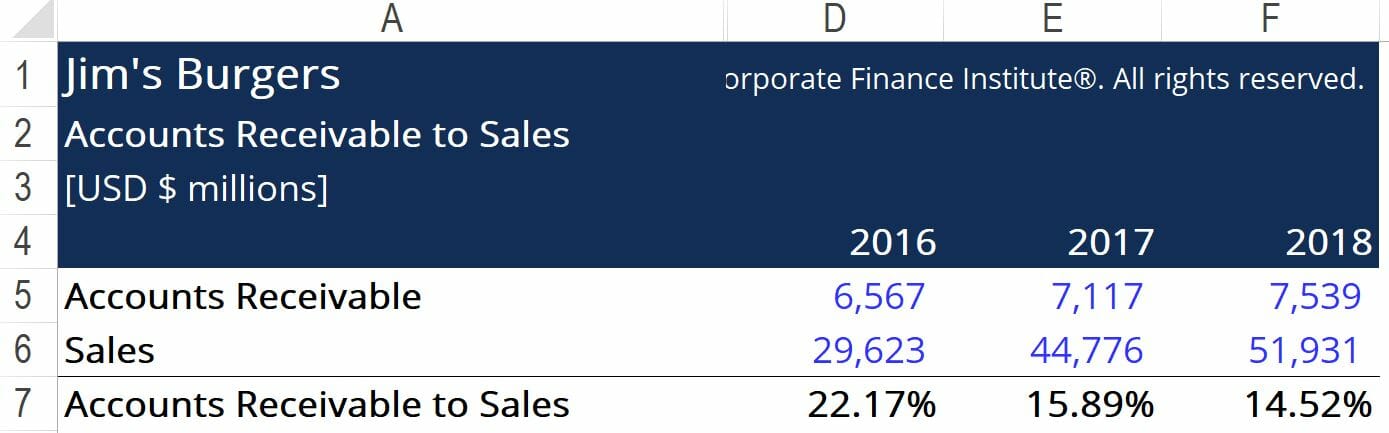
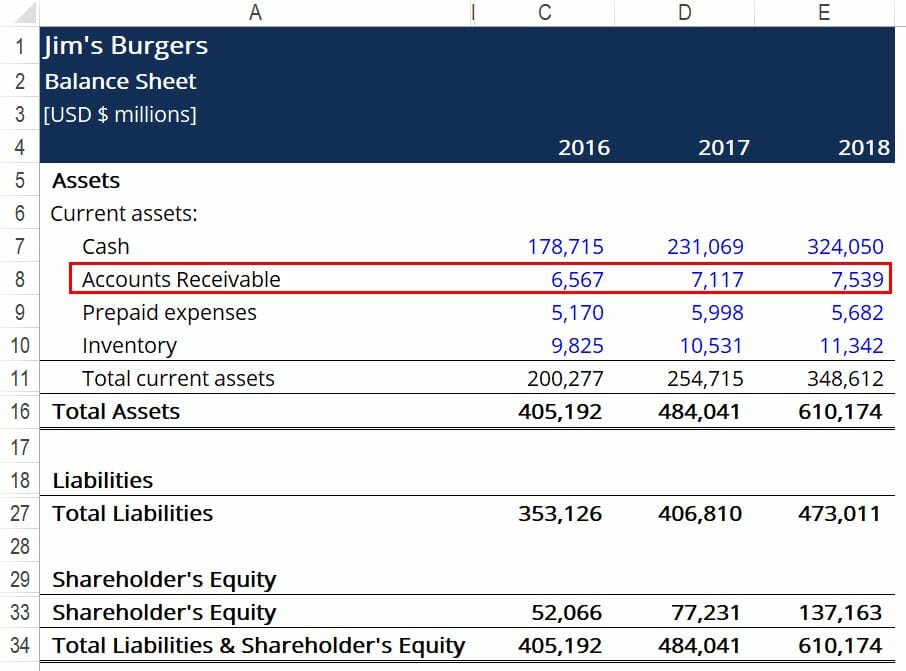
The red boxes highlight the important information that we need to calculate Accounts Receivables to Sales, namely the company’s current accounts receivable and its total sales. Using the formula provided above, we arrive at the following figures:
In this case, we see that Jim’s AR to sales ratio is consistently decreasing year over year, which is indicative of improving liquidity for the business. This means that an increasing number of purchasers are buying from Jim’s with cash upfront, rather than on credit. This will likely lead to an increase in Jim’s operating cash flow, which may allow the company to consider debt financing in the future.
Additional Resources
We hope you enjoyed reading CFI’s explanation of the Accounts Receivable to Sales Ratio. CFI offers the Financial Modeling & Valuation Analyst (FMVA)™Become a Certified Financial Modeling & Valuation Analyst (FMVA)®CFI's Financial Modeling and Valuation Analyst (FMVA)® certification will help you gain the confidence you need in your finance career. Enroll today! certification program for those looking to take their careers to the next level. To learn more about related topics, check out the following CFI resources:
- How to Calculate Debt Service Coverage RatioHow to Calculate Debt Service Coverage RatioThis guide will describe how to calculate the Debt Service Coverage Ratio. First, we will go over a brief description of the Debt Service Coverage Ratio, why it is important, and then go over step-by-step solutions to several examples of Debt Service Coverage Ratio Calculations.
- Current Portion of Long-Term DebtCurrent Portion of Long-Term DebtThe current portion of long-term debt is the portion of long-term debt due that is due within a year’s time. Long-term debt has a maturity of
- Accounting Fundamentals Course – CFI
- Defensive Interval RatioDefensive Interval RatioThe defensive interval ratio (DIR) is a financial liquidity ratio that indicates how many days a company can operate without needing to tap into capital sources other than its current assets. It is also known as the basic defense interval ratio (BDIR) or the defensive interval period ratio (DIPR).
-

Accounts Receivable Turnover Ratio: Calculation & Analysis
Days receivables outstanding can also be referred to as the companys average collection period for receivables. As part of a financial statement analysis, the account receivables turnover rat
-
Times Interest Earned (TIE) Ratio: Calculation & Interpretation
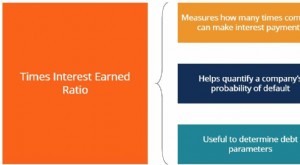
The Times Interest Earned (TIE) ratio measures a company’s ability to meet its debt obligations on a periodic basis. This ratio can be calculated by dividing a company’s EBITEBIT GuideEBIT
finance
- Accounts Receivable Financing: A Comprehensive Guide for Businesses
- Acid-Test Ratio: Understanding Your Company's Short-Term Liquidity
- Advertising to Sales Ratio: Measuring Ad Effectiveness & ROI
- Asset Turnover Ratio: Definition & Calculation - Financial Analysis
- Debt-to-Asset Ratio: Definition, Calculation & Significance
- Equity Ratio: Understanding Financial Leverage & Risk
- Solvency Ratio: Understanding a Company's Financial Stability
- Accounts Receivable (AR): Definition, Management & Forecasting
- Accounts Receivable Turnover Ratio: Definition & Calculation
-
 Dividend Payout Ratio (DPR): Understanding & Calculation
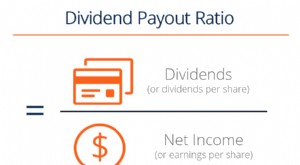
The Dividend Payout Ratio (DPR) is the amount of dividends paid to shareholders in relation to the total amount of net incomeNet IncomeNet Income is a key line item, not only in the income statement, ...
-
 Understanding the Hockey Stick Effect: Causes & Implications
The hockey stick effect is characterized by a sharp rise or fall of data points after a long flat period. It is illustrated using the graphical shape of a line chart that resembles a hockey stick. The...