
Understanding Book Value: A Key Financial Metric
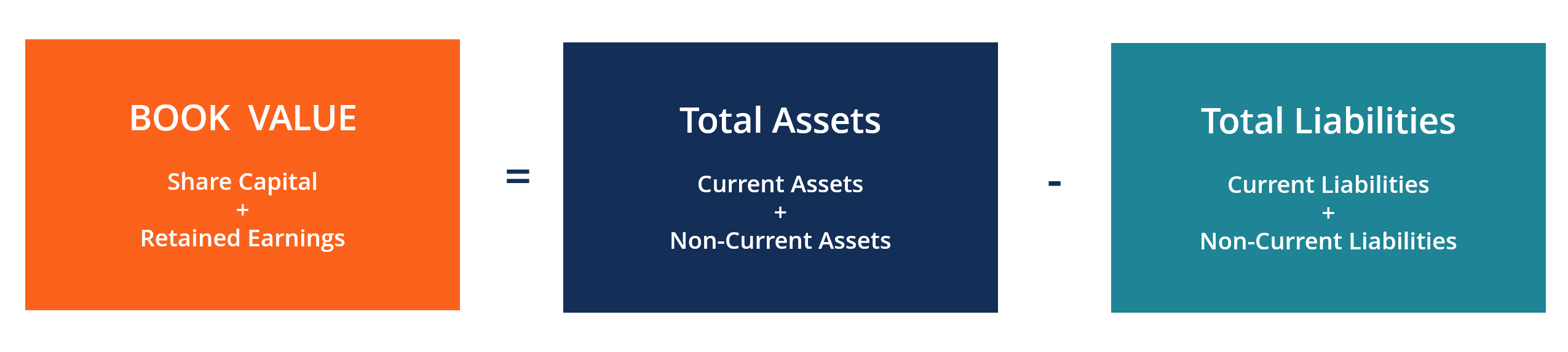
Book value is a company’s equity value as reported in its financial statementsThree Financial StatementsThe three financial statements are the income statement, the balance sheet, and the statement of cash flows. These three core statements are. The book value figure is typically viewed in relation to the company’s stock value (market capitalizationMarket CapitalizationMarket Capitalization (Market Cap) is the most recent market value of a company’s outstanding shares. Market Cap is equal to the current share price multiplied by the number of shares outstanding. The investing community often uses the market capitalization value to rank companies) and is determined by taking the total value of a company’s assets and subtracting any of the liabilities the company still owes.
Below is the Book Value Formula:
The company’s balance sheetBalance SheetThe balance sheet is one of the three fundamental financial statements. The financial statements are key to both financial modeling and accounting. also incorporates depreciation in the book value of assets. It attempts to match the book value with the real or actual value of the company. Book value is typically shown per share, determined by dividing all shareholder equityStockholders EquityStockholders Equity (also known as Shareholders Equity) is an account on a company's balance sheet that consists of share capital plus by the number of common stock shares that are outstanding.
Importance of Book Value
Book value is considered important in terms of valuation because it represents a fair and accurate picture of a company’s worth. The figure is determined using historical company data and isn’t typically a subjective figure. It means that investors and market analysts get a reasonable idea of the company’s worth.
Book value is primarily important for investors using a value investing strategyStock Investing: A Guide to Value InvestingSince the publication of "The Intelligent Investor" by Ben Graham, what is commonly known as "value investing" has become one of the most widely respected and widely followed methods of stock picking. because it can enable them to find bargain deals on stocks, especially if they suspect that a company is undervalued and/or is poised to grow, and the stock is going to rise in price.
Stocks that trade below book value are often considered a steal because they are anticipated to turn around and trade higher. Investors who can grab the stocks while costs are low in relation to the company’s book value are in an ideal position to make a substantial profit and be in a good trading position down the road.
The Issue of Intangibles
Book value’s inescapable flaw is the fact that it doesn’t accurately account for intangible assets of value within a company, which includes items such as patents and intellectual property. What does this mean for investors? It means they need to be wise and observant, taking the type of company and the industry it operates in under consideration.
For example, consider a value investor who is looking at the stock of a company that designs and sells apps. Because it is a technology company, a major portion of the company’s value is rooted in the ideas for, and rights to create, the apps it markets.
The company could be trading much higher than its book value because the market’s valuation takes into account the company’s intangible assets,Intangible AssetsAccording to the IFRS, intangible assets are identifiable, non-monetary assets without physical substance. Like all assets, intangible assets such as intellectual property. The stock, then, isn’t really overpriced – its book value is lower simply because it doesn’t accurately account for all the aspects of value that the company holds.
Final Word
Book value is a widely-used financial metric to determine a company’s value and to ascertain whether its stock price is over- or under-appreciated. It’s wise for investors and traders to pay close attention, however, to the nature of the company and other assets that may not be well represented in the book value.
Related Readings
CFI is the official provider of the global Financial Modeling & Valuation Analyst (FMVA)®Become a Certified Financial Modeling & Valuation Analyst (FMVA)®CFI's Financial Modeling and Valuation Analyst (FMVA)® certification will help you gain the confidence you need in your finance career. Enroll today! certification program, designed to help anyone become a world-class financial analyst. To keep advancing your career, the additional CFI resources below will be useful:
- GoodwillGoodwillIn accounting, goodwill is an intangible asset. The concept of goodwill comes into play when a company looking to acquire another company is
- Par ValuePar ValuePar Value is the nominal or face value of a bond, or stock, or coupon as indicated on a bond or stock certificate. It is a static value
- Senior and Subordinated DebtSenior and Subordinated DebtIn order to understand senior and subordinated debt, we must first review the capital stack. Capital stack ranks the priority of different sources of financing. Senior and subordinated debt refer to their rank in a company's capital stack. In the event of a liquidation, senior debt is paid out first
- Types of AssetsTypes of AssetsCommon types of assets include current, non-current, physical, intangible, operating, and non-operating. Correctly identifying and
-
Understanding Equity: A Comprehensive Guide for Investors
In finance and accounting, equity is the value attributable to the owners of a business. The book value of equity is calculated as the difference between assetsTypes of AssetsCommon types of assets in
-

Face Value Explained: Definition, Examples & Importance
The value mentioned on an instrument like a coin, stamp, or bill is called the face value of that instrument. For example, a $100 bill comes with a face value of $100. In calculus, the face value of 3
Accounting
- Understanding Book Value of Debt: A Comprehensive Guide
- Value Traps: Identifying & Avoiding Investment Pitfalls
- Book Value vs. Fair Value: Understanding the Difference
- EBITA Explained: Understanding Earnings Before Interest, Taxes, and Amortization
- Understanding Expenditures: Definition and Types
- Market Value vs. Book Value: Understanding the Difference
- Net Book Value (NBV): Definition & Calculation
- Understanding Salvage Value: Definition & Importance
- Shareholder Value: Definition, Calculation & Importance
-
 Understanding Clawbacks: Protecting Stakeholders from Failed Performance
What happens when a person promises to perform and then fails to deliver on their promises? Or what happens when it is found that a performance reportDue Diligence ReportExample due diligence report o...
-
 Understanding Financial Denomination: A Comprehensive Guide
A denomination is a classification for the face value of a financial instrument. It includes financial instruments, such as bondsBondsBonds are fixed-income securities that are issued by corporations ...