
Understanding Salvage Value: Definition & Importance
Salvage value is the amount that an asset is estimated to be worth at the end of its useful life. It is also known as scrap value or residual value, and is used when determining the annual depreciation expense of an asset. The value of the asset is recorded on a company’s balance sheetBalance SheetThe balance sheet is one of the three fundamental financial statements. The financial statements are key to both financial modeling and accounting., while the depreciation expense is recorded on its income statement.

Determining the Salvage Value of an Asset
The Internal Revenue Service (IRS) requires companies to estimate a “reasonable” salvage value. The value depends on how long the company expects to use the asset and how hard the asset is used. For example, if a company sells an asset before the end of its useful life, a higher value can be justified. Typically, companies set a salvage value of zero on assets that are used for a long time, are relatively inexpensive, or if the technology becomes obsolete quickly (5-year-old printer, 4-year-old laptop, etc.).
Importance of Salvage Value
If the salvage value is set too high or too low, it can be harmful to a company.
If set too high:
- Depreciation would be understated.
- Net incomeNet IncomeNet Income is a key line item, not only in the income statement, but in all three core financial statements. While it is arrived at through would be overstated.
- Total fixed assets and retained earnings would be overstated on the balance sheet.
If set too low:
- Depreciation would be overstated.
- Net income would be understated.
- Total fixed assets and retained earnings would be understated on the balance sheet.
- Values for the debt-to-equity ratioFinanceCFI's Finance Articles are designed as self-study guides to learn important finance concepts online at your own pace. Browse hundreds of articles! and loan collateral would be lower. This may result in difficulties securing future financing or in violation of loan covenants that require the company to maintain certain minimum debt ratio levels.
Using Salvage Value to Determine Depreciation
The estimated salvage value is deducted from the cost of the asset to determine the total depreciable amount of an asset.
For example, Company A purchases a computer for $1,000. The company estimates that the computer’s useful life is 4 years. This means that the computer will be used by Company A for 4 years and then sold afterward. The company also estimates that they would be able to sell the computer at a salvage value of $200 at the end of 4 years. The company follows a straight-line depreciation method.
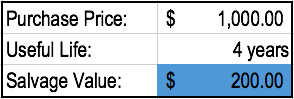

The depreciable value of this computer is determined by taking the purchase price and subtracting it from the estimated salvage value. In the example above, the depreciable value on this computer would be $1,000 – $200 = $800 taken over four years (the useful life of the asset). If the company uses a straight-line depreciation method, the computer would be depreciated annually by $200 ($800 / 4).
Download the Free Template
Enter your name and email in the form below and download the free salvage value and depreciation expense template now!
Real-World Example of Salvage Value Fraud
Waste Management, Inc. is a waste company founded in 1968 and was the largest waste management and environmental services company in 1980. Between 1992 and 1997, Waste Management, Inc. committed fraud several times. Among other fraudulent activities, the company:
- Avoided depreciation expenses by inflating salvage values and extending the useful life of the company’s garbage trucks
- Assigned arbitrary salvage values to assets that previously did not possess salvage value
The fraud was perpetrated in an attempt to meet predetermined earnings targets. In 1998, the company restated its earnings by $1.7 billion – the largest restatement in history.
More Resources
CFI is the official global provider of the Financial Modeling and Valuation Analyst (FMVA)Become a Certified Financial Modeling & Valuation Analyst (FMVA)®CFI's Financial Modeling and Valuation Analyst (FMVA)® certification will help you gain the confidence you need in your finance career. Enroll today!®Become a Certified Financial Modeling & Valuation Analyst (FMVA)®CFI's Financial Modeling and Valuation Analyst (FMVA)® certification will help you gain the confidence you need in your finance career. Enroll today! certification, designed to transform anyone into a world-class financial analyst.
To keep learning and advancing your career as a financial analyst, these additional CFI resources will be a help in your journey:
- Depreciation ScheduleDepreciation ScheduleA depreciation schedule is required in financial modeling to link the three financial statements (income, balance sheet, cash flow) in Excel.
- Accumulated DepreciationAccumulated DepreciationAccumulated depreciation is the total amount of depreciation expense allocated to a specific asset since the asset was put into use.
- Projecting Income Statement Line ItemsProjecting Income Statement Line ItemsWe discuss the different methods of projecting income statement line items. Projecting income statement line items begins with sales revenue, then cost
- Income Statement TemplateIncome StatementThe Income Statement is one of a company's core financial statements that shows their profit and loss over a period of time. The profit or
-

Understanding Money: Definition, History & Value
Money refers to any verifiable record that is accepted as a medium of exchange for payment of goods and services and repayment of debts in a specific country. Throughout history, governments adopted d
-

Nominal Value Explained: Definition & Financial Significance
Nominal value is a common financial term that is used in various contexts within finance. For stocks and bonds, it is also referred to as the “face value” of an investment that is stated o
Accounting
- Value Traps: Identifying & Avoiding Investment Pitfalls
- Understanding Book Value: A Key Financial Metric
- EBITA Explained: Understanding Earnings Before Interest, Taxes, and Amortization
- Understanding Expenditures: Definition and Types
- Goodwill in Accounting: Definition & Value
- OIBDA Explained: Understanding Operating Income Before Depreciation & Amortization
- Par Value Explained: Understanding Bonds & Stocks
- Understanding Vouchers: A Guide to Accounts Payable Documents
- Shareholder Value: Definition, Calculation & Importance
-
 Understanding Financial Gearing: Debt & Leverage Explained
Gearing is the amount of debtNet DebtNet debt = total debt - cash. Net debt is a financial liquidity metric that measures a company’s ability to pay all its debts if they were due today. Compare...
-
 Leverage in Finance: Strategies, Types & Risks
In finance, leverage is a strategy that companies use to increase assets, cash flows, and returns, though it can also magnify losses. There are two main types of leverage: financial and operating. To ...