
Net Profit Margin: Definition, Calculation & Importance
Net Profit Margin (also known as “Profit Margin” or “Net Profit Margin Ratio”) is a financial ratioFinancial RatiosFinancial ratios are created with the use of numerical values taken from financial statements to gain meaningful information about a company used to calculate the percentage of profit a company produces from its total revenue. It measures the amount of net profit a company obtains per dollar of revenue gained. The net profit margin is equal to net profit (also known as net income)Net IncomeNet Income is a key line item, not only in the income statement, but in all three core financial statements. While it is arrived at through divided by total revenueSales RevenueSales revenue is the income received by a company from its sales of goods or the provision of services. In accounting, the terms "sales" and, expressed as a percentage.

The typical profit margin ratio of a company can be different depending on which industry the company is in. As a financial analystGuide to Becoming a Financial AnalystHow to become a financial analyst. Follow CFI's guide on networking, resume, interviews, financial modeling skills and more. We've helped thousands of people become financial analysts over the years and know precisely what it takes., this is important in day-to-day financial analysis.
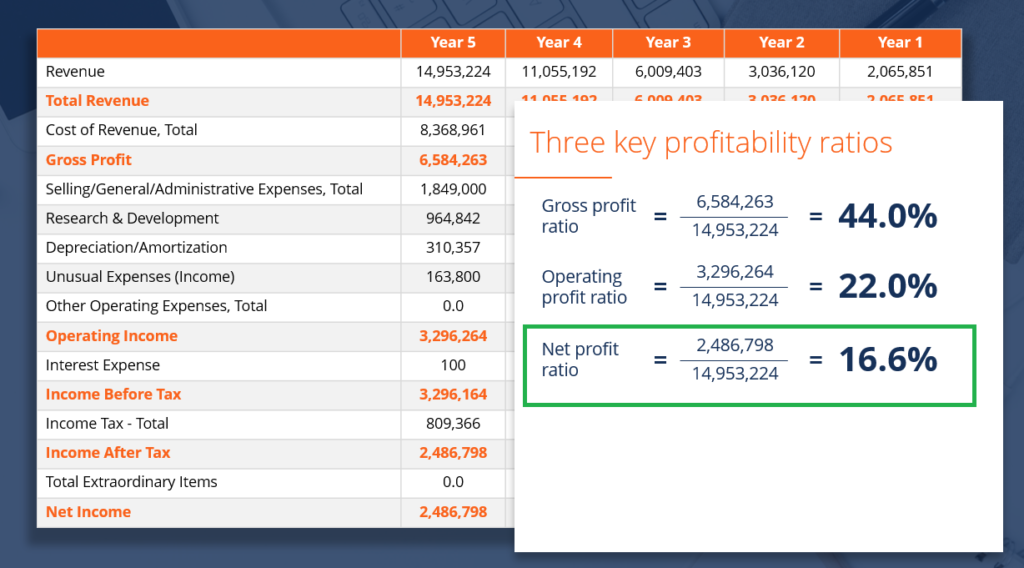
Source: CFI Financial Analysis Fundamentals Course.
Net Profit Margin Formula
Net Profit margin = Net Profit ⁄ Total revenue x 100
Net profitNet IncomeNet Income is a key line item, not only in the income statement, but in all three core financial statements. While it is arrived at through is calculated by deducting all company expenses from its total revenue. The result of the profit margin calculation is a percentage – for example, a 10% profit marginProfit MarginIn accounting and finance, profit margin is a measure of a company's earnings relative to its revenue. The three main profit margin metrics means for each $1 of revenue the company earns $0.10 in net profit. Revenue represents the total sales of the company in a period.
Calculation Example #1
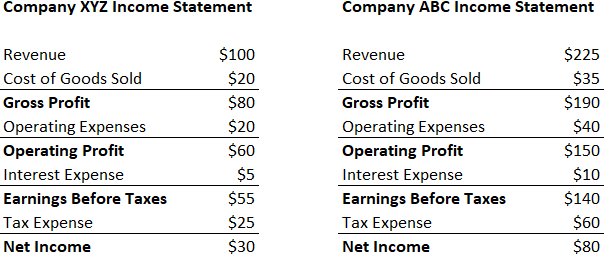
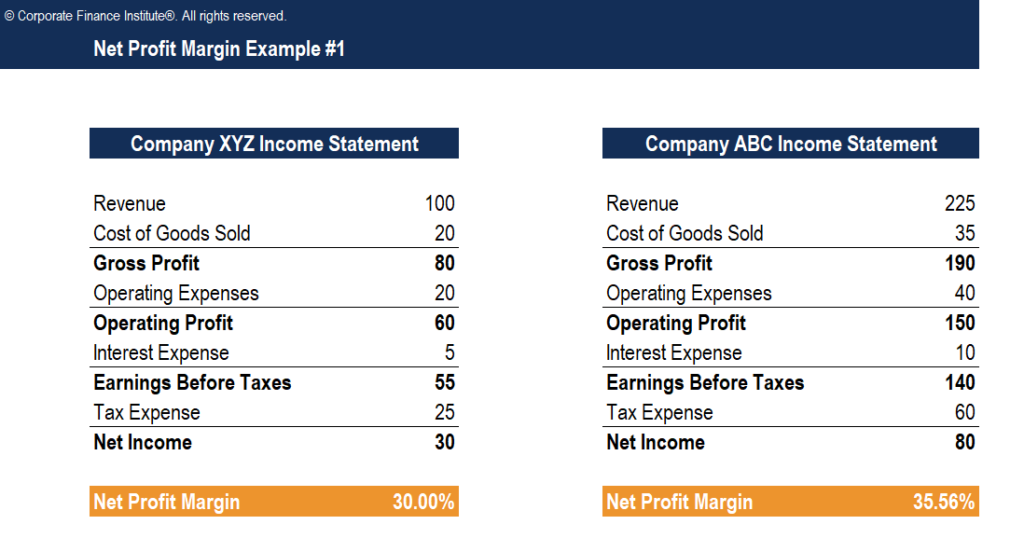
Company XYZ and ABC both operate in the same industry. Which company has a higher net profit margin?
Step 1: Write out the formula
Net Profit Margin = Net Profit/Revenue
Step 2: Calculate the net profit margin for each company
Company XYZ:
Net Profit Margin = Net Profit/Revenue = $30/$100 = 30%
Company ABC:
Net Profit Margin = Net Profit/Revenue = $80/$225 = 35.56%
Company ABC has a higher net profit margin.
Calculation Example #2
Company A and company B have net profit margins of 12% and 15% respectively. Both companies earned $150 in revenueSales RevenueSales revenue is the income received by a company from its sales of goods or the provision of services. In accounting, the terms "sales" and. How much net profit did each company make?
Step 1: Write out formula
Net Profit Margin = Net Profit/Revenue
Net Profit = Net Margin * Revenue
Step 2: Calculate net profit for each company
Company A:
Net Profit = Net Margin * Revenue = 12% * $150 = $18
Company B:
Net Profit = Net Margin * Revenue = 15% * $150 = $22.50
Calculation Example #3
Company A and B earned $83.50 and $67.22 in net profit respectively. Both companies have a net profit margin of 18.22%. How much revenue did each company earn?
Step 1: Write out formula
Net Profit Margin = Net Profit/Revenue
Revenue = Net Profit/Net Profit Margin
Step 2: Calculate revenue for each company
Company A:
Revenue = $83.50/18.22% = $458.29
Company B:
Revenue = $67.22/18.22% = $368.94
Download the Free Template
Enter your name and email in the form below and download the free template now!
Video Explanation of Net Profit margin
Below is a video explanation from CFI’s Financial Analysis Fundamentals Course of how net profit margin is calculated and what it means when analyzing a company’s performance.
Get more video tutorials in CFI’s Financial Analyst Training ProgramBecome a Certified Financial Modeling & Valuation Analyst (FMVA)®CFI's Financial Modeling and Valuation Analyst (FMVA)® certification will help you gain the confidence you need in your finance career. Enroll today!.
Understanding the Ratio
The net profit margin ratio is used to describe a company’s ability to produce profit and to consider several scenarios, such as an increase in expenses which is deemed ineffective. It is used extensively in financial modelingWhat is Financial ModelingFinancial modeling is performed in Excel to forecast a company's financial performance. Overview of what is financial modeling, how & why to build a model. and company valuationValuation MethodsWhen valuing a company as a going concern there are three main valuation methods used: DCF analysis, comparable companies, and precedent transactions.
Net profit margin is a strong indicator of a firm’s overall success and is usually stated as a percentage. However, keep in mind that a single number in a company report is rarely adequate to point out overall company performance. An increase in revenue might translate to a loss if followed by an increase in expenses. On the other hand, a decrease in revenue, followed by tight control over expenses, might put the company further in profit.
Other common financial metrics are EBITDAEBITDAEBITDA or Earnings Before Interest, Tax, Depreciation, Amortization is a company's profits before any of these net deductions are made. EBITDA focuses on the operating decisions of a business because it looks at the business’ profitability from core operations before the impact of capital structure. Formula, examples and Gross ProfitGross ProfitGross profit is the direct profit left over after deducting the cost of goods sold, or cost of sales, from sales revenue. It's used to calculate the gross profit margin..
A high net profit margin means that a company is able to effectively control its costs and/or provide goods or services at a price significantly higher than its costs. Therefore, a high ratio can result from:
- Efficient management
- Low costs (expenses)
- Strong pricing strategies
A low net profit margin means that a company uses an ineffective cost structure and/or poor pricing strategies. Therefore, a low ratio can result from:
- Inefficient management
- High costs (expenses)
- Weak pricing strategies
Investors need to take numbers from the profit margin ratio as an overall indicator of company profitability performanceProfitability RatiosProfitability ratios are financial metrics used by analysts and investors to measure and evaluate the ability of a company to generate income (profit) relative to revenue, balance sheet assets, operating costs, and shareholders' equity during a specific period of time. They show how well a company utilizes its assets to produce profit and initiate deeper research into the cause of an increase or decrease in the profitability as needed.
Limitations of Net Profit Margin Ratio
When calculating the net profit margin ratio, analystsGuide to Becoming a Financial AnalystHow to become a financial analyst. Follow CFI's guide on networking, resume, interviews, financial modeling skills and more. We've helped thousands of people become financial analysts over the years and know precisely what it takes. commonly compare the figure to different companies to determine which business performs the best.
While this is common practice, the net profit margin ratio can greatly differ between companies in different industries. For example, companies in the automotive industry may report a high profit margin ratio but lower revenue as compared to a company in the food industry. A company in the food industry may show a lower profit margin ratio, but higher revenue.
It is recommended to compare only companies in the same sector with similar business models.
Other limitations include the possibility of misinterpreting the profit margin ratio and cash flow figures. A low net profit margin does not always indicate a poorly performing company. Also, a high net profit margin does not necessarily translate to high cash flowsCash FlowCash Flow (CF) is the increase or decrease in the amount of money a business, institution, or individual has. In finance, the term is used to describe the amount of cash (currency) that is generated or consumed in a given time period. There are many types of CF.
Limitations Example #1 – Comparing Companies
A jewelry company that sells a few expensive products may have a much higher profit margin as compared to a grocery store that sells many cheap products.
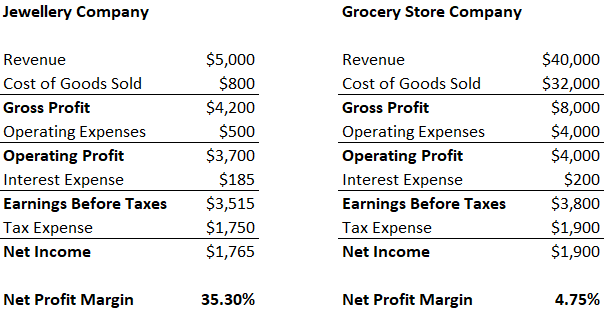
It’d be inappropriate to compare the margins for these two companies, as their operations are completely different.
Limitations Example #2 – Companies with Debt
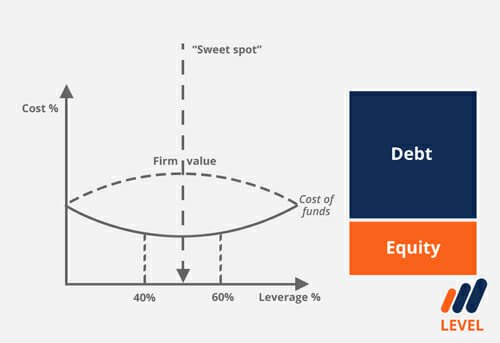
If a company has higher financial leverageFinancial LeverageFinancial leverage refers to the amount of borrowed money used to purchase an asset with the expectation that the income from the new asset will exceed the cost of borrowing. than another, then the firm with more debt financing may have a smaller net profit margin due to the higher interest expenses. This negatively affects net profit, lowering the net profit margin for the company.
Limitations Example #3 – Depreciation Expense
Companies with high property plant & equipment (PP&E)PP&E (Property, Plant and Equipment)PP&E (Property, Plant, and Equipment) is one of the core non-current assets found on the balance sheet. PP&E is impacted by Capex, assets will be affected by higher depreciation expenses, lowering the firm’s net profit margin. This may be misleading because the company could have significant cash flow but may seem inferior due to their lower profit margin.
Limitations Example #4 – Manipulation of Profit
Management may reduce long-term expenses (such as research and development) to increase their profit in the short-term. This can mislead investors looking at net margin, as a company can boost their margin temporarily.
Financial Analysis
Calculating the net margin of a business is a routine part of financial analysis. It is part of a type of analysis known as vertical analysis, which takes every line item on the income statement and divides it into revenue. To compare the margin for a company on a year-over-year (YoYYoY (Year over Year)YoY stands for Year over Year and is a type of financial analysis used for comparing time series data. It is useful for measuring growth and detecting trends.) basis, a horizontal analysis is performed. To learn more, read CFI’s free guide to analyzing financial statementsAnalysis of Financial StatementsHow to perform Analysis of Financial Statements. This guide will teach you to perform financial statement analysis of the income statement,.
To learn more via online courses, check out our wide ranges of topics such as:
- Financial analysis
- Financial modeling
- Business valuation
Additional Resources
Thank you for reading our guide to the net margin formula. CFI is the official global provider of the Financial Modeling and Valuation Analyst (FMVA)™Become a Certified Financial Modeling & Valuation Analyst (FMVA)®CFI's Financial Modeling and Valuation Analyst (FMVA)® certification will help you gain the confidence you need in your finance career. Enroll today! certification, designed to transform anyone into a world-class financial analyst.
If You’re interested in advancing your career in corporate finance, these articles will help you on your way:
- Gross Profit MarginGross ProfitGross profit is the direct profit left over after deducting the cost of goods sold, or cost of sales, from sales revenue. It's used to calculate the gross profit margin.
- EBITDA MarginEBITDA MarginEBITDA margin = EBITDA / Revenue. It is a profitability ratio that measures earnings a company is generating before taxes, interest, depreciation, and amortization. This guide has examples and a downloadable template
- Free Cash Flow GuideValuationFree valuation guides to learn the most important concepts at your own pace. These articles will teach you business valuation best practices and how to value a company using comparable company analysis, discounted cash flow (DCF) modeling, and precedent transactions, as used in investment banking, equity research,
- Financial Modeling GuideFree Financial Modeling GuideThis financial modeling guide covers Excel tips and best practices on assumptions, drivers, forecasting, linking the three statements, DCF analysis, more
-

Understanding Sellouts in Investing: Non-Economic Forced Liquidations
A sellout is a situation where investors are compelled to dispose of their assets due to non-economic factors, such as divorce, illness, or margin calls by a brokerage firm. In times of panic, investo
-

Gross vs. Net: Understanding the Difference - Definitions & Examples
Gross means the total or whole amount of something, whereas net means what remains from the whole after certain deductions are made. For example, a company with revenuesSales RevenueSales revenue is t
finance
- Understanding Gross Profit Margin: Definition & Calculation
- EBITDA Margin: Definition, Calculation & Importance
- Margin of Safety: Definition, Calculation & Importance
- Net Interest Margin (NIM): Definition & Importance
- Net Settlement Explained: How Banks Settle Transactions
- Operating Profit Margin: Definition & Calculation | [Your Company Name]
- Understanding Profitability Ratios: A Comprehensive Guide
- Operating Margin: Definition, Calculation & Importance
- Profit Margin Explained: Types & How to Calculate
-
 Margin Debt Explained: Understanding Brokerage Loans for Investing
Margin debt represents the amount that an investor owes a broker in their margin account. When a broker approves a margin account for an investor, the margin account is granted a line of credit that c...
-
 Understanding Net Change: Definition & Calculation
Net change is the difference between the closing price of a prior trading period and the closing price of the current trading period for a financial security. Net change is generally used for stock pr...