
Understanding Revenue Streams: A Comprehensive Guide
Revenue streams are the various sources from which a business earns money from the sale of goods or the provision of services. The types of revenue that a business records on its accounts depend on the types of activities carried out by the business. Generally speaking, the revenue accounts of retail businesses are more diverse, as compared to businesses that provide services.
Video Explanation of Revenue Streams
Watch this short video to quickly understand the main concepts covered in this guide, including the different types of revenues, examples of revenue streams, and the importance of understanding where a company’s revenue comes from.
Types of Revenues
To classify revenues at a high level, there are operating revenues and non-operating revenues. Operating revenues describe the amount earned from the company’s core business operations. Sales of goods or services are examples of operating revenues. Non-operating revenues refer to the money earned from a business’s side activities. Examples include interest revenueCapital Gains YieldCapital gains yield (CGY) is the price appreciation on an investment or a security expressed as a percentage. Because the calculation of Capital Gain Yield involves the market price of a security over time, it can be used to analyze the fluctuation in the market price of a security. See calculation and example and dividend revenue.
Many different revenue accounts are used by businesses in various industries. For the majority of companies, the following are a few common revenue accounts:
- Revenue from goods sales or service fees: This is the core operating revenue account for most businesses, and it is usually given a specific name, such as sales revenue or service revenue.
- Interest revenue: This account records the interest earned on investments such as debt securities. This is usually a non-operating revenue.
- Rent revenue: This account records the amount earned from renting out buildings or equipment, and is considered non-operating revenue.
- Dividend revenue: The amount of dividends earned from holding stocks of other companies. This is also non-operating revenue.
Examples of Revenue Streams
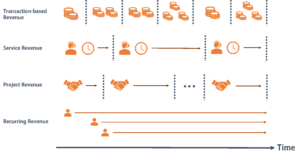
Revenue streams categorize the earnings a business generates from certain pricing mechanisms and channels. To describe it simply, a revenue stream can take the form of one of these revenue models:
- Transaction-based revenue: Proceeds from sales of goods that are usually one-time customer payments.
- Service revenue: Revenues are generated by providing service to customers and are calculated based on time. For example, the number of hours of consulting services provided.
- Project revenue: Revenues earned through one-time projects with existing or new customers.
- Recurring revenue: Earnings from ongoing payments for continuing services or after-sale services to customers. The recurring revenue model is the model most commonly used by businesses because it is predictable and it assures the company’s source of revenue as ongoing. Possible recurring revenue streams include:
- Subscription fees (e.g., monthly fees for Netflix)
- Renting, leasing, or lending assets
- Licensing content to third parties
- Brokerage fees
- Advertising fees
Importance of Revenue Streams
1. Revenue is a Key Performance Indicator (KPI) for all businesses
As a financial analystGuide to Becoming a Financial AnalystHow to become a financial analyst. Follow CFI's guide on networking, resume, interviews, financial modeling skills and more. We've helped thousands of people become financial analysts over the years and know precisely what it takes., analyzing a company’s performance in terms of revenue is always one of the crucial tasks. Therefore, an analyst must be able to recognize the different revenue streams from which the company generates cash and interpret the revenue figures on financial statements.
When a financial analyst looks at financial statements, the revenue number reflects the amount recognized by the company when goods are sold or services rendered, regardless of whether cash is received at that time.
2. Performance prediction differs between different revenue streams
Out of the four revenue streams discussed, recurring revenue is the most predictable income to a business because it is expected that the cash inflowThe Ultimate Cash Flow Guide (EBITDA, CF, FCF, FCFE, FCFF)This is the ultimate Cash Flow Guide to understand the differences between EBITDA, Cash Flow from Operations (CF), Free Cash Flow (FCF), Unlevered Free Cash Flow or Free Cash Flow to Firm (FCFF). Learn the formula to calculate each and derive them from an income statement, balance sheet or statement of cash flows remains consistent with a stable customer base. In contrast, transaction-based and service revenues tend to fluctuate with customer demand and are more difficult to foresee. Seasonality is also often a major factor contributing to the variability in sales of goods and services.
Project revenue is the most volatile and risky revenue stream out of the four because it is largely contingent on customer relationships. Therefore, businesses need to invest a considerable amount of time in managing their relationships to maintain this revenue source.
Understanding the revenue stream enables a financial analyst to realize the pattern of cash inflows, and therefore be able to quickly observe unusual movement or changes in revenue trend, and identify the causes. This is when an analyst performs financial analysis and provides a meaningful explanation for variances.
3. Different forecasting models are needed for different revenue models
Depending on the type of revenue models a company employs, a financial analyst develops different forecasting models and carries out different procedures to obtain necessary information when performing financial forecasting. For companies with a recurring revenue stream, a forecast model should have a uniform structure and a similar pattern in revenue predictions.
For a project-based revenue stream, it is essential for an analyst to keep track of the latest project opportunities and continuously modify the forecast model to produce an accurate forecast. The forecast model might look very different each month, due to the constant renewal of projects taking place and the inclusion of various risk factors.
Related Readings
Thank you for reading CFI’s guide to revenue streams. CFI is the official provider of the Financial Modeling & Valuation Analyst (FMVA)Become a Certified Financial Modeling & Valuation Analyst (FMVA)®CFI's Financial Modeling and Valuation Analyst (FMVA)® certification will help you gain the confidence you need in your finance career. Enroll today!®Become a Certified Financial Modeling & Valuation Analyst (FMVA)®CFI's Financial Modeling and Valuation Analyst (FMVA)® certification will help you gain the confidence you need in your finance career. Enroll today! designationBecome a Certified Financial Modeling & Valuation Analyst (FMVA)®CFI's Financial Modeling and Valuation Analyst (FMVA)® certification will help you gain the confidence you need in your finance career. Enroll today!. To learn more about revenue, income, and accounting, the following free CFI resources will be helpful:
- Revenue Recognition PrincipleRevenue Recognition PrincipleThe revenue recognition principle dictates the process and timing by which revenue is recorded and recognized as an item in a company's
- Revenue Variance AnalysisRevenue Variance AnalysisRevenue Variance Analysis is used to measure differences between actual sales and expected sales, based on sales volume metrics, sales mix
- Projecting Income Statement Line ItemsProjecting Income Statement Line ItemsWe discuss the different methods of projecting income statement line items. Projecting income statement line items begins with sales revenue, then cost
- Analysis of Financial StatementsAnalysis of Financial StatementsHow to perform Analysis of Financial Statements. This guide will teach you to perform financial statement analysis of the income statement,
-

Understanding Installment Sales: A Comprehensive Guide
An installment sale is a financing arrangement in which the seller allows the buyer to make payments over an extended period of time. In an installment sale, the buyer receives the goods at the beginn
-

Understanding Intangible Assets: Definition & Importance
According to the IFRS, intangible assets are identifiable, non-monetary assets without physical substance. Like all assets, intangible assets are expected to generate economic returns for the company
Accounting
- LTM Revenue: Definition & Importance in Financial Analysis
- Understanding Accounting Policies: A Guide for Businesses
- Understanding Accounting Ratios: A Comprehensive Guide
- Accrued Revenue: Definition, Examples & Accounting Explained
- Ancillary Revenue: Definition, Examples & Maximization
- Marginal Revenue: Definition, Calculation & Importance
- Understanding Revenue: A Comprehensive Guide for Businesses
- Revenue vs. Income: Understanding the Key Differences
- ARPU: Understanding and Calculating Average Revenue Per User
-
 Understanding Financial Statements: A Comprehensive Guide
Financial statements are the records of a company’s financial condition and activities during a period of time. Financial statements show the financial performance and strength of a companyCorpo...
-
 Headline Earnings: Understanding Core Business Performance
Headline earnings are a restatement of a company’s profit that removes the effect of one-time charges, write-downs, cost-cutting, and other extraordinary items like tax liabilities. Another way ...