
Understanding Value Added Tax (VAT): A Comprehensive Guide
Value Added Tax (VAT), also known as Goods and Services Tax (GST) in Canada, is a consumption tax that is assessed on products at each stage of the production process – from labor and raw materials to the sale of the final product.
The VAT is assessed incrementally at each stage of the production process, where value is added. However, it is ultimately passed on to the final retail consumer. For example, if there is a 20% VAT on a product that costs $10, the consumerTypes of CustomersCustomers play a significant role in any business. By better understanding the different types of customers, businesses can be better equipped to develop will end up paying a price of $12.
Calculating Value Added Tax (VAT)
To calculate the amount of value added tax that must be paid at each stage, take the VAT amount at the latest stage of production and subtract the VAT that’s already been paid. It prevents double taxation and ensures that buyers at each stage get reimbursed for the VAT they’ve previously paid.
Example: Calculating VAT
Consider the following example with a 10% VAT assessed at each stage.
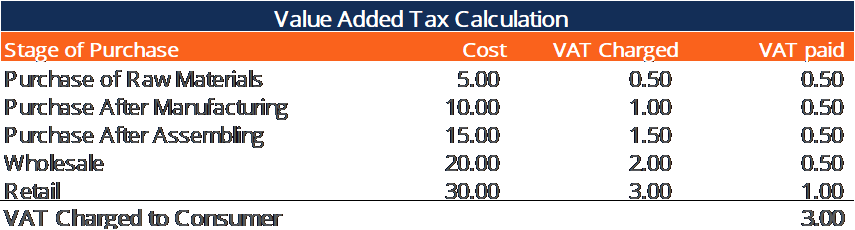
A bike manufacturer purchases raw materials for $5.50, which includes a 10% VAT. After completing the manufacturing of the parts, they are purchased by the assembler for $11, which includes a VAT of $1. The manufacturer receives $11, of which he pays $0.50 to the government.
The full $1 VAT is not paid to the government, as the manufacturer will keep the portion of VAT that he already paid to the seller of the raw materials. Since the manufacturer paid $0.50 in VAT to the seller of the raw materials, he will pay only a VAT of $0.50 ($1 – $0.50) to the government (i.e., the incremental VAT).
Similarly, VAT paid at each stage can be calculated by subtracting the VAT that’s already been charged from the VAT at the latest stage of purchase/production.
As already mentioned, the entire VAT is ultimately passed to the final buyer(s), as consumers at the previous stages of purchase are reimbursed for the VAT they’ve paid. As seen below, the final retail consumer pays the entire sum of the VAT paid by the other buyers at prior stages. The final consumer’s VAT can also be calculated by multiplying the price (excl. VAT) by the VAT rate (i.e., $30 * 10% = $3).
Value Added Tax vs. Sales Tax
Sales tax is very similar to VAT, with the key difference being that sales tax is assessed only once at the final stage of the purchase. Unlike VAT, which is assessed at each stage of purchase/production and paid by every successive buyer, sales tax is paid only once by the final consumer.
A key advantage of VAT over sales tax is that the former can allocate the tax amount to different stages at production based on the value added at that stage. Since sales tax is only paid once by the final buyer, one cannot measure the value added at each production stage. It makes it difficult to track and allocate the sales tax to specific stages of production.
Value Added Tax (VAT) – Advantages and Disadvantages
Advocates of VAT argue that adopting a regressive tax systemRegressive TaxA regressive tax is a tax applied in a way that the tax rate decreases with the increase of the taxpayer’s income. The regressive tax system, such as VAT, gives people a stronger incentive to work and earn higher salaries, as they get to keep their income (i.e., they are not taxed more for earning more, which is true with progressive taxesProgressive TaxA progressive tax is a tax rate that increases as the taxable value goes up. It is usually segmented into tax brackets that progress to, such as income taxes) and are only taxed when purchasing goods. VAT also makes it harder to evade taxes, as the tax is already embedded in the purchase of goods and services.
However, critics of VAT argue that, unlike the income tax rate, which varies at different levels of income, VAT is a fixed rate for everyone, and thus the poor end up paying a greater VAT rate than the rich, relative to their respective incomes. With VAT, goods and services become more expensive, and the entire tax is passed on to the consumers. It reduces the purchasing power of consumers and may make it difficult for low-income individuals and households to purchase necessities.
Another disadvantage of VAT is that businesses are faced with increased costs due to the administrative burden of calculating taxes at each stage of production. It can be especially challenging for global firms and multinational corporations with global supply chains spanning multiple tax regimes.
Despite the arguments against VAT, it offers some important benefits. The regressive tax can provide strong incentives to work, which can boost the overall gross domestic product (GDP)Gross Domestic Product (GDP)Gross domestic product (GDP) is a standard measure of a country’s economic health and an indicator of its standard of living. Also, GDP can be used to compare the productivity levels between different countries. of an economy. It can also increase government revenues by reducing tax evasion and providing a more timely and efficient framework for collecting taxes.
Additional Resources
CFI is the official provider of the global Commercial Banking & Credit Analyst (CBCA)™Program Page - CBCAGet CFI's CBCA™ certification and become a Commercial Banking & Credit Analyst. Enroll and advance your career with our certification programs and courses. certification program, designed to help anyone become a world-class financial analyst. To keep advancing your career, the additional resources below will be useful:
- How to use the IRS.gov Website?How to Use the IRS.gov WebsiteIRS.gov is the official website of the Internal Revenue Service (IRS), the United States’ tax collection agency. The website is used by businesses and
- Indirect TaxesIndirect TaxesIndirect taxes are basically taxes that can be passed on to another entity or individual. They are usually imposed on a manufacturer or supplier who then
- Permanent/Temporary Differences in Tax AccountingPermanent/Temporary Differences in Tax AccountingPermanent differences are created when there's a discrepancy between pre-tax book income and taxable income under tax returns and tax
- Multinational CorporationMultinational Corporation (MNC)A multinational corporation is a company that operates in its home country, as well as in other countries around the world. It maintains a
-

Annualized Income: Definition, Calculation & Tax Implications
Annualized income refers to an estimate of the total income generated for one year. It is calculated using partial data, and therefore, the income generated represents an estimate of the amount a busi
-
Understanding Book Value: A Key Financial Metric
Book value is a company’s equity value as reported in its financial statementsThree Financial StatementsThe three financial statements are the income statement, the balance sheet, and the statem
Accounting
- Understanding Financial Denomination: A Comprehensive Guide
- Understanding Equity: A Comprehensive Guide for Investors
- Face Value Explained: Definition, Examples & Importance
- Understanding Fair Value: Definition & Importance
- Understanding Value Added: Definition & Business Applications
- Par Value Explained: Understanding Bonds & Stocks
- Progressive Tax Explained: How It Works & Examples
- Regressive Taxes: Definition, Examples & Impact on Income Inequality
- Tax Depreciation Explained: A Comprehensive Guide for Taxpayers
-
 Accounting vs. Tax Depreciation: Key Differences Explained
Before we discuss accounting depreciation vs tax depreciation, let us first talk about depreciation itself. Essentially, depreciation is a method of allocating the cost of a tangible asset over severa...
-
 Amended Tax Return: Definition, Filing & 1040-X Form
An amended return is filed with the tax authority to make corrections to a previous year’s tax return. The tax return’s amended version can increase tax benefits or tax liability, dependin...