
McKinsey 7S Model: Understanding Organizational Effectiveness
The McKinsey 7S Model refers to a tool that analyzes a company’s “organizational design.” The goal of the model is to depict how effectiveness can be achieved in an organization through the interactions of seven key elements – Structure, Strategy, Skill, System, Shared Values, Style, and Staff.
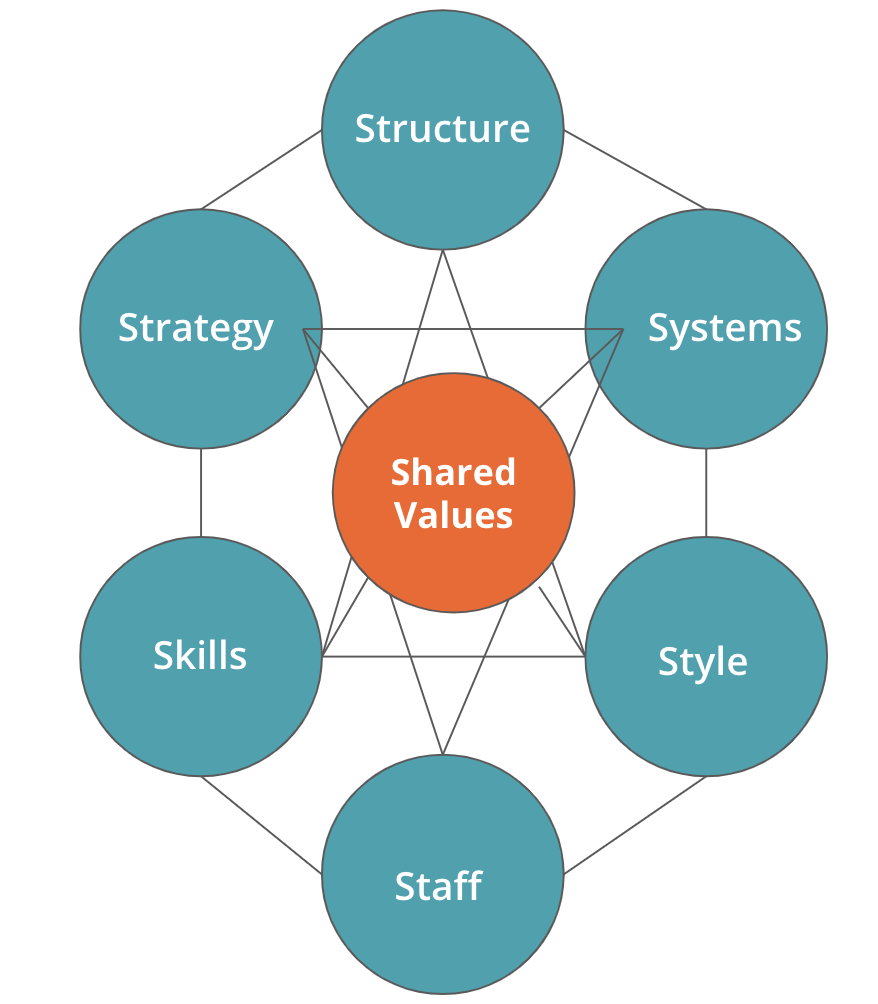
The focus of the McKinsey 7s Model lies in the interconnectedness of the elements that are categorized by “Soft Ss” and “Hard Ss” – implying that a domino effect exists when changing one element in order to maintain an effective balance. Placing “Shared Values” as the “center” reflects the crucial nature of the impact of changes in founder values on all other elements.
Structure of the McKinsey 7S Model
Structure, Strategy, and Systems collectively account for the “Hard Ss” elements, whereas the remaining are considered “Soft Ss.”
1. Structure
Structure is the way in which a company is organized – chain of command and accountability relationships that form its organizational chart.
2. Strategy
Strategy refers to a well-curated business plan that allows the company to formulate a plan of action to achieve a sustainable competitive advantageCompetitive AdvantageA competitive advantage is an attribute that enables a company to outperform its competitors. It allows a company to achieve superior margins, reinforced by the company’s mission and values.
3. Systems
Systems entail the business and technical infrastructure of the company that establishes workflows and the chain of decision-making.
4. Skills
Skills form the capabilities and competencies of a company that enables its employees to achieve its objectives.
5. Style
The attitude of senior employees in a company establishes a code of conductBusiness EthicsTo keep it simple, business ethics are the moral principles that act as guidelines for the way a business conducts itself and its transactions through their ways of interactions and symbolic decision-making, which forms the management style of its leaders.
6. Staff
Staff involves talent management and all human resources related to company decisions, such as training, recruiting, and rewards systems
7. Shared Values
The missionMission StatementA mission statement defines what line of business a company is in, and why it exists or what purpose it serves., objectives, and values form the foundation of every organization and play an important role in aligning all key elements to maintain an effective organizational design.
Application of the McKinsey 7S Model
The subjectivity surrounding the concept of alignment concerning the seven key elements contributes to why this model seems to have a complicated application. However, it is suggested to follow a top-down approach – ranging from broad strategy and shared values to style and staff.
Step 1: Identify the areas that are not effectively aligned
Is there consistency in the values, strategy, structure, and systems? Look for gaps and inconsistencies in the relationship of elements. What needs to change?
Step 2: Determine the optimal organization design
It is important to consolidate the opinions of top management and create a generic optimal organizational design that will allow the company to set realistic goals and achievable objectives. The step requires a tremendous amount of research and analysis since there are no “organizational industry templates” to follow.
Step 3: Decide where and what changes should be made
Once the outliers are identified, the plan of action can be created, which will involve making concrete changes to the chain of hierarchy, the flow of communication, and reporting relationships. It will allow the company to achieve an efficient organizational design.
Step 4: Make the necessary changes
Implementation of the decision strategy is a make-or-break situation for the company in realistically achieving what they set out to do. Several hurdles in the process of implementation arise, which are best dealt with a well-thought-out implementation plan.
Advantages of the Model
- It enables different parts of a company to act in a coherent and “synced” manner.
- It allows for the effective tracking of the impact of the changes in key elements.
- It is considered a longstanding theory, with numerous organizations adopting the model over time.
Disadvantages of the Model
- It is considered a long-term model.
- With the changing nature of businesses, it remains to be seen how the model will adapt.
- It seems to rely on internal factors and processes and may be disadvantageous in situations where external circumstances influence an organization.
Practical Example
The McKinsey 7S model can be applied in circumstances where changes are being brought into the organization that may affect one or more of the shared values. Suppose a company is planning to undertake a merger. It will affect how the company is organized since new staff will be coming in. It will also affect the structure of the company, along with strategic decision-making, as new ideas flow in through synergy.
In such a case, the McKinsey 7s model can be used to first identify the inconsistent areas – here, it would primarily be the structure, staff, and strategy. After identifying the relevant areas, the company can make effective decisions to optimally re-organize and incorporate the changes in a way that streamlines the merger process – after conducting extensive research and analysis of the consequences that the changes bring to the company.
Additional Resources
CFI offers the Commercial Banking & Credit Analyst (CBCA)™Program Page - CBCAGet CFI's CBCA™ certification and become a Commercial Banking & Credit Analyst. Enroll and advance your career with our certification programs and courses. certification program for those looking to take their careers to the next level. To keep learning and advancing your career, the following resources will be helpful:
- Corporate StructureCorporate StructureCorporate structure refers to the organization of different departments or business units within a company. Depending on a company’s goals and the industry
- Mission and ValuesMission & ValuesCFI's mission is to help anyone become a world-class financial analyst. Learn more about Corporate Finance Institute's mission, vision, values and culture
- Organizational AnalysisOrganizational AnalysisOrganizational analysis is the process of appraising the growth, personnel, operations, and work environment of an entity.
- M&A Considerations and ImplicationsM&A Considerations and ImplicationsWhen conducting M&A a company must acknowledge & review all factors and complexities that go into mergers and acquisitions. This guide outlines important
-

Holding Companies: Definition, Purpose & How They Work
A holding company is a company that doesn’t conduct any operations, ventures, or other active tasks for itself. Instead, it exists for the purpose of owning assets. In other words, the company d
-

Kaizen: Understanding Continuous Improvement for Business
Kaizen is a Japanese word (改善) that means “improvement” or “to improve.” When applied to the world of business, kaizen refers to every action, operation, or rule
Business strategy
- Acid-Test Ratio: Understanding Your Company's Short-Term Liquidity
- Understanding the Earnings Multiplier (P/E Ratio): A Comprehensive Guide
- Understanding the IPO Process: A Comprehensive Guide
- Modigliani-Miller Theorem: Understanding Capital Structure & Firm Value
- Skin in the Game: Understanding Risk & Accountability
- Black-Scholes Model: Understanding Stock Option Pricing
- Clientele Effect: How Investor Preferences Impact Stock Prices
- Understanding the Heath-Jarrow-Morton (HJM) Interest Rate Model
- 5C Analysis: A Comprehensive Framework for Business Strategy
-
 Business Model Canvas: A Strategic Planning Tool Explained
The business model canvas is a strategic planning Strategic PlanningStrategic planning is the art of formulating business strategies, implementing them, and evaluating their impact on organizatio...
-
 Porter's Five Forces: A Comprehensive Guide to Competitive Analysis
The Competitive Forces Model is an important tool used in strategic analysisStrategic AnalysisStrategic analysis refers to the process of conducting research on a company and its operating environment...