
Heston Model: Understanding Volatility in Financial Options
The Heston model is a stochastic model used to evaluate the volatility of an underlying asset. Like other stochastic models, the Heston model assumes that the volatility of an asset follows a random process rather than a constant or deterministic process.

The Heston model was developed to help price options while accounting for variations in the asset’s price and volatility. When pricing options, one aspect to consider is market volatility and its effects on asset prices.
To account for this volatility, the Heston model was developed to address an asset’s volatility as a stochastic process. As such, it stands out in comparison to other models, including the Black-Scholes model that treats volatility as a constant.
Summary
- The Heston model is a stochastic model developed to price options while accounting for variations in the asset price and volatility.
- It assumes that the volatility of an asset follows a random process rather than a constant one.
- It stands out in comparison to other models that treat volatility as a constant, such as the Black-Scholes model.
Application of the Heston Model
Developed by mathematician Steven Heston in 1993, the Heston model was created to price options, which are a type of financial derivative. Unlike other financial assets such as equitiesEquityIn finance and accounting, equity is the value attributable to a business. Book value of equity is the difference between assets and liabilities, the value of an option is not based on the value of an asset but rather the change in an underlying asset’s price.
Each option is a contract between a buyer and seller, which gives the holder of the option the right to buy or sell the underlying asset at a specific price. All options have a specific expiration date, at which point the contract must be executed at the previously set price or risk expiring.
However, the volatility of options depends on the price and maturity. Therefore, the Heston model was designed to price an option while accounting for these variations in market volatility.
There are two categories of options: calls and putsOptions: Calls and PutsAn option is a derivative contract that gives the holder the right, but not the obligation, to buy or sell an asset by a certain date at a specified price.. Calls allow the holder to buy at a specific price, and puts allow the holder to sell at a specific price.
Once a call or put option has been purchased, the date at which the holder can buy or sell depends on whether it is an American or European option. American options allow the holder to execute the option anytime before the expiry date, while European options only allow the holder to execute the option on the expiry date. It’s important to note that the Heston model is only capable of pricing European options.
Calculating the Heston Model
Mathematically, the Heston model assumes that asset prices are determined by a stochastic process. To calculate the underlying price of an asset, the model uses the following equations:
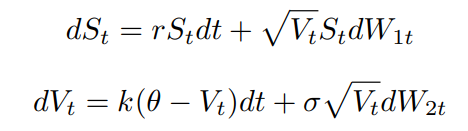
In the equations above, the variables are defined as:
- W1t is the Brownian motion of the asset price
- W2t is the Brownian motion of the asset’s price variance
- ρ is the correlation coefficient for W1t and W2t
- St is the price of a specific asset at time t
- √Vt is the volatility of the asset price
- σ is the volatility of the volatility
- r is the risk-free interest rate
- θ is the long-term price variance
- k is the rate of reversion to the long-term price variance
- dt is the indefinitely small positive time increment
Note that the Brownian motions are random processes that exhibit the following properties:
- W0 = 0
- Wt has independent movements
- Wt is continuous in t
- Increments of Wt – Ws have a normal distribution, mean zero, and variance|t – s|
Heston Model vs. Black-Scholes Model
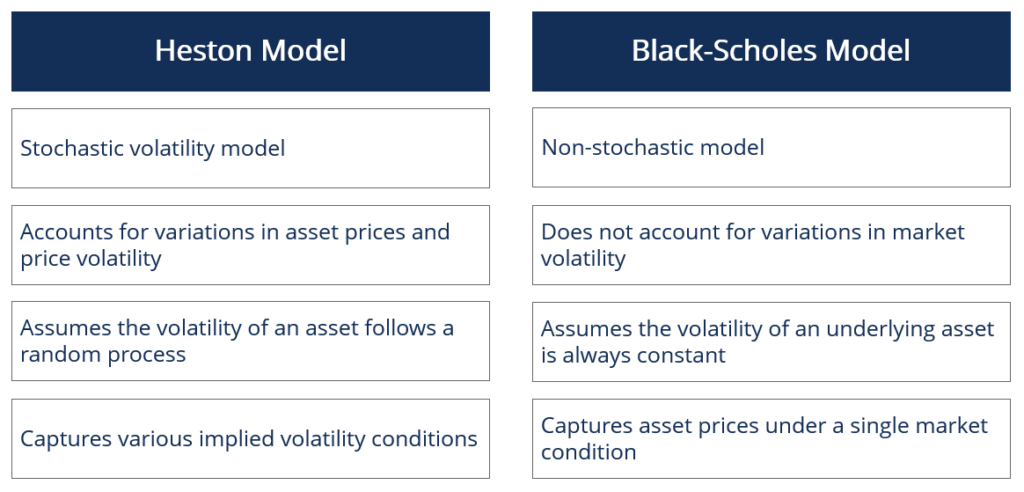
In the realm of quantitative financeQuantitative FinanceQuantitative finance is the use of mathematical models and extremely large datasets to analyze financial markets and securities. Common examples include (1) the pricing of derivative securities such as options, and (2) risk management, especially as it relates to portfolio management, the Black-Scholes model is the most well-known option-pricing model due to its simplicity and widespread use. However, it is not stochastic and therefore assumes that the volatility of an underlying asset is always constant.
Under actual market conditions, the volatility of options tends to vary due to factors such as price and maturity. As such, the model does not account for variations in asset prices and price volatility.
In contrast, the Heston model is a stochastic volatility model and accounts for variations in the asset’s price and volatility. Therefore, this model assumes that the volatility of an asset follows a random process rather than a constant one.
In general, it captures market conditions more accurately than the Black-Scholes model by providing an overview of various implied volatility conditions.
Additional Resources
CFI is the official provider of the Capital Markets & Securities Analyst (CMSA)®Program Page - CMSAEnroll in CFI's CMSA® program and become a certified Capital Markets &Securities Analyst. Advance your career with our certification programs and courses. certification program, designed to transform anyone into a world-class financial analyst.
In order to help you become a world-class financial analyst and advance your career to your fullest potential, these additional resources will be very helpful:
- Stochastic ModelingStochastic ModelingStochastic modeling is used to estimate the probability of various outcomes while allowing for randomness in one or more inputs over time.
- Black-Scholes-Merton ModelBlack-Scholes-Merton ModelThe Black-Scholes-Merton (BSM) model is a pricing model for financial instruments. It is used for the valuation of stock options.
- VolatilityVolatilityVolatility is a measure of the rate of fluctuations in the price of a security over time. It indicates the level of risk associated with the price changes of a security. Investors and traders calculate the volatility of a security to assess past variations in the prices
- American vs. European vs. Bermudan OptionsAmerican vs European vs Bermudan OptionsThere are different types of options that differ in terms of their exercise restrictions. Let’s explore American vs European vs Bermudan options to find out
-

Understanding Divergence in Technical Analysis: A Guide
Divergence is when the asset price moves in the direction opposite to what a technical indicator indicates. When a stock is diverging, it signals weaker price trends and the beginning of a reversal.&n
-

Dow 30 Explained: Understanding the Dow Jones Industrial Average
The Dow 30, or Dow Jones Industrial Average, is a stock index that tracks the performance of the 30 biggest companies listed on the stock indices in the United States. Despite being used by analysts t
invest
- Understanding Silver Price Fluctuations: Key Factors & Trends
- Black-Scholes Model: Understanding Stock Option Pricing
- Double Top Pattern: Definition, Trading Signals & Analysis
- Understanding the Forward Curve: A Comprehensive Guide
- Understanding the Heath-Jarrow-Morton (HJM) Interest Rate Model
- Understanding Market Support: What is 'Holding the Market'?
- Understanding Offering Price: A Guide for Investors
- Understanding Quoted Prices: A Comprehensive Guide
- Understanding Strike Price: Options Trading Explained
-
 Backtesting: A Comprehensive Guide to Strategy Validation
Backtesting involves applying a strategy or predictive model to historical data to determine its accuracy. It can be used to test and compare the viability of trading strategies so tradersSix Essentia...
-
 Understanding Dead Cat bounces: A Stock Market Indicator
The dead cat bounce describes a financial phenomenon whereby a stock in a steady decline suddenly, and without a logical cause, gains value temporarily before continuing its downward trend. The term o...