
Balanced Scorecard: A Comprehensive Guide to Strategic Performance
A balanced scorecard is a strategic planning framework that companies use to assign priority to their products, projects, and services; communicate about their targets or goals; and plan their routine activities. The scorecard enables companies to monitor and measure the success of their strategies to determine how well they have performed.
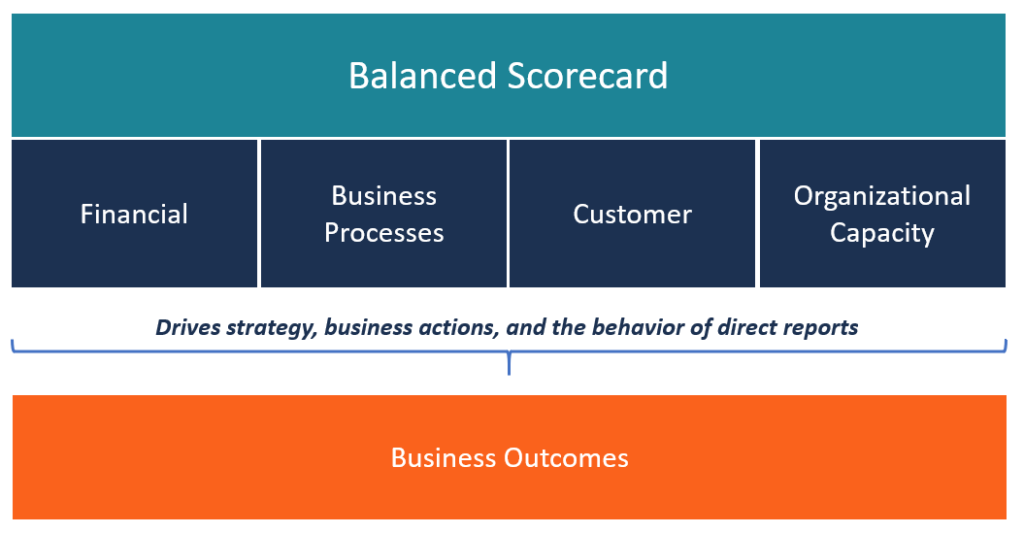
The balanced scorecard acts as a structured report that measures the performance of company management. The management team can be evaluated against Key Performance Indicators (KPIs)Key Performance Indicators (KPIs)Key Performance Indicators (KPIs) are metrics used to periodically track and evaluate the performance of an organization toward the achievement of specific goals. They are also used to gauge the overall performance of a company to show their contributions to the strategy and attainment of the targets set forth. Success is measured against the specified goals or targets to determine the rate at which the business is growing and how it compares to its competitors.
Other personnel in the organizational hierarchy can depend on the balanced scorecard to show their contribution to the growth of the business, or their suitability for job promotions and salary reviews. The key features of a balanced scorecard include a focus on a strategic topic relevant to the organization, and the use of both financial and non-financial data to create strategies.
Quick Summary
- A balanced scorecard is used to help in the strategic management of organizations.
- The balanced scorecard is anchored on four perspectives, which include financial, business process, customer, and organizational capacity.
- It enables entities to discover their shortcomings and come up with strategies to overcome them.
Four Perspectives of the Balanced Scorecard
The following are the key areas that a balanced scorecard focuses on:
1. Financial perspective
Under the financial perspective, the goal of a company is to ensure that it earns a return on the investments made and manages key risks involved in running the business. The goals can be achieved by satisfying the needs of all players involved with the business, such as the shareholdersStakeholder vs. ShareholderThe terms “stakeholder” and “shareholder” are often used interchangeably in the business environment. Looking closely at the meanings of stakeholder vs shareholder, there are key differences in usage. Generally, a shareholder is a stakeholder of the company while a stakeholder is not necessarily a shareholder., customers, and suppliers.
The shareholders are an integral part of the business since they are the providers of capital; they should be happy when the company achieves financial success. They want to be sure that the company is continually generating revenues and that the organization meets goals such as improving profitability and developing new revenue sources. Steps taken to achieve such goals may include introducing new products and services, improving the company’s value propositionValue PropositionValue proposition is a promise of value stated by a company that summarizes the benefit(s) of the company’s product or service and how they are delivered, and cutting down on the costs of doing business.
2. Customer perspective
The customer perspective monitors how the entity is providing value to its customers and determines the level of customer satisfaction with the company’s products or servicesProducts and ServicesA product is a tangible item that is put on the market for acquisition, attention, or consumption while a service is an intangible item, which arises from. Customer satisfaction is an indicator of the company’s success. How well a company treats its customers can obviously affect its profitability.
The balanced scorecard considers the company’s reputation versus its competitors. How do customers see your company vis-à-vis your competitors? It enables the organization to step out of its comfort zone to view itself from the customer’s point of view rather than just from an internal perspective.
Some of the strategies that a company can focus on to improve its reputation among customers include improving product quality, enhancing the customer shopping experience, and adjusting the prices of its main products and services.
3. Internal business processes perspective
A business’ internal processes determine how well the entity runs. A balanced scorecard puts into perspective the measures and objectives that can help the business run more effectively. Also, the scorecard helps evaluate the company’s products or services and determine whether they conform to the standards that customers desire. A key part of this perspective is aiming to answer the question, “What are we good at?”
The answer to that question can help the company formulate marketing strategies and pursue innovations that lead to the creation of new and improved ways of meeting the needs of customers.
4. Organizational capacity perspective
Organizational capacity is important in optimizing goals and objectives with favorable results. The personnel in the organization’s departments are required to demonstrate high performance in terms of leadership, the entity’s culture, application of knowledge, and skill sets.
Proper infrastructure is required for the organization to deliver according to the expectations of management. For example, the organization should use the latest technology to automate activities and ensure a smooth flow of activities.
Related Readings
CFI is the official provider of the global Financial Modeling & Valuation Analyst (FMVA)™Become a Certified Financial Modeling & Valuation Analyst (FMVA)®CFI's Financial Modeling and Valuation Analyst (FMVA)® certification will help you gain the confidence you need in your finance career. Enroll today! certification program, designed to help anyone become a world-class financial analyst. Through financial modeling courses, training, and exercises, anyone in the world can become a great analyst. To keep advancing your career, the additional CFI resources below will be useful:
- Business PlanBusiness PlanA business plan is a document that outlines how and why a new business is being created. A well-researched and comprehensive business plan is important
- Corporate StrategyCorporate StrategyCorporate Strategy focuses on how to manage resources, risk and return across a firm, as opposed to looking at competitive advantages in business strategy
- Labor Force KPIsLabor Force KPIsHow can we monitor the labor force? Governments and economists usually refer to three main key performance indicators (KPIs) to assess the strength of a nation's labor force
- Mission StatementMission StatementA mission statement defines what line of business a company is in, and why it exists or what purpose it serves.
-

Understanding Acquisition Cost: Definitions & Applications
Acquisition cost is the cost of purchasing an asset. It is generally used in three different contexts in business, which include the following:Mergers and acquisitionsFixed assetsCustomer acquisition&
-

Advertising Budget: Definition, Planning & Best Practices
An advertising budget is a company’s allocation of promotional expenditures over a specified time period. It is a measure of a company’s planned expenditure on accomplishing marketing obje
finance
- Acquirer Definition: Understanding Corporate Acquisitions
- Understanding Balanced Budgets: Definition & Importance
- Understanding Clawbacks: Protecting Stakeholders from Failed Performance
- Understanding Financial Gearing: Debt & Leverage Explained
- Leverage in Finance: Strategies, Types & Risks
- Parent Company Explained: Definition, Control & Examples
- Understanding Stocks: A Beginner's Guide to Share Ownership
- Understanding Net-Net: A Financial Health Indicator
- EBITA Explained: Understanding Earnings Before Interest, Taxes, and Amortization
-
 Ramp-Up: Definition, Benefits & How to Achieve It
In business, ramp-up is a term that describes a significant increase in the output of a company’s products or services. Essentially, ramp-up implies bringing the company’s capacity utiliza...
-
 Streamlining Processes: Definition, Benefits & Techniques
Streamlining refers to the improvement of the efficiency of a certain process within an organization. It can be done by automationExcel vs Automation in Financial ModelingBefore we discuss Excel vs au...