
Understanding Debt Capacity: A Guide for Businesses
Debt capacity refers to the total amount of debt a business can incur and repay according to the terms of a debt agreementDebt ScheduleA debt schedule lays out all of the debt a business has in a schedule based on its maturity and interest rate. In financial modeling, interest expense flows. A business takes on debt for several reasons – such as boosting production or marketing, expanding capacity, or acquiring new businesses. However, incurring too much debt or taking on the wrong type can result in damaging consequences.
How do lenders make decisions on which businesses to lend their money to? In this article, we will explore the most commonly used financial metricsHow the 3 Financial Statements are LinkedHow are the 3 financial statements linked together? We explain how to link the 3 financial statements together for financial modeling and to evaluate how much leverage a business can handle. At the end of the day, lenders wish to have comfort and confidence in lending their money to businesses that can internally generate enough earnings and cash flow to not only pay the interest but also the principal balance.
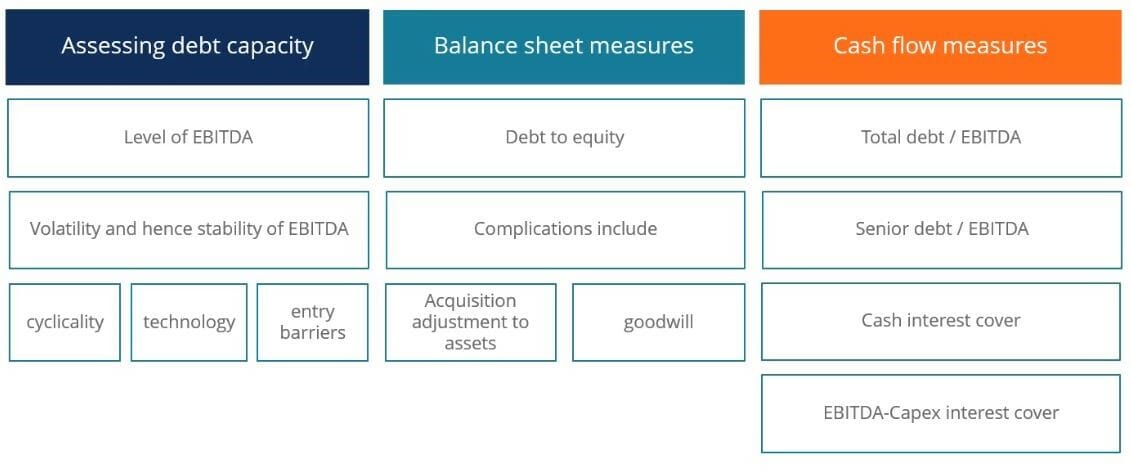
Source: CFI’s free Introduction to Corporate Finance course.
Assessing Debt Capacity
The two main measures to assess a company’s debt capacity are its balance sheetBalance SheetThe balance sheet is one of the three fundamental financial statements. The financial statements are key to both financial modeling and accounting. and cash flow measures. By analyzing key metrics from the balance sheet and cash flow statementsValuationFree valuation guides to learn the most important concepts at your own pace. These articles will teach you business valuation best practices and how to value a company using comparable company analysis, discounted cash flow (DCF) modeling, and precedent transactions, as used in investment banking, equity research,, investment bankers determine the amount of sustainable debt a company can handle in an M&A transaction.
EBITDA and Debt Capacity
One measure to evaluate debt capacity is EBITDA, or Earnings Before Interest, Tax, Depreciation, and Amortization. To learn more about EBITDA, please see our EBITDA GuideEBITDAEBITDA or Earnings Before Interest, Tax, Depreciation, Amortization is a company's profits before any of these net deductions are made. EBITDA focuses on the operating decisions of a business because it looks at the business’ profitability from core operations before the impact of capital structure. Formula, examples.
The level of EBITDA is important to assess the debt capacity, as companies with higher levels of EBITDA can generate more earnings to repay their debt. Hence, the higher the EBITDA level, the higher the debt capacity. However, although the level of EBITDA is crucial, the stability of a company’s EBITDA level is also important in assessing its debt capacity. There are a few factors that contribute to a company’s EBITDA stability – cyclicality, technology, and barriers to entry.
Cyclical businesses inherently have less debt capacity than non-cyclical businesses. For example, mining businesses are cyclical in nature due to their operations, whereas food businesses are much more stable. From a lender’s point of view, volatile EBITDA represents volatile retained earnings and the ability to repay debt, hence a much higher default risk.
Industries with low barriers to entry also have less debt capacity compared to industries with high barriers to entry. For example, tech companies that have low barriers to entry can easily be disrupted as competition enters. Even if tech companies are legally protected through patents and copyrights, competition will eventually enter as the patent term expires or with newer and more efficient innovations. On the other hand, industries with high barriers to entry, such as long-term infrastructure projects, are less likely to be disrupted by new entrants and, therefore, can sustain a more stable EBITDA.
Learn more in CFI’s free introduction to corporate finance course.
Credit Metrics
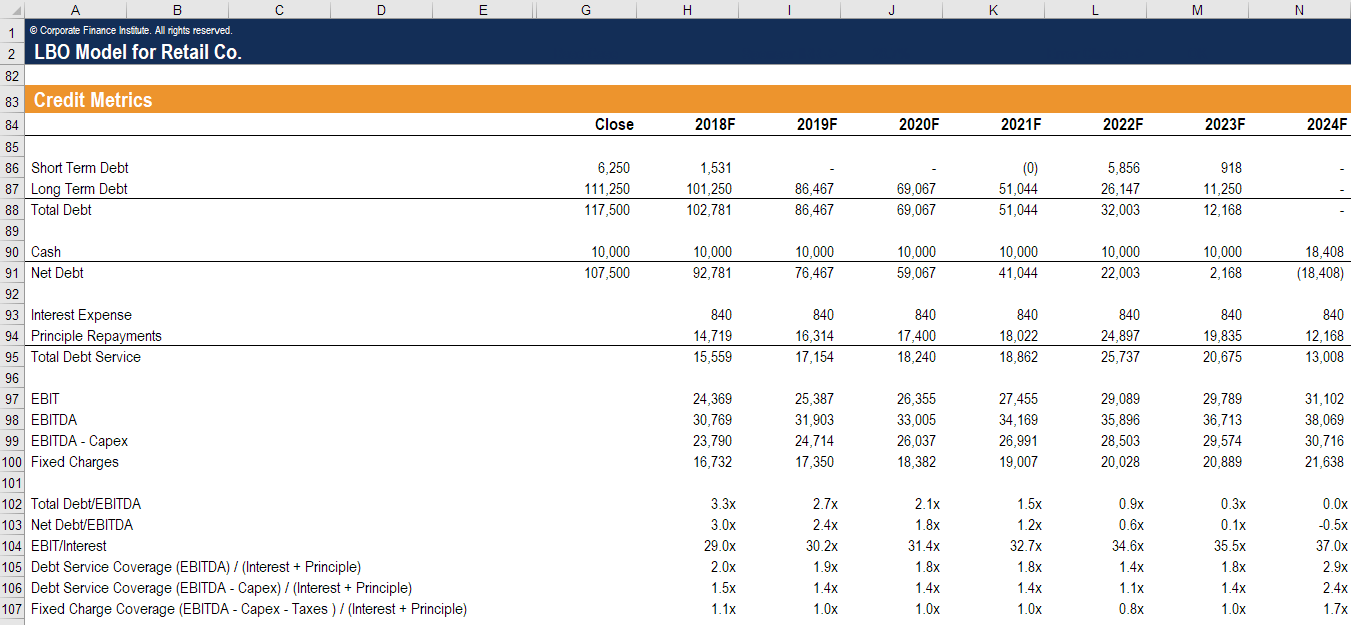
Credit metrics are extremely useful to determine debt capacity, as they directly reflect the book values of assets, liabilities, and shareholder equity. The most commonly used balance sheet measure is the debt-to-equity ratio. Other common metrics include debt/EBITDA, interest coverage, and fixed-charge coverage ratios.
As you can see in the screenshot from CFI’s financial modeling course below, an analyst will look at all of these credit metrics in assessing a company’s debt capacity.
Debt-to-Equity
Debt-to-equity ratiosFinanceCFI's Finance Articles are designed as self-study guides to learn important finance concepts online at your own pace. Browse hundreds of articles! provide investment bankers with a high-level overview of a company’s capital structure. However, this ratio can be complicated, as there can be a discrepancy between the book value and the market value of equity. Acquisitions, adjustments to assets, goodwill, and impairment are all influential factors that may create a discrepancy between the book value and market value of debt-to-equity ratios.
Cash Flow Metrics
Another set of measures investment bankers use to assess debt capacity is cash flow metrics. These metrics include total debt-to-EBITDA, which can be broken down further to senior debt-to-EBITDA, cash interest coverage, and EBITDA-Capital Expenditures interest coverage.
Total Debt / EBITDA
The Debt-to-EBITDADebt/EBITDA RatioThe net debt to earnings before interest, taxes, depreciation, and amortization (EBITDA) ratio measures financial leverage and a company’s ability to pay off its debt. Essentially, the net debt to EBITDA ratio (debt/EBITDA) gives an indication as to how long a company would need to operate at its current level to pay off all its debt. measure is the most common cash flow metric to evaluate debt capacity. The ratio demonstrates a company’s ability to pay off its incurred debt and provides investment bankers with information on the amount of time required to clear all debt, ignoring interest, taxes, depreciation, and amortization. Total debt-to-EBITDA can be broken down into the senior or subordinated debt-to-EBITDA metric, which focuses on debt that a company must repay first in the event of distress.
Cash Interest Coverage
The cash interest coverage measure depicts how many times the cash flow generated from business operations can service the interest expense on the debt. This is a key metric, as it shows not only a company’s ability to pay interest but also its ability to repay principal.
Learn more in CFI’s free introduction to corporate finance course.
EBITDA-CapEx Interest Coverage
By taking the EBITDA, deducting capital expenditures, and examining how many times this metric can cover the interest expense, investment bankers can assess a company’s debt capacity. This metric is specifically useful for companies with high capital expendituresCapEx Formula TemplateThis CapEx formula template helps you calculate the amount of capital expenditures using numbers in the income statement and balance sheet. CapEx (short for Capital Expenditures) is the money invested by a company in acquiring, maintaining, or improving fixed assets such as property, buildings, factories, equipment, an, including manufacturing and mining firms.
Fixed-Charge Coverage Ratio
The fixed-charge coverage ratioFixed-Charge Coverage Ratio (FCCR)The Fixed-Charge Coverage Ratio (FCCR) is a measure of a company’s ability to meet fixed-charge obligations such as interest and lease expenses. is equal to a company’s EBITDA – CapEx – Cash Taxes – Distributions. The ratio is very close to a true cash flow measure and thus very relevant for assessing debt capacity.
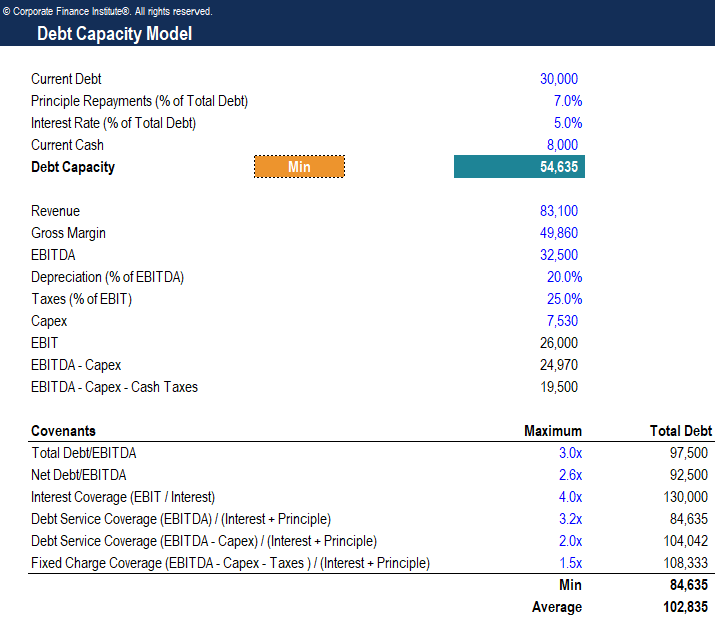
Download the Free Template
Enter your name and email in the form below and download the free template now!
Additional Resources
Thank you for reviewing this article on debt capacity. CFI is a global provider of the Financial Modeling & Valuation Analyst (FMVA)®Become a Certified Financial Modeling & Valuation Analyst (FMVA)®CFI's Financial Modeling and Valuation Analyst (FMVA)® certification will help you gain the confidence you need in your finance career. Enroll today! certification program and several other courses for finance professionals. To help you advance your career, check out the additional CFI resources below:
- EBIT vs. EBITDAEBIT vs EBITDAEBIT vs EBITDA - two very common metrics used in finance and company valuation. There are important differences, pros/cons to understand.
- Revolving Debt GuideRevolving DebtA revolving debt (a "revolver", also sometimes known as a line of credit, or LOC) does not feature fixed monthly payments. It differs from a fixed payment or term loan that has a guaranteed balance and payment structure. Instead, the payments of revolving debt are based on the balance of credit every month.
- Market Value of DebtMarket Value of DebtThe Market Value of Debt refers to the market price investors would be willing to buy a company's debt at, which differs from the book value on the balance sheet.
- Debt Capital MarketsDebt Capital Markets (DCM)Debt Capital Markets (DCM) groups are responsible for providing advice directly to corporate issuers on the raising of debt for acquisitions, refinancing of existing debt, or restructuring of existing debt. These teams operate in a rapidly moving environment and work closely with an advisory partner
-

Leveraged Finance Explained: Strategies & Applications
Leveraged finance is the use of an above-normal amount of debt, as opposed to equity or cash, to finance the purchase of investment assets. Leveraged finance is done with the goal of increasing a
-

Understanding Market Value of Debt: Beyond Book Value
The Market Value of Debt refers to the market price investors would be willing to buy a company’s debt for, which differs from the book value on the balance sheet. A company’s debt doesn&r
finance
- Understanding Capital: Types, Categories & Value Creation
- Understanding Debt: Types, Obligations & Financial Implications
- Debt Consolidation: Simplify Payments & Lower Interest Rates
- Understanding Debt Default: Causes, Consequences, and Prevention
- Debt Financing: A Comprehensive Guide for Businesses
- Debt Refinancing: A Comprehensive Guide to Lowering Your Payments
- Debt Restructuring: A Comprehensive Guide for Financial Distress
- Debt Settlement: Definition, How It Works & Is It Right For You?
- Unitranche Debt Explained: Structure, Benefits & Risks
-
 Coverage Ratio: Understanding Your Company's Debt Repayment Ability
A Coverage Ratio is any one of a group of financial ratios used to measure a company’s ability to pay its financial obligationsDebt CapacityDebt capacity refers to the total amount of debt a bus...
-
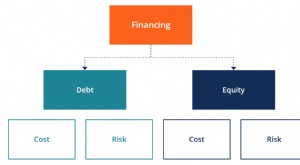 Understanding Business Financing: A Comprehensive Guide
Financing refers to the methods and types of funding a business uses to sustain and grow its operations. It consists of debtSenior and Subordinated DebtIn order to understand senior and subordinated d...