
Coverage Ratio: Understanding Your Company's Debt Repayment Ability
A Coverage Ratio is any one of a group of financial ratios used to measure a company’s ability to pay its financial obligationsDebt CapacityDebt capacity refers to the total amount of debt a business can incur and repay according to the terms of the debt agreement.. A higher ratio indicates a greater ability of the company to meet its financial obligations while a lower ratio indicates a lesser ability. Coverage ratios are commonly used by creditors and lendersTop Banks in the USAAccording to the US Federal Deposit Insurance Corporation, there were 6,799 FDIC-insured commercial banks in the USA as of February 2014. to determine the financial standing of a prospective borrower.
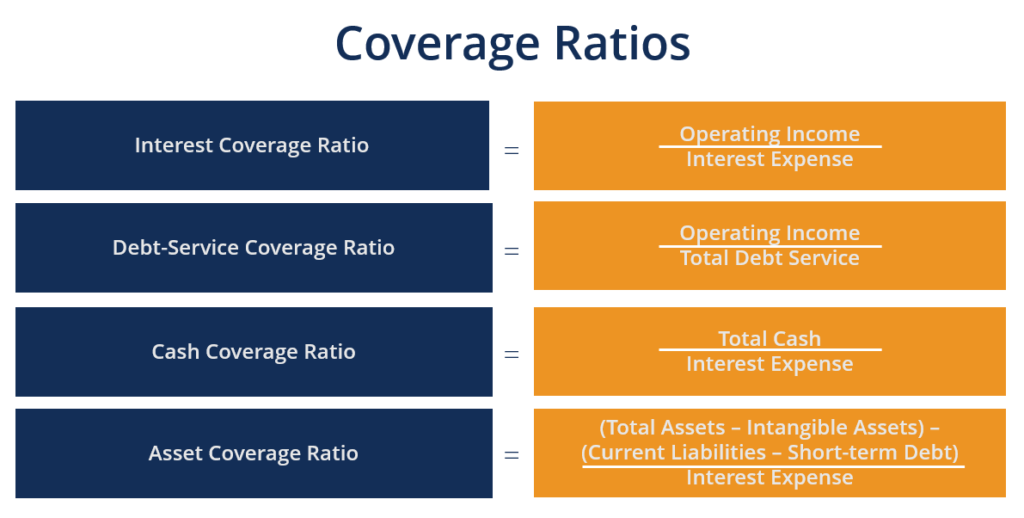
The most common coverage ratios are:
- Interest coverage ratioInterest Coverage RatioInterest Coverage Ratio (ICR) is a financial ratio that is used to determine the ability of a company to pay the interest on its outstanding debt.: The ability of a company to pay the interest expenseInterest ExpenseInterest expense arises out of a company that finances through debt or capital leases. Interest is found in the income statement, but can also (only) on its debt
- Debt service coverage ratioDebt Service Coverage RatioThe Debt Service Coverage Ratio (DSCR) measures the ability of a company to use its operating income to repay all its debt obligations, including repayment of principal and interest on both short-term and long-term debt.: The ability of a company to pay all debt obligations, including repayment of principal and interest
- Cash coverage ratio: The ability of a company to pay interest expense with its cash balance
- Asset coverage ratio: The ability of a company to repay its debt obligations with its assets
#1 Interest Coverage Ratio
The interest coverage ratioInterest Coverage RatioInterest Coverage Ratio (ICR) is a financial ratio that is used to determine the ability of a company to pay the interest on its outstanding debt. (ICR), also called the “times interest earned”, evaluates the number of times a company is able to pay the interest expenses on its debt with its operating income. As a general benchmark, an interest coverage ratio of 1.5 is considered the minimum acceptable ratio. An ICR below 1.5 may signal default risk and the refusal of lenders to lend more money to the company.
Formula
Interest coverage ratio = Operating income / Interest expense
Example
A company reports an operating income of $500,000. The company is liable for interest payments of $60,000.
Interest coverage = $500,000 / ($60,000) = 8.3x
Therefore, the company would be able to pay its interest payment 8.3x over with its operating income.
#2 Debt Service Coverage Ratio
The debt service coverage ratioDebt Service Coverage RatioThe Debt Service Coverage Ratio (DSCR) measures the ability of a company to use its operating income to repay all its debt obligations, including repayment of principal and interest on both short-term and long-term debt. (DSCR) evaluates a company’s ability to use its operating income to repay its debt obligations including interest. The DSCR is often calculated when a company takes a loan from a bank, financial institution, or another loan provider. A DSCR of less than 1 suggests an inability to serve the company’s debt. For example, a DSCR of 0.9 means that there is only enough net operating income to cover 90% of annual debt and interest payments. As a general rule of thumb, an ideal debt service coverage ratio is 2 or higher.
Formula
Debt service coverage ratio = Operating Income / Total debt service
Example
For example, a company’s financial statement showed the following figures:
- Operating profits: $500,000
- Interest expense: $100,000
- Principal payments: $150,000
Debt service coverage = $500,000 / ($100,000 + $150,000) = 2.0x
Therefore, the company would be able to cover its debt service 2x over with its operating income.
#3 Cash Coverage Ratio
This is one more additional ratio, known as the cash coverage ratio, which is used to compare the company’s cash balance to its annual interest expense. This is a very conservative metric, as it compares only cash on hand (no other assets) to the interest expense the company has relative to its debt.
Formula
Cash coverage ratio = Total cash / Total interest expense
Example
Consider a company with the following information:
- Cash balance: $50 million
- Short-term debt: $12 million
- Long-term debt: $25 million
- Interest expense: $2.5 million
Cash coverage = $50 million / $2.5 million = 20.0x
This means the company can cover its interest expense twenty times over. Since the cash balance is greater than the total debt balance, the company can also repay all the principal it owes with the cash on hand.
#4 Asset Coverage Ratio
The asset coverage ratio (ACR) evaluates a company’s ability to repay its debt obligations by selling its assets. In other words, this ratio assesses a company’s ability to pay debt obligations with assets after satisfying liabilities. The acceptable level of asset coverage depends on the industry. An ASR of 1 means that the company would just be able to pay off all its debts by selling all its assets. An ASR above 1 means that the company would be able to pay off all debts without selling all its assets.
Formula
Asset coverage ratio = ((Total assets – Intangible assets) – (Current liabilities – Short-term debt)) / Total debt obligations
Example
For example, a company’s financials include:
- Total assets: $170 million
- Intangible assets: $30 million
- Current liabilities: $30 million
- Short-term debt: $20 million
- Total debt: $100 million
Asset coverage = (($170 million – $30 million) – ($30 million – $20 million)) / $100 million = 1.3x
Therefore, the company would be able to pay off all of its debts without selling all of its assets.
Additional resources
CFI is the global provider of the Financial Modeling and Valuation Analyst ProgramBecome a Certified Financial Modeling & Valuation Analyst (FMVA)®CFI's Financial Modeling and Valuation Analyst (FMVA)® certification will help you gain the confidence you need in your finance career. Enroll today!, a certification for financial analysts who want to perform world-class analysis. To continue learning and advancing your career, these additional CFI resources will be helpful:
- Cost of DebtCost of DebtThe cost of debt is the return that a company provides to its debtholders and creditors. Cost of debt is used in WACC calculations for valuation analysis.
- Debt ScheduleDebt ScheduleA debt schedule lays out all of the debt a business has in a schedule based on its maturity and interest rate. In financial modeling, interest expense flows
- Senior and Subordinated DebtSenior and Subordinated DebtIn order to understand senior and subordinated debt, we must first review the capital stack. Capital stack ranks the priority of different sources of financing. Senior and subordinated debt refer to their rank in a company's capital stack. In the event of a liquidation, senior debt is paid out first
- Debt CovenantsDebt CovenantsDebt covenants are restrictions that lenders (creditors, debt holders, investors) put on lending agreements to limit the actions of the borrower (debtor).
-

Debt Consolidation: Simplify Payments & Lower Interest Rates
Debt consolidation is a form of debt refinancing in which several smaller debts are consolidated into one simplified debt. It generally results in a lower interest rateInterest RateAn interest rate re
-

Understanding Debt Default: Causes, Consequences, and Prevention
A debt default happens when a borrower fails to pay his or her loan at the time it is due. The time a default happens varies, depending on the termsDebt CovenantsDebt covenants are restrictions that l
finance
- Cash Debt Coverage Ratio: Definition & Calculation
- Asset Coverage Ratio: Understanding Financial Solvency
- Cash Flow to Debt Ratio: Understanding and Calculation
- Debt Service Coverage Ratio (DSCR): Definition & Calculation
- Debt-to-Asset Ratio: Definition, Calculation & Significance
- Debt-to-Assets Ratio: Definition, Calculation & Risk Assessment
- Debt-to-Equity Ratio: Definition, Calculation & Importance
- Loan Life Coverage Ratio (LLCR): Definition & Importance
- Understanding Current Debt: Definition & Implications
-
 Understanding Debt: Types, Obligations & Financial Implications
Debt is the money borrowed by one party from another to serve a financial need that otherwise cannot be met outright. Many organizationsTypes of OrganizationsThis article on the different types of org...
-
 Understanding Debt Capacity: A Guide for Businesses
Debt capacity refers to the total amount of debt a business can incur and repay according to the terms of a debt agreementDebt ScheduleA debt schedule lays out all of the debt a business has in a sche...