
Understanding Liquidating Dividends: A Comprehensive Guide
A liquidating dividend is a dividend issued by a business as part of its liquidation process. Liquidation is the process by which a company ends its business activities and exits the market. Liquidation can be voluntary or involuntary (forced).

A liquidating dividend is also known as a liquidating distribution or a terminal distribution, as it involves the distribution of semi-liquid and liquid assets Liquid AssetA liquid asset is cash on hand or an asset other than cash that can be quickly converted into cash at a reasonable price.among the shareholders of the company. When the operators of a business believe they can no longer sustain operations, they wind down the business and return the assets of the business to shareholders via dividend payments.
What is a Dividend?
A dividend is a reward that shareholders receive for investing in a company. A company can distribute dividends in many different ways, such as cash payments or additional stock. The board of directorsBoard of DirectorsA board of directors is a panel of people elected to represent shareholders. Every public company is required to install a board of directors. of a company decides how much of a dividend the company will pay out and follow a certain dividend policy when distributing the profits.
Many investors find dividends attractive because they provide a regular stream of income. Usually, dividends are paid out quarterly (in line with the company’s earnings), but in certain instances, the company may choose to pay out a special or irregular dividendSpecial DividendA special dividend, also referred to as an extra dividend, is a non-recurring, "one-time" dividend distributed by a company to its shareholders. It is separate from the regular cycle of dividends and is usually abnormally larger than a company’s typical dividend payment..
Illustrative Example – Liquidating Dividend
Company X purchases a 20% stake in Company Y for $200 million. A 20% transfer of ownership does not constitute a significant change in influence or control. Consider the following information about Company Y’s stock. The table below shows the Company Y’s net incomeNet IncomeNet Income is a key line item, not only in the income statement, but in all three core financial statements. While it is arrived at through, total dividends, accumulated earnings, ordinary dividend, and liquidating dividend.
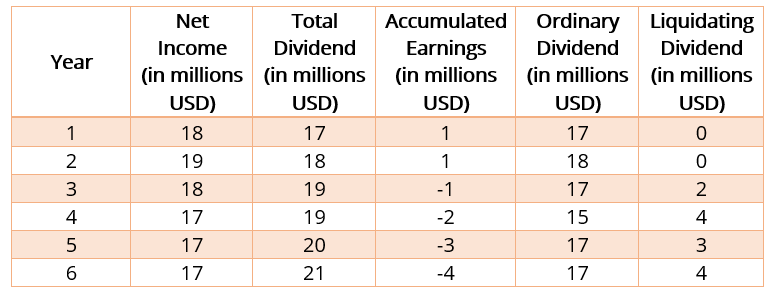
During Year 1 and Year 2, the net income of Company Y was $20 million and $22 million, respectively. During the same period, Company Y paid out $17 million and $18 million as dividends. The dividends are paid out of Company Y’s income and constitute income for Company X.
Company X Balance Sheet for Year 1
AccountDebitCreditCash$17 millionDividend Income$17 million
Company X Balance Sheet for Year 2
AccountDebitCreditCash$18 millionDividend Income$18 million
During Years 3, 4,5, and 6, the dividends declared exceed net income. The dividend paid out from the year’s net income or the accumulated income from previous years is considered an ordinary dividend. The rest is considered a liquidating dividend.
Company X Balance Sheet for Year 3
AccountDebitCreditCash$19 millionDividend Income$17 millionInvestment in Company Y$2 million
Company X Balance Sheet for Year 4
AccountDebitCreditCash$19 millionDividend Income$15 millionInvestment in Company Y$4 million
Company X Balance Sheet for Year 5
AccountDebitCreditCash$20 millionDividend Income$17 millionInvestment in Company Y$3 million
Company X Balance Sheet for Year 6
AccountDebitCreditCash$21 millionDividend Income$17 millionInvestment in Company Y$4 million
More Resources
CFI is the official provider of the global Financial Modeling & Valuation Analyst (FMVA)™Become a Certified Financial Modeling & Valuation Analyst (FMVA)®CFI's Financial Modeling and Valuation Analyst (FMVA)® certification will help you gain the confidence you need in your finance career. Enroll today! certification program, designed to help anyone become a world-class financial analyst. To keep advancing your career, the additional CFI resources below will be useful:
- BankruptcyBankruptcyBankruptcy is the legal status of a human or a non-human entity (a firm or a government agency) that is unable to repay its outstanding debts
- Dividend PolicyDividend PolicyA company’s dividend policy dictates the amount of dividends paid out by the company to its shareholders and the frequency with which the dividends are paid
- Dividend Reinvestment Plan (DRiP)Dividend Reinvestment Plan (DRIP)A dividend reinvestment plan (DRIP or DRP) is a plan offered by a company to shareholders that it allows them to automatically reinvest their
- Important Dividend DatesImportant Dividend DatesIn order to understand dividend-paying stocks, knowledge of important dividend dates is crucial. A dividend typically comes in the form of a cash distribution that is paid from the company's earnings to investors.
-

Understanding Dividend Yield: A Comprehensive Guide
The dividend rate is the amount of cash returned by a company to its stockholders on an annual basis as a percentage of the market valueMarket ValueMarket value is usually used to describe how much an
-

Understanding Net-Net: A Financial Health Indicator
Net-net is a term used for a company with a market capitalization that is less than the difference between the company’s current assets and total liabilities. The equation does not consider long
finance
- Acquirer Definition: Understanding Corporate Acquisitions
- Understanding Dividend Per Share (DPS): A Comprehensive Guide
- Understanding Dividend Yield: A Key Metric for Investors
- DRIP (Dividend Reinvestment Plan): A Comprehensive Guide for Investors
- Understanding Forward Dividend Yield: A Key Metric for Investors
- Special Dividends: Understanding One-Time Distributions
- Understanding Stable Dividend Policies: A Comprehensive Guide
- Understanding Dividend Policy: A Comprehensive Guide
- Dividend Recapitalization: Definition & How It Works
-
 Dividend Irrelevance Theory: Understanding Its Implications
Dividend Irrelevance Theory is a financial theory that claims that the issuing of dividends does not increase a company’s potential profitability or its stock price. It suggests that invest...
-
 Dividend Payout Ratio (DPR): Understanding & Calculation
The Dividend Payout Ratio (DPR) is the amount of dividends paid to shareholders in relation to the total amount of net incomeNet IncomeNet Income is a key line item, not only in the income statement, ...