
Understanding Annual Percentage Yield (APY): A Comprehensive Guide
The annual percentage yield (APY) is a normalized interest rateInterest RateAn interest rate refers to the amount charged by a lender to a borrower for any form of debt given, generally expressed as a percentage of the principal. based on the compounding period of one year. The APY provides a standardized representation of the underlying interest rates of financial products.

The primary advantage of the annual percentage yield is the consideration of the compounding effect. Recall that compounding is essentially a process in which an asset or liability earns interest on both principal and capital gainsCapital Gains YieldCapital gains yield (CGY) is the price appreciation on an investment or a security expressed as a percentage. Because the calculation of Capital Gain Yield involves the market price of a security over time, it can be used to analyze the fluctuation in the market price of a security. See calculation and example or accrued interest. In other words, the APY reflects the true interest rate that a lender or an investor will earn.
Using the annual percentage yield, one can compare various financial products whose interest rates come with different compounding periods. However, the APY does not consider potential account feesService ChargeA service charge, also called a service fee, refers to a fee collected to pay for services that relate to a product or service that is being purchased. that can affect the net gain.
Formula
The general formula to calculate the annual percentage yield (APY) is expressed using the following mathematical equation:
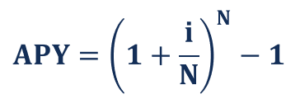
Where:
- i – the nominal interest rate
- N – the number of compounding periods
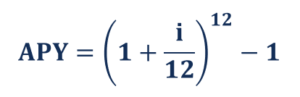
For example, if the interest is compounded monthly, then the relevant formula to calculate the APY is the following:
APY vs. APR
Although both the annual percentage yield (APY) and annual percentage rate (APR)Annual Percentage Rate (APR)The Annual Percentage Rate (APR) is the yearly rate of interest that an individual must pay on a loan, or that they receive on a deposit account. Ultimately, APR is a simple percentage term used to express the numerical amount paid by an individual or entity yearly for the privilege of borrowing money. are representations of an interest rate, there is a significant distinction between the two terms. Unlike the APY, the APR does not consider compounding effects.
As mentioned above, the primary advantage of the APY over the APR is the standardized representation of interest rates. In other words, the former can be utilized to compare products with various compounding structures for interest rates.
Since the APY takes into consideration the compounding effect, it will be higher than the APR. Due to this reason, financial institutions tend to prefer to quote the APR in their loan offerings, as the lower rate makes their deals appear more attractive to potential customers.
For the same reason, the annual percentage yield is frequently reported in the offerings of investment products or interest-earning bank accounts, as the APY figure will appear more attractive to investors.
More Resources
CFI is the official provider of the global Financial Modeling & Valuation Analyst (FMVA)™Become a Certified Financial Modeling & Valuation Analyst (FMVA)®CFI's Financial Modeling and Valuation Analyst (FMVA)® certification will help you gain the confidence you need in your finance career. Enroll today! certification program, designed to help anyone become a world-class financial analyst. To keep advancing your career, the additional CFI resources below will be useful:
- Continuously Compounded ReturnContinuously Compounded ReturnContinuously compounded return is what happens when the interest earned on an investment is calculated and reinvested back into the account for an infinite number of periods. The interest is calculated on the principal amount and the interest accumulated over the given periods
- Effective Annual Interest RateEffective Annual Interest RateThe Effective Annual Interest Rate (EAR) is the interest rate that is adjusted for compounding over a given period. Simply put, the effective
- Simple InterestSimple InterestSimple interest formula, definition and example. Simple interest is a calculation of interest that doesn't take into account the effect of compounding. In many cases, interest compounds with each designated period of a loan, but in the case of simple interest, it does not. The calculation of simple interest is equal to the principal amount multiplied by the interest rate, multiplied by the number of periods.
- Rate of ReturnRate of ReturnThe Rate of Return (ROR) is the gain or loss of an investment over a period of time copmared to the initial cost of the investment expressed as a percentage. This guide teaches the most common formulas
-

Understanding Economic Value of Equity (EVE): A Comprehensive Guide
The economic value of equity (EVE) is a long-term economic measure/indicator of net cash flow. The EVE is calculated by taking into account the present value of all asset cash flows and subtracting th
-

Equivalent Annual Annuity (EAA): Project Evaluation Explained
Equivalent Annual Annuity (or EAA) is a method of evaluating projects with different life durations. Traditional project profitability metrics such as NPVNPV FormulaA guide to the NPV formula in Excel
finance
- Understanding APR: What It Is and How It Works
- Compound Interest Formula: Calculate & Understand Growth
- Effective Annual Interest Rate (EAR): Understanding & Calculation
- Effective Annual Rate (EAR): Understanding & Calculation
- Nominal Interest Rate Explained: Definition & Implications
- Understanding Yield Curve Rollover: A Fixed Income Strategy
- Swap Rate Explained: Understanding Fixed Exchange Rates in Derivatives
- Understanding the Yield Curve: Definition & Significance
- Yield to Maturity (YTM): Definition & Calculation | [Your Brand/Website Name]
-
 Understanding the Par Yield Curve: A Guide for Investors
The par yield curve is a graphical representation that shows the yield to maturityYield to Maturity (YTM)Yield to Maturity (YTM) – otherwise referred to as redemption or book yield – is th...
-
 Short Interest Ratio: Understanding Investor Sentiment & Market Risk
The short interest ratio is a mathematical indicator of the average number of days it takes for short sellers to repurchase borrowed securities in the open marketOpen MarketAn open market is an econom...