
Understanding Management Discussion & Analysis (MD&A): A Comprehensive Guide
Management discussion and analysis, or MD&A, is a section that can be found in the annual report of a company. The MD&A section provides key information regarding how a company is performing financially.
The information can also be found in the SEC Form 10-K10-KForm 10-K is a detailed annual report that is required to be submitted to the U.S. Securities and Exchange Commission (SEC). The filing provides a comprehensive summary of a company’s performance for the year. It is more detailed than the annual report that is sent to shareholders. As per required by the Securities and Exchange Commission (SEC) and its jurisdiction, the MD&A must be disclosed for publicly-traded companies.
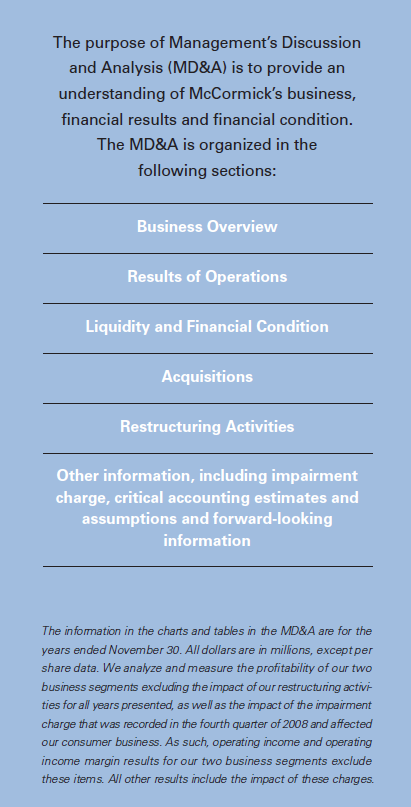
The MD&A provides information on a company’s performance in its previous fiscal year, its current financial standing, and projections by management for future performances. The section assists investors with understanding how the management thinks, how the company performs following the management’s decision-making processes, and the company’s core financial fundamentals.
Summary
- The management discussion and analysis, or MD&A, is a section that can be found in the annual report of a company. It provides key information regarding how a company is performing financially.
- The MD&A provides information on a company’s performance in its previous fiscal year, its current financial standing, and projections by management for future performances.
- Since a publicly-traded company falls under the jurisdiction of the SEC, the commission screens and oversees the MD&A section of the annual report to ensure that the company’s compliance with all its requirements.
The Securities and Exchange Commission (SEC) and MD&A
Since a publicly-traded company falls under the jurisdiction of the Securities and Exchange Commission (SEC)Securities and Exchange Commission (SEC)The US Securities and Exchange Commission, or SEC, is an independent agency of the US federal government that is responsible for implementing federal securities laws and proposing securities rules. It is also in charge of maintaining the securities industry and stock and options exchanges, the commission screens and oversees the MD&A section of the annual report to ensure that the company has presented all noteworthy information about the company’s liquidity status, information on the capital of the company, and its operations.
In addition to that information, the management of the company should also add projections or estimates on their expectations of market performance and economic trends that can influence the company’s position in terms of liquidity and operations.
The MD&A section is also expected to present information on the risks and uncertainties that can lead to the potential failure to meet the projections or estimations made for future financial outcomes and operations.
An example of expected information can include political factors or unrest in the country in which a company operates. Political unrest can result in a major impact on the performance of a company and its operations. Information circling the effects of the political unrest on the company must be included in the report in order to depict the expected future earnings estimates.
Key Factors Found in the Management Discussion and Analysis
The following is some of the key information that should be found in the MD&A section of the annual report:
Important accounting policies and estimates
The SEC urges companies to provide detailed information regarding their accounting policies in the MD&A section of the annual reportAnnual ReportAn annual report is a comprehensive report detailing a company’s activities throughout the preceding year. Its purpose is to provide users, such as. It enables investors and other stakeholders to understand the impacts of the accounting policies and the decisions made following the application of the policies and possible variations should the company have applied other assumptions.
Operational results and position
Companies are expected to disclose the results or performance of operations following notable economic changes that may have had an influence on income or possible extraordinary events and transactions. In addition, the companies are expected to disclose any trends or risks that may positively or negatively impact revenue from operations.
Liquidity and capital resources
The management should report on any notable events that may have altered the liquidity and capital resources. They should also provide information on any existing or potential future capital expenditure commitments and the funding options available to meet the capex commitments.
Examples of Accounting Information Found in the MD&A
Recognition of revenue
Revenue recognitionRevenue RecognitionRevenue recognition is an accounting principle that outlines the specific conditions under which revenue is recognized. In theory, there is a follows an accounting principle that provides a framework for particular conditions, under which revenue is (or can be) recognized. The conditions include the transfer of ownership from a seller to a buyer, assured collection of payment from the goods and services, and the revenue amount.
Restructuring costs or charges
In a situation where a company undergoes complete or partial restructuring, the management is expected to disclose the impact of the restructure on the company and highlight the cost implications related to the restructuring.
An example of cost implications can be the costs related to closing down a facility or severance payment to employees resulting from shutdowns.
Asset impairment
The impairment of an asset refers to the diminishing of its value or its quality. As per SEC expectations, a company is expected to report on the loss of an asset’s value and the causes of the loss. It is important information for shareholders of the company; thus, it should be reported. Depreciation and amortization are also key information factors concerning the impairment of the assets.
Related Readings
CFI is the official provider of the Commercial Banking & Credit Analyst (CBCA)™Program Page - CBCAGet CFI's CBCA™ certification and become a Commercial Banking & Credit Analyst. Enroll and advance your career with our certification programs and courses. certification program, designed to transform anyone into a world-class financial analyst.
To keep learning and developing your knowledge of financial analysis, we highly recommend the additional resources below:
- Analysis of Financial StatementsAnalysis of Financial StatementsHow to perform Analysis of Financial Statements. This guide will teach you to perform financial statement analysis of the income statement,
- Earnings GuidanceEarnings GuidanceAn earnings guidance is the information provided by the management of a publicly traded company regarding its expected future results, including estimates
- Financial Statement NotesFinancial Statement NotesFinancial statement notes are the supplemental notes that are included with the published financial statements of a company. The notes are
- Types of SEC FilingsTypes of SEC FilingsThe US SEC makes it mandatory for publicly traded companies to submit different types of SEC filings, forms include 10-K, 10-Q, S-1, S-4, see examples. If you are a serious investor or finance professional, knowing and being able to interpret the various types of SEC filings will help you in making informed investment decisions.
-

Quantitative Analysis: Definition, Methods & Applications
Quantitative analysis is the process of collecting and evaluating measurable and verifiable data such as revenues, market share, and wagesRemunerationRemuneration is any type of compensation or paymen
-

Understanding Stocks: A Beginner's Guide to Share Ownership
When a person owns stock in a company, the individual is called a shareholder and is eligible to claim part of the company’s residual assets and earnings (should the company ever have to dissolv
finance
- Inventory Management: Types, Examples & ROI Analysis
- Acquirer Definition: Understanding Corporate Acquisitions
- DuPont Analysis: A Comprehensive Guide to Profitability Assessment
- Working Capital Management: A Comprehensive Guide
- Asset Management Companies (AMCs): A Comprehensive Guide
- Stock Analysis: A Comprehensive Guide for Investors
- 5C Analysis: A Comprehensive Framework for Business Strategy
- Strategic Management: Definition, Objectives & Implementation
- SWOT Analysis: A Comprehensive Guide for Strategic Planning
-
 Mastering Money Management: A Comprehensive Guide
Money management refers to the process of tracking and planning an individual or group’s use of capital. In personal and corporate finance, money management usually includes budgetingBudgetingBu...
-
 Parent Company Explained: Definition, Control & Examples
A parent company is a company that owns more than 50% of the outstanding voting shares of another company. Therefore, it controls the other company or companies and can directly influence the business...