
Understanding Stakeholders: Definition, Types & Importance
In business, a stakeholder is any individual, group, or party that has an interest in an organization and the outcomes of its actions. Common examples of stakeholders include employees, customers, shareholdersStockholders EquityStockholders Equity (also known as Shareholders Equity) is an account on a company's balance sheet that consists of share capital plus, suppliers, communities, and governments. Different stakeholders have different interests, and companiesCorporationA corporation is a legal entity created by individuals, stockholders, or shareholders, with the purpose of operating for profit. Corporations are allowed to enter into contracts, sue and be sued, own assets, remit federal and state taxes, and borrow money from financial institutions. often face trade-offs in trying to please all of them.
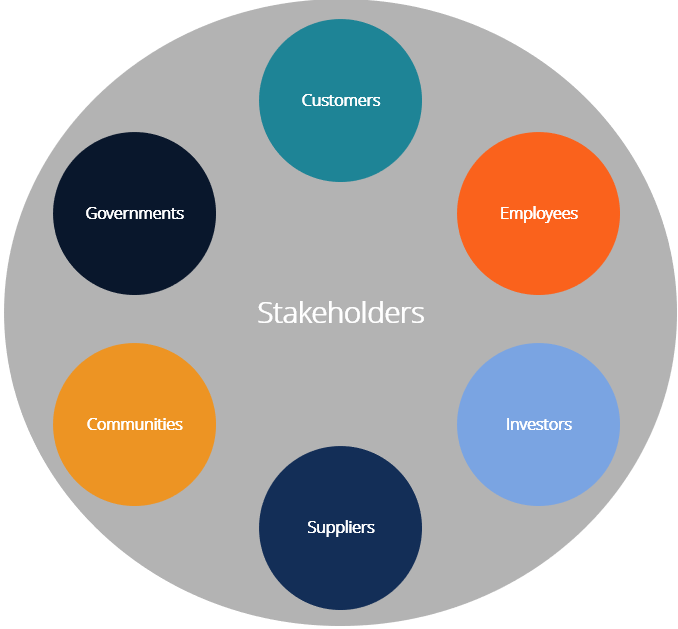
Types of Stakeholders
This guide will analyze the most common types of stakeholders and look at the unique needs that each of them typically has. The goal is to put yourself in the shoes of each type of stakeholder and see things from their point of view.
#1 Customers
Stake: Product/service quality and value
Many would argue that businesses exist to serve their customers. Customers are actually stakeholders of a business, in that they are impacted by the quality of service/products and their value. For example, passengers traveling on an airplane literally have their lives in the company’s hands when flying with the airline.
#2 Employees
Stake: Employment income and safety
Employees have a direct stake in the company in that they earn an income to support themselves, along with other benefits (both monetary and non-monetary). Depending on the nature of the business, employees may also have a health and safety interest (for example, in the industries of transportation, mining, oil and gas, construction, etc.).
#3 Investors
Stake: Financial returns
Investors include both shareholders and debtholders. Shareholders invest capital in the business and expect to earn a certain rate of return on that invested capital. Investors are commonly concerned with the concept of shareholder valueShareholder ValueShareholder value is the financial worth owners of a business receive for owning shares in the company. An increase in shareholder value is created. Lumped in with this group are all other providers of capital, such as lendersTop Banks in the USAAccording to the US Federal Deposit Insurance Corporation, there were 6,799 FDIC-insured commercial banks in the USA as of February 2014. and potential acquirers. All shareholders are inherently stakeholders, but stakeholders are not inherently shareholders.
#4 Suppliers and Vendors
Stake: Revenues and safety
Suppliers and vendors sell goods and/or services to a business and rely on it for revenue generation and on-going income. In many industries, suppliers also have their health and safety on the line, as they may be directly involved in the company’s operations.
#5 Communities
Stake: Health, safety, economic development
Communities are major stakeholders in large businesses located in them. They are impacted by a wide range of things, including job creation, economic development, health, and safety. When a big company enters or exits a small community, there is an immediate and significant impact on employment, incomes, and spending in the area. With some industries, there is a potential health impact, too, as companies may alter the environment.
#6 Governments
Stake: Taxes and GDP
Governments can also be considered a major stakeholder in a business, as they collect taxes from the company (corporate income taxes), as well as from all the people it employs (payroll taxes) and from other spending the company incurs (sales taxes). Governments benefit from the overall Gross Domestic Product (GDP) that companies contribute to.
Ranking/Prioritizing Stakeholders
Companies often struggle to prioritize stakeholders and their competing interests. Where stakeholders are aligned, the process is easy. However, in many cases, they do not have the same interests. For example, if the company is pressured by shareholders to cut costs, it may lay off employees or reduce their wages, which presents a difficult tradeoff.
Jack Ma, the CEO of Alibaba, has famously said that, in his company, they rank stakeholders in the following priority sequence:
- Customers
- Employees
- Investors
Read more about Jack Ma’s stakeholder priorities here.
Many other CEOs tout shareholder primacy as their number one interest.
Much of the prioritization will be based on the stage a company is in. For example, if it’s a startup or an early-stage business, then customers and employees are more likely to be the stakeholders considered foremost. If it’s a mature, publicly-traded company, then shareholders are likely to be front and center.
At the end of the day, it’s up to a company, the CEOCEOA CEO, short for Chief Executive Officer, is the highest-ranking individual in a company or organization. The CEO is responsible for the overall success of an organization and for making top-level managerial decisions. Read a job description, and the board of directors to determine the appropriate ranking of stakeholders when competing interests arise.
Stakeholder vs Shareholder
This is an important distinction to make. A stakeholder is anyone who has any type of stake in a business, while a shareholder is someone who owns shares (stock) in a business and thereby has an equity interest.
Additional resources
CFI offers the Financial Modeling & Valuation Analyst (FMVA)™ certification programBecome a Certified Financial Modeling & Valuation Analyst (FMVA)®CFI's Financial Modeling and Valuation Analyst (FMVA)® certification will help you gain the confidence you need in your finance career. Enroll today! for those looking to take their careers to the next level. To keep learning and advancing your career, the following CFI resources will be helpful:
- Corporate StructureCorporate StructureCorporate structure refers to the organization of different departments or business units within a company. Depending on a company’s goals and the industry
- Shareholder PrimacyShareholder PrimacyShareholder primacy is a shareholder-centric form of corporate governance that focuses on maximizing the value of shareholders before considering
- Bargaining Power of SuppliersBargaining Power of SuppliersThe Bargaining Power of Suppliers, one of the forces in Porter’s Five Forces Industry Analysis Framework, is the mirror image of the bargaining power
- Fixed and Variable CostsFixed and Variable CostsCost is something that can be classified in several ways depending on its nature. One of the most popular methods is classification according
-

Understanding Acquisition Cost: Definitions & Applications
Acquisition cost is the cost of purchasing an asset. It is generally used in three different contexts in business, which include the following:Mergers and acquisitionsFixed assetsCustomer acquisition&
-

Advertising Budget: Definition, Planning & Best Practices
An advertising budget is a company’s allocation of promotional expenditures over a specified time period. It is a measure of a company’s planned expenditure on accomplishing marketing obje
finance
- Acquirer Definition: Understanding Corporate Acquisitions
- Understanding Clawbacks: Protecting Stakeholders from Failed Performance
- Understanding Financial Gearing: Debt & Leverage Explained
- Leverage in Finance: Strategies, Types & Risks
- Parent Company Explained: Definition, Control & Examples
- Stakeholders vs. Shareholders: Understanding the Key Differences
- Understanding Stocks: A Beginner's Guide to Share Ownership
- Understanding Net-Net: A Financial Health Indicator
- EBITA Explained: Understanding Earnings Before Interest, Taxes, and Amortization
-
 Ramp-Up: Definition, Benefits & How to Achieve It
In business, ramp-up is a term that describes a significant increase in the output of a company’s products or services. Essentially, ramp-up implies bringing the company’s capacity utiliza...
-
 Streamlining Processes: Definition, Benefits & Techniques
Streamlining refers to the improvement of the efficiency of a certain process within an organization. It can be done by automationExcel vs Automation in Financial ModelingBefore we discuss Excel vs au...