
Understanding Stable Dividend Policies: A Comprehensive Guide
A business with a stable dividend policy pays out a steady dividend every given period, regardless of the volatilityVolatilityVolatility is a measure of the rate of fluctuations in the price of a security over time. It indicates the level of risk associated with the price changes of a security. Investors and traders calculate the volatility of a security to assess past variations in the prices in the market. The exact amount of dividends that are paid out depends on the long-term earnings of the company. The dividend’s growth is in line with the company’s long-term earnings.
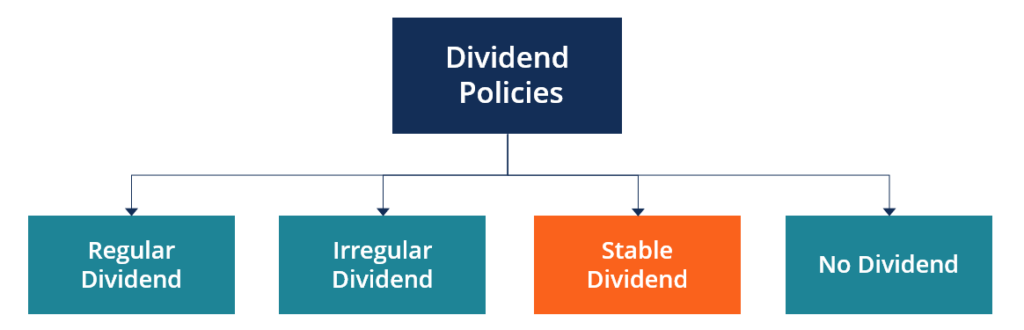
Under a stable dividend policy, it is common for companies to distribute dividends every quarter, with the payout in line with the quarterly earnings of the company. However, it can also be paid out annually or semi-annually. The stable dividend policy is one of the most popular policies because the company’s volatility is not reflected in the dividend payout. Shareholders can be certain that they will receive a dividend payment at least once a year.
Dividends and Dividend Policies
A dividend is a reward that a company gives to its shareholders for investing in the company. The dividends can be distributed in many different ways, such as cash payment or through stock shares. The board of directorsBoard of DirectorsA board of directors is a panel of people elected to represent shareholders. Every public company is required to install a board of directors. of a company decides how much of a dividend to give out and how to time the redistribution of profits.
One of the most important decisions made by the shareholders in the company is the dividend policy they need to follow. At the highest level, a company faces two decisions: retain profits or distribute them to the shareholders. Sometimes, the company may choose to retain the profits in the company for a variety of reasons, such as potential investment opportunities for the company, future earnings, flotation costs, tax liabilities, or other considerations that restrict the company from paying out a dividend.
After the company makes a decision on what they should do with the profits, the next step is to create the dividend policy. The dividend policy acts as a tool for the company to attract investors and receive preferential treatment in the financial marketsFinancial MarketsFinancial markets, from the name itself, are a type of marketplace that provides an avenue for the sale and purchase of assets such as bonds, stocks, foreign exchange, and derivatives. Often, they are called by different names, including "Wall Street" and "capital market," but all of them still mean one and the same thing.. The investors’ preferences also play a key role in deciding the type of dividend policy to use.
The tax policy of the country also determines if the shareholder would want to receive the stock in cash or as stock repurchase options.
Implementation of the Stable Dividend Policy
1. Constant payout ratio
This is when a certain specified percentage of the company’s earnings is distributed to shareholders as dividends. Many companies prefer the constant payout policy as it makes it easier for management to decide how much of the earnings should be retained.
2. Constant dividend per share
The company distributes a fixed amount of cash dividends. It creates a reserve that allows them to pay a fixed dividend even when earnings are low or there are losses. The constant dividend policy is more suited for companies whose earnings remain stable over a number of years.
3. Combination of the two policies
Under a combination of the policies, the company distributes a fixed amount of regular dividend in addition to an extra dividend that is paid in line with its earnings. The combination policy allows the management to be flexible and is a good option for companies whose earnings constantly fluctuate.
Stable Dividend Policy and Target Payout Ratio
The stable dividend policy can also be defined by the target payout ratio. The target payout ratio represents the percentage of earnings that the company chooses to distribute to shareholders in the long term. As per the model, the earnings of the company are expected to rise if the dividend payout ratio is below the target dividend payout ratio. An investor can calculate the estimated future dividend as follows:
Expected Future Dividend = Current Dividend + (Expected Increase in EPS x Target Payout Ratio x Adjustment Factor)
Where:
- Adjustment Factor is the number of years over which dividend adjustments will happen
More Resources
CFI offers the Financial Modeling & Valuation Analyst (FMVA)™Become a Certified Financial Modeling & Valuation Analyst (FMVA)®CFI's Financial Modeling and Valuation Analyst (FMVA)® certification will help you gain the confidence you need in your finance career. Enroll today! certification program for those looking to take their careers to the next level. To keep learning and advancing your career, the following CFI resources will be helpful:
- Capital Gains TaxCapital Gains TaxCapital gains tax is a tax imposed on capital gains or the profits that an individual makes from selling assets. The tax is only imposed once the asset has been converted into cash, and not when it’s still in the hands of an investor.
- Dividend Reinvesting Plan (DRIP)Dividend Reinvestment Plan (DRIP)A dividend reinvestment plan (DRIP or DRP) is a plan offered by a company to shareholders that it allows them to automatically reinvest their
- Important Dividend DatesImportant Dividend DatesIn order to understand dividend-paying stocks, knowledge of important dividend dates is crucial. A dividend typically comes in the form of a cash distribution that is paid from the company's earnings to investors.
- Special DividendSpecial DividendA special dividend, also referred to as an extra dividend, is a non-recurring, "one-time" dividend distributed by a company to its shareholders. It is separate from the regular cycle of dividends and is usually abnormally larger than a company’s typical dividend payment.
-
Debt-to-Asset Ratio: Definition, Calculation & Significance
The Debt to Asset Ratio, also known as the debt ratio, is a leverage ratioLeverage RatiosA leverage ratio indicates the level of debt incurred by a business entity against several other accounts in it
-
Defensive Interval Ratio (DIR): Understanding Company Liquidity
The defensive interval ratio (DIR) is a financial liquidity ratio that indicates how many days a company can operate without needing to tap into capital sources other than its current assetsCurrent As
finance
- Acid-Test Ratio: Understanding Your Company's Short-Term Liquidity
- Dividend Growth Rate (DGR): Definition & Calculation
- Dividend Irrelevance Theory: Understanding Its Implications
- Understanding Dividend Yield: A Key Metric for Investors
- Understanding the Earnings Multiplier (P/E Ratio): A Comprehensive Guide
- Understanding Liquidating Dividends: A Comprehensive Guide
- Modigliani-Miller Theorem: Understanding Capital Structure & Firm Value
- Special Dividends: Understanding One-Time Distributions
- Understanding Dividend Policy: A Comprehensive Guide
-
 Asset Turnover Ratio: Definition & Calculation - Financial Analysis
The asset turnover ratio, also known as the total asset turnover ratio, measures the efficiency with which a company uses its assets to produce salesSales RevenueSales revenue is the income recei...
-
 Constant Dividend Payout Ratio: Definition & Implications
A constant dividend payout ratio policy is a dividend policy in which the percentage of earnings paid in the form of dividends is held constant. In other words, a constant dividend payout ratio policy...