
Subscription Agreement: Definition, Details & Importance
A subscription agreement is a formal agreement between a company and an investor to buy shares of a company at an agreed-upon price. The subscription agreement contains all the required details. It is used to keep track of outstanding sharesOutstanding SharesOutstanding shares represent the number of a company’s shares that are traded on the secondary market and, therefore, available to investors. Outstanding shares include all restricted shares held by the company’s officers and insiders (senior employees), as well as the equity portion owned by institutional investors and share ownership (who owns what and how much) and mitigate any potential legal disputes in the future regarding share payout.

Subscription agreements are important to understand when analyzing business partnerships and being an early owner, employee, or investor in a start-up.
Summary
- A subscription agreement is a formal agreement between a company and an investor to buy shares of a company at an agreed-upon price.
- It contains all the details of such an agreement, including Outstanding Shares, Shares Ownership, and Payouts.
- A well organized and well-structured subscription agreement will include the details about the transaction, the number of shares being sold and the price per share, and any legally binding confidentiality agreements and clauses.
How Do Subscription Agreements Work?
Subscription agreements vary depending on the company they pertain to and the reason they are offered. Often, they will contain the details on a predetermined rate of return on the initial investment by a new investor into a company. It could be a percentage of corporate profits after the company passes certain agreed-upon financial milestones.
Subscription agreements generally are offered at earlier stages with start-up companies before they are able to access venture capitalVenture CapitalVenture capital is a form of financing that provides funds to early stage, emerging companies with high growth potential, in exchange for equity or an ownership stake. Venture capitalists take the risk of investing in startup companies, with the hope that they will earn significant returns when the companies become a success. or are able to go public. A well organized and well-structured subscription agreement will include the details about the transaction, the number of shares being sold and the price per share, and any legally binding confidentiality agreements and clauses.
How They Are Regulated
The graphic below shows the legal methods governing subscription agreements in the United States:
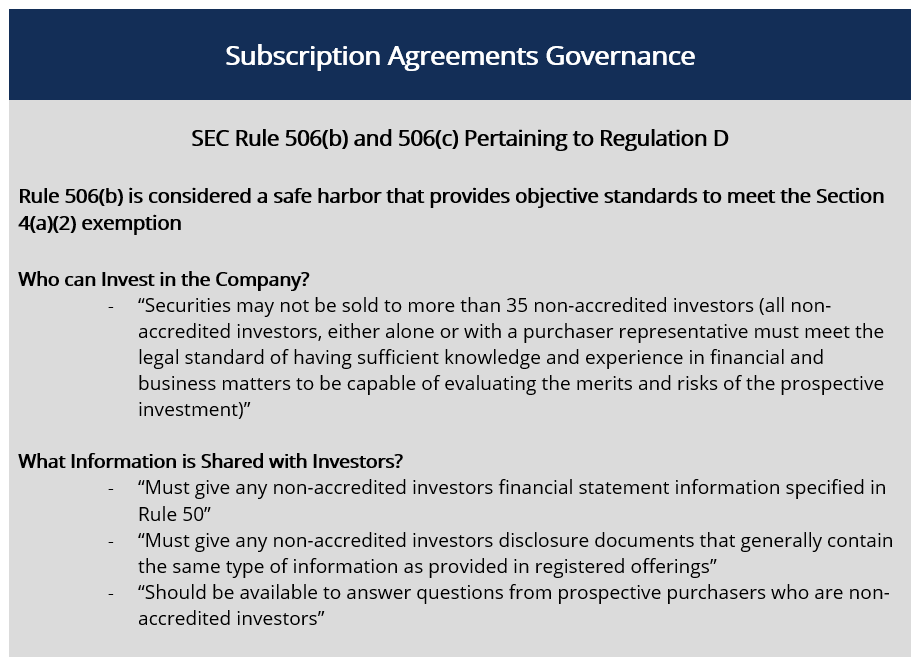
Why Would A Company Choose Subscription Agreements?
Subscription agreements are chosen for a few different reasons. They are primarily done because the company is not yet at a point where they can attract venture capital or investment banks to invest in their organization. The agreements are also done to raise money from private investors without registering with the Securities and Exchange Commission (SEC)Securities and Exchange Commission (SEC)The US Securities and Exchange Commission, or SEC, is an independent agency of the US federal government that is responsible for implementing federal securities laws and proposing securities rules. It is also in charge of maintaining the securities industry and stock and options exchanges.
Advantages of a Subscription Agreement
- Generally are limited partnerships without any personal liability
- One-time lump sum investment instead of ongoing venture capital contributions
- Able to invest early and watch your investment grow as the company scales up
- Can provide a positive voice and influence the company’s leadership
Disadvantages of a Subscription Agreement
- Lack of voting rights Voting SharesVoting shares are shares of a company that entitle the shareholder to vote on key issues of the company. It is generally one vote per share. The shares
- Requires a large lump-sum contribution, instead of traditional equities that can be purchased in lower dollar share amounts
- No liquidity: Once funds are invested, you must find someone to buy you out, which can be difficult to do
- Lack of transparency and oversight without the SEC involvement
- Legal issues that can arise if proper counsel is not used to examine and advise on the deal
Related Readings
CFI is the official provider of the Capital Markets & Securities Analyst (CMSA)®Program Page - CMSAEnroll in CFI's CMSA® program and become a certified Capital Markets &Securities Analyst. Advance your career with our certification programs and courses. certification program, designed to transform anyone into a world-class financial analyst.
To keep learning and developing your knowledge of financial analysis, we highly recommend the additional resources below:
- Common vs. Preferred SharesCommon vs Preferred SharesPotential investors who are looking to acquire a stake or ownership in a company can choose to purchase between common vs preferred shares. Companies
- Limited Liability Partnerships (LLPs)Limited Liability Partnerships (LLPs)Limited Liability Partnerships (LLPs) are a corporate business structure that enables entrepreneurs, professionals, and enterprises to provide services via
- Non-Disclosure Agreement (NDA)Non Disclosure Agreement (NDA)A Non Disclosure Agreement (NDA) is a document that is exchanged between a prospective buyer and a seller in the initial stages of an M&A transaction.
- Shareholders’ AgreementShareholders’ AgreementA shareholders’ agreement is an arrangement among the shareholders of a company. It contains provisions regarding the operation of the
-

Ramp-Up: Definition, Benefits & How to Achieve It
In business, ramp-up is a term that describes a significant increase in the output of a company’s products or services. Essentially, ramp-up implies bringing the company’s capacity utiliza
-

Streamlining Processes: Definition, Benefits & Techniques
Streamlining refers to the improvement of the efficiency of a certain process within an organization. It can be done by automationExcel vs Automation in Financial ModelingBefore we discuss Excel vs au
finance
- Acquirer Definition: Understanding Corporate Acquisitions
- Understanding Clawbacks: Protecting Stakeholders from Failed Performance
- Understanding Financial Gearing: Debt & Leverage Explained
- Keepwell Agreement: Definition, Purpose & Benefits
- Leverage in Finance: Strategies, Types & Risks
- Parent Company Explained: Definition, Control & Examples
- Shareholders' Agreement: Definition, Purpose & Key Provisions
- Understanding Stocks: A Beginner's Guide to Share Ownership
- Lock-Up Agreements: Understanding Insider Restrictions During IPOs
-
 Kaizen: Understanding Continuous Improvement for Business
Kaizen is a Japanese word (改善) that means “improvement” or “to improve.” When applied to the world of business, kaizen refers to every action, operation, or rule ...
-
 Outsourcing: A Comprehensive Guide to Benefits & Strategy
Outsourcing is a strategic decisionCorporate StrategyCorporate Strategy focuses on how to manage resources, risk and return across a firm, as opposed to looking at competitive advantages in business s...