
Attribution Analysis: Understanding Portfolio Performance
Attribution analysis, also known as “return attribution” or “performance attribution,” is an evaluation tool used to explain and analyze a portfolio’s performance against a particular benchmarkDow Jones Industrial Average (DJIA)The Dow Jones Industrial Average (DJIA), also referred to as "Dow Jones” or "the Dow", is one of the most widely-recognized stock market indices.. It is used to identify sources of excess returns from a firm or fund manager’s active investment decisions.
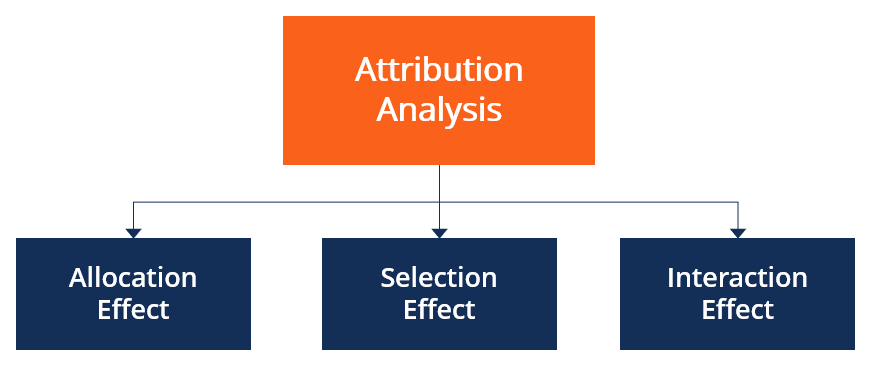
Components of Attribution Analysis
Attribution analysis compares the return generated by a particular portfolio with that of a portfolio that has been benchmarked for evaluation. It involves comparing different components of the portfolio, which are the result of investment decisions made by the portfolio managerPortfolio ManagerPortfolio managers manage investment portfolios using a six-step portfolio management process. Learn exactly what does a portfolio manager do in this guide. Portfolio managers are professionals who manage investment portfolios, with the goal of achieving their clients’ investment objectives..
The most important factors for effective attribution analyses are portfolio allocation, asset/security selection, and the interaction of these effects – as outlined by the BHB (Brinson, Hoover, and Beebower) model – which is one of the commonly used performance attribution methods.
1. Allocation Effect
The allocation effect refers to the returns generated by allocating portfolio weights to specific segments, sectors, or industries. For example, a portfolio may consist of 20% allocated to assets in the technology sector, 50% to the utility sector, and 30% to the transport sector. The weights are then compared with a benchmark portfolio.
- If the portfolio weighs a sector higher than the benchmark, it is described as an overweight
- If the portfolio weighs a sector lower than the benchmark, it is described as an underweight
Ideally, the aim of a portfolio manager or investment decision-maker is to place a higher weight on sectors that perform well (i.e., overweight the sectors) and place a lower weight on sectors that are bad investments (i.e., underweight the sectors).
To quantify the effect of allocation decisions, the sector weights and returns in the portfolio are compared to those in the benchmark portfolio, and the arithmetic difference in returns is the effect of the portfolio manager’s decisions regarding asset allocationAsset AllocationAsset allocation refers to a strategy in which individuals divide their investment portfolio between different diverse categories.
2. Selection Effect
The selection effect refers to the impact of the selection of specific stocks or securities within a segment on the portfolio’s overall return.
- A positive selection effect occurs when the portfolio return from a particular segment is greater than the benchmark return from the same segment.
- A negative selection effect occurs when the portfolio return from a particular segment is lower than the benchmark return from the same segment.
Since the analysis compares returns from equivalent segments in the portfolio against the benchmark, the excess (or lost) returns are attributed to selections within segments, which are made by the portfolio manager.
Caveat: It is important to note that stock selection is unrelated to allocation in that it is not affected by segment weights, but simply by decisions regarding specific securities that are included in the portfolio.
3. Interaction Effect
The interaction effect is the combination of the selection and allocation effect. If the portfolio allocation outweighs and outperforms the benchmark, the interaction effect is positive, and vice versa. The interaction effect is essentially the cumulative effect created by asset allocation, security selection, and other investment decisions made by the portfolio manager.
However, it is important to note that the interaction effect is not easily attributable due to the fact that it is a mathematical consequence of the allocation and selection effects rather than an actively made investment decision.
Active Management Effect
The active management effect refers to the sum of the allocation, selection, and interaction effects. It is essentially the difference between the portfolio returns and the benchmark returns, and the excess (or lack thereof) is attributed to the portfolio manager and their decisions.
What Makes a Benchmark Valid?
A valid benchmarked portfolio comes with the following characteristics:
- Measurable
- Investable
- Appropriate
- Owned
- Unambiguous
- Reflective of the current investment landscape
Importance of Attribution Analysis
For portfolio managers – An effective tool to assess strategies
Attribution analysis can be used to separate the selection and allocation effects. The selection effect reflects the quality and ability to pick the right securities at the right time. It allows managers to reflect on the entire investment decision-making process and gives them opportunities to improve.
It is also used to evaluate the performance of employees at an asset managementAsset ManagementAsset management refers to the process of developing, operating, maintaining, and selling assets in a cost-effective manner. firm. If an analyst or employee recommended overweighting a particular sector or buying a particular stock, the returns can be attributed to their performance, and it can be used to reward them and motivate them further.
For investors – An effective tool to assess the performance of fund managers
For investors and clients of portfolio managers, attribution analysis is an important method to assess how a portfolio manager has performed and whether they have adhered to their investment strategies and styles.
For example, a portfolio manager may have underweighted the right sector but has picked high-return stocks, and it shows that they are better at selection than allocation. Similarly, a portfolio manager may agree to build a risk-averse portfolio. Examining the allocation and selection strategies can increase transparency and assure investors that the risk-averse strategy is being implemented.
Additional Resources
CFI is the official provider of the global Commercial Banking & Credit Analyst (CBCA)™Program Page - CBCAGet CFI's CBCA™ certification and become a Commercial Banking & Credit Analyst. Enroll and advance your career with our certification programs and courses. certification program, designed to help anyone become a world-class financial analyst. To keep advancing your career, the additional resources below will be useful:
- Active ReturnActive ReturnActive return refers to the gains or losses from a portfolio that are directly related to the decisions made by the portfolio manager. The active return can
- Portfolio Turnover RatioPortfolio Turnover RatioThe portfolio turnover ratio is the rate of which assets in a fund are bought and sold by the portfolio managers. In other words, the portfolio turnover
- Rate of ReturnRate of ReturnThe Rate of Return (ROR) is the gain or loss of an investment over a period of time copmared to the initial cost of the investment expressed as a percentage. This guide teaches the most common formulas
- Strategic Asset Allocation (SAA)Strategic Asset Allocation (SAA)Strategic asset allocation refers to a long-term portfolio strategy that involves choosing asset class allocations and rebalancing the allocations
-
Laddered Bond Portfolio: A Risk-Mitigating Investment Strategy
A laddered bond portfolio is an investment portfolio strategy that is composed of fixed income securities with different maturity dates. It is also referred to as a “bond ladder” portfolio
-

Portfolio Planning: A Comprehensive Guide to Investment Strategies
Portfolio planning is the process of strategizing the construction of an investment portfolio. The investment portfolio should be encompassing of the investor’s risk toleranceRisk ToleranceRisk
invest
- Understanding Attribution Analysis: Performance & Return Evaluation
- Contribution Analysis: Understanding Profitability & Cost Management
- Credit Analysis: A Comprehensive Guide to Assessing Credit Risk
- Portfolio Variance: Understanding Risk and Diversification
- Quantitative Analysis: Definition, Methods & Applications
- Understanding Financial Benchmarks: A Comprehensive Guide
- Fundamental Analysis: A Comprehensive Guide to Investment Valuation
- Horizon Analysis: Predicting Portfolio Returns & Investment Strategies
- Portfolio Rebalancing: A Comprehensive Guide for Investors
-
 Understanding the January Effect: Stock Market Trends & Causes
The January Effect is known to be a seasonal increase in stock prices throughout the month of January. The increase in demand for stocks is often preceded by a decrease in price during the month of De...
-
 Understanding the Joseph Effect: Trends vs. Randomness
The Joseph Effect, which derives its name from a Biblical reference, is a phrase created by Benoit Mandelbrot, a Polish-born French-American mathematician. The phrase asserts that variations over time...