
Understanding Average Cost Basis: A Comprehensive Guide
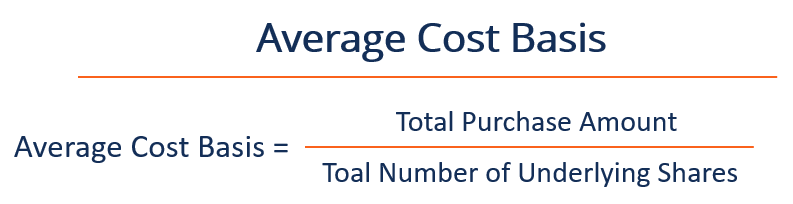
Average cost basis is defined as the means to attribute the purchase price to shares underlying a mutual fundMutual FundsA mutual fund is a pool of money collected from many investors for the purpose of investing in stocks, bonds, or other securities. Mutual funds are owned by a group of investors and managed by professionals. Learn about the various types of fund, how they work, and benefits and tradeoffs of investing in them or an account managed by a custodian (broker). It is calculated as the total amount paid to purchase the mutual fund or investment in a custodian account divided by the total number of underlying shares. The utility of the average cost basis method is its simplicity during multiple purchases, reinvestment of dividendsDividendA dividend is a share of profits and retained earnings that a company pays out to its shareholders. When a company generates a profit and accumulates retained earnings, those earnings can be either reinvested in the business or paid out to shareholders as a dividend., and actual capital gains.
Summary
- Cost basis is a tool for establishing the starting point or purchase point for the initiation of tax calculation provided a profit is generated. Profits are the returns generated and above the cost basis.
- Average cost basis is one of the methods available among several other methods to determine the cost basis.
- Average cost basis is widely used owing to its ease of use. The average cost price is the total purchase amount divided by the total number of shares.
Importance of Cost Basis
The cost basis forms the fulcrum around which the investor comes to know whether they’ve earned a profit or loss. Average cost basis is not the only method; there are other methods like LIFOLast-In First-Out (LIFO)The Last-in First-out (LIFO) method of inventory valuation is based on the practice of assets produced or acquired last being the first to be, HIFO, and specific identification that are available. The average cost method is the easiest to administer and calculate. However, the average cost method may not always be the most tax-efficient.
Example 1: Mutual Fund Purchase
Let’s assume an investor buys the same mutual fund (units /shares) on two separate occasions, i.e., Feb. 1, 2019 and Mar. 2, 2019 for an outflow of $1,000 and $2,500, respectively.
After a month, a dividend worth of $100 is received, and the entire proceeds of the dividend are reinvested to purchase new units.
The average cost basis is defined as the total purchase amount divided by the total number of shares. It works out to $28.53.
DateTransactionShare PricePurchase AmountNo. of Shares
Feb. 1, 2019
Buy$25$1,00040Mar. 2, 2019
Buy
$30
$2,500
83.3
Mar. 4, 2019Reinvestment of Dividends
$35
$100
2.9
Total$3,600
126.2
Average Cost Basis
$28.53
The cost basis of $28.53 is the reference point around which gains and losses would now be calculated for taxation purposes.
Let us suppose after a couple of months the investor sells 40 shares for $50.
DateTransactionShare PriceProceedsNo. of SharesMay 2, 2019Sell$50$2,00040
Working on Average Cost Basis
Cost Basis of the 40 Shares
No. of Shares (40) * Average Cost Basis (28.53) = $1,412.20
Sales Proceeds$2,000Capital Gains from the Transaction$2,000 – $1,412.20 = $858.80From the investor’s marginal tax rate, we can now calculate the incidence of taxation (assume a tax rate of 30%)Capital Gains ($858.80) * Tax Rate (30%) = $257.64
The importance of the cost basis stems from the fact that it is the price that is used to determine whether an investor makes a profit or loss. The presence of profits would lead to the incidence of taxation. The average cost basis should not be construed as a proxy for performance.
As illustrated above, the cost basis helps in establishing the starting point to calculate the profit or loss from a tax point of view. Losses are not taxed, whereas profits are taxed. However, not all profits are taxed equally. Short-term profits are taxed at a higher rate, whereas long-term profits are taxed at a lower rate. Average cost basis thus helps determine what is taxable and what is not taxable.
Example 2: Purchase of ETFs
An investor named Mr. X decides to secure exposure to a basket of securities using an exchange-traded fund (ETF)Exchange Traded Fund (ETF)An Exchange Traded Fund (ETF) is a popular investment vehicle where portfolios can be more flexible and diversified across a broad range of all the available asset classes. Learn about various types of ETFs by reading this guide.. The cost basis of the purchase can be determined in several ways, especially in the United States. At the one end of the spectrum, there is the FIFO method, and at the other end, there is the average cost method.
Let us suppose Mr. X purchases 100 shares of Company QQQ at $10 each for a net outflow of $1,000 on Jan. 2, 2020. At the beginning of the next quarter, Apr. 3, Mr. X decides to purchase another 50 shares of QQQ at $7 each, totaling $350. Now, let us look at the cost basis under the two different methods.
DateTransactionShare PriceNo. of SharesPurchase AmountJan. 2, 2020Buy$10100$1,000Apr. 3, 2020Buy$750$350
DateTransactionShare PriceNo. of SharesAverage CostFIFO CostApr. 30, 2020Redemption$1250Total Purchase Amount/ Total Number of SharesPurchase Price of First 50 SharesCalculation$1,350 / 150 = $9$10Profit Per Share$12 – $9 = $3$12 – $10 = $2Total Profit
50 * $3 = $150
50 * $2 = $100
As illustrated above, we can clearly see that the average cost method is the least punitive method of calculating the cost basis. An investor can benefit from the FIFO method only when the initial tranche of shares are purchased at a lower price.
It may not be the case all the time, as can be seen from the example above. Hence, the average cost basis provides the best compromise between the lowering of cost basis and ease of calculation.
More Resources
CFI offers the Commercial Banking & Credit Analyst (CBCA)™Program Page - CBCAGet CFI's CBCA™ certification and become a Commercial Banking & Credit Analyst. Enroll and advance your career with our certification programs and courses. certification program for those looking to take their careers to the next level. To keep learning and advancing your career, the following resources will be helpful:
- Activity-based CostingActivity-Based CostingActivity-based costing is a more specific way of allocating overhead costs based on “activities” that actually contribute to overhead costs. An activity is
- Capital Gains TaxCapital Gains TaxCapital gains tax is a tax imposed on capital gains or the profits that an individual makes from selling assets. The tax is only imposed once the asset has been converted into cash, and not when it’s still in the hands of an investor.
- LIFO vs. FIFOLIFO vs. FIFOAmid the ongoing LIFO vs. FIFO debate in accounting, deciding which method to use is not always easy. LIFO and FIFO are the two most common techniques used in valuing the cost of goods sold and inventory.
- How to Use the IRS.gov WebsiteHow to Use the IRS.gov WebsiteIRS.gov is the official website of the Internal Revenue Service (IRS), the United States’ tax collection agency. The website is used by businesses and
-

Incremental Analysis: A Comprehensive Guide for Business Decisions
Incremental analysis (also referred to as the relevant cost approach, marginal analysis, or differential analysis) is a decision-making tool used to assess financial information and derive a decision
-

Understanding Incremental Cost: A Definition & Key Considerations
Incremental cost is the additional cost incurred by a company if it produces one extra unit of output. The additional cost comprises relevant costs that only change in line with the decision to produc
invest
- Pool Heating Costs: A Comprehensive Guide to Average Expenses & Savings
- Cost of Capital: Definition, Calculation & Importance
- Understanding Loan Lifespan: What is Average Life?
- Understanding Average Return: A Simple Guide
- Basis Risk Explained: Understanding and Managing Hedging Risk
- Basis Trading: Definition, Strategy & How It Works
- Marginal Cost: Definition, Calculation & Examples
- Weighted Average Cost (WAC): Definition & Calculation
- Average Vacation Cost: A Comprehensive Breakdown for 2024
-
 Understanding Cost Structure: Fixed vs. Variable Costs
Cost structure refers to the various types of expenses a business incurs and is typically composed of fixed and variable costsFixed and Variable CostsCost is something that can be classified in severa...
-
 Economic Order Quantity (EOQ): Definition & Importance
EOQ stands for Economic Order Quantity. It is a measurement used in the field of Operations, Logistics, and Supply Management. In essence, EOQ is a tool used to determine the volume and frequency of o...