
Directional Trading Strategies: A Comprehensive Guide
Directional trading strategies are strategies that bet on the up or down movement of the market. For example, if an investor believes the market is rising, they would take a long positionLong and Short PositionsIn investing, long and short positions represent directional bets by investors that a security will either go up (when long) or down (when short). In the trading of assets, an investor can take two types of positions: long and short. An investor can either buy an asset (going long), or sell it (going short).. On the other hand, if an investor believes the prices will drop, then they will take a short position. Directional trading strategies can be used simultaneously to create bets on volatility. This includes a straddleStraddleA straddle strategy is a strategy that involves simultaneously taking a long position and a short position on a security. Consider the following example: A trader buys and sells a call option and put option at the same time for the same underlying asset at a certain point of time, strangleLong StrangleA long strangle is a neutral-approach options strategy – otherwise known as a “buy strangle” or purely a “strangle” – that involves the purchase of a call, and box spreadBox SpreadA box spread is an options trading strategy that combines a bear put and a bull call spread. In order for a box spread to be effective:The expiration dates strategy.

Quick Summary Points
- Directional options strategy is a strategy investors use to make money by betting on the direction of the market.
- The four types of strategies are bull calls, bull puts, bear calls, and bear puts.
- The strategies help decrease the cost of options, volatilityVolatilityVolatility is a measure of the rate of fluctuations in the price of a security over time. It indicates the level of risk associated with the price changes of a security. Investors and traders calculate the volatility of a security to assess past variations in the prices, and risk, but also create smaller payoffs.
Types of directional trading strategies
Trading strategies use either callsCall OptionA call option, commonly referred to as a "call," is a form of a derivatives contract that gives the call option buyer the right, but not the obligation, to buy a stock or other financial instrument at a specific price - the strike price of the option - within a specified time frame. or putsPut OptionA put option is an option contract that gives the buyer the right, but not the obligation, to sell the underlying security at a specified price (also known as strike price) before or at a predetermined expiration date. It is one of the two main types of options, the other type being a call option.. First, investors predict the movement of the market. Next, investors can create spreads by buying and selling options at different strike prices. Doing so will help decrease the risk and cost.
Bull Call
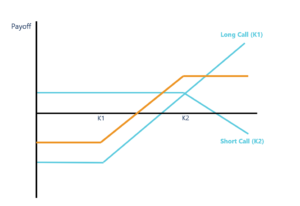
Investors create bull calls when they think the markets are good and will increase in price. They create this by buying a call option with a lower strike priceStrike PriceThe strike price is the price at which the holder of the option can exercise the option to buy or sell an underlying security, depending on and sell a call option with a higher strike price. When buying the call option, investors will have to pay a premium. The premium is higher for options with a low strike price because it has greater value. Since buying a call option can be expensive, investors can choose to sell a call to collect a premium. By doing so, they create a bull call.
The diagram below is an illustration of a bull call. The vertical axis represents the payoff, which is the profit minus price of premium and the horizontal axis is the price. The blue lines are the long and short position on a call option and the orange line is the payoff of the bull call depending on the price of the underlying asset. Since a bull call is a bet the price will increase, the payoff is higher when the price is high. The diagram also shows that when the price is low, the long call has a lower payoff than the bull call. However, the long call has more potential for higher payoff as the bull call’s payoff is caped after the price is the same as the K2 strike price.
Bull Put
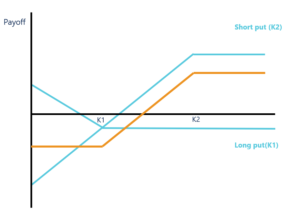
Bull put is also a bet that the markets are good and prices will increase. It is similar to bull calls but uses put options instead. Investors can create bull puts by buying a put with a lower strike priceStrike PriceThe strike price is the price at which the holder of the option can exercise the option to buy or sell an underlying security, depending on and selling a put with a higher strike price. A bull put will have lower loses in comparison with a long put when prices fall. However, it also caps the earnings of the option. Thus, the cash flow is less volatile.
Similar to the bull call, the diagram below shows that the payoff is higher when the price is high. It also shows that a short put has a more extreme negative payoff when the price is low. By buying a long put option with strike price K1, the payoff is less extreme.
Bear Call
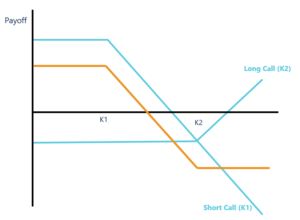
Bear call is based on the belief that market prices will fall. Investors or traders create this by selling a call with a low strike price and buying a call with a high strike price. Much like other directional strategies, the loss and gain of the option are limited. However, the reward to the strategy is that there is less volatility. If prices end up increasing, an investor with a bear call will suffer fewer losses than an investor with a call option.
As a bear call is a bet that the price of the underlying asset will fall, the diagram demonstrates higher payoff when prices are low. It also shows that the loss of the bear call, orange line, is capped. This takes away the risk of a short call, which can have unlimited loss depending on how high the price rises.
Bear Put
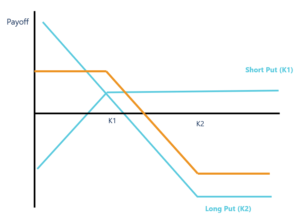
Similar to bear calls, bear puts create a profitProfitProfit is the value remaining after a company’s expenses have been paid. It can be found on an income statement. If the value that remains when the market prices fall. Investors create bear puts by selling a put with a low strike price and buying a put with a high strike price. A bear put is cheaper than just buying a put option and decreases volatility. Since an investor is selling a put option, they can collect a premium to offset the cost of buying a put option with a high strike price. Since a put option gives the buyer the ability to sell the underlying asset at a strike price, the option with a higher strike price is more valuable as it gives the buyer more income.
As shown by the diagram below, the payoff is at the highest before the price of the underlying asset reaches the strike priceStrike PriceThe strike price is the price at which the holder of the option can exercise the option to buy or sell an underlying security, depending on K1. This fits in with the investor’s prediction and provides high payoffs when the price is low. The diagram also shows that the bear put’s payoff shown by the orange line decreases steadily with the rise in price. However, it is not as low as having just a long put option as the short position on another put option provides a positive payoff.
Why does it matter?
Directional trading strategies help investors limit their risk, decrease costs, and predict the cash flow with greater accuracy. Understanding directional strategies also help investors create more complex strategies. These strategies combine bull spreads and call spreads and bet on the volatility of the underlying asset.
Additional resources
Thank you for reading CFI’s article on directional trading strategies. To keep learning and advancing your career, we recommend the following resources.
- Put-Call Parity Put-Call ParityPut-call parity is an important concept in options pricing which shows how the prices of puts, calls, and the underlying asset must be consistent with one another. This equation establishes a relationship between the price of a call and put option which have the same underlying asset.
- Margin TradingMargin TradingMargin trading is the act of borrowing funds from a broker with the aim of investing in financial securities. The purchased stock serves as collateral for the loan. The primary reason behind borrowing money is to gain more capital to invest
- Stock Index FuturesStock Index FuturesStock index futures, also referred to as equity index futures or just index futures, are futures contracts based on a stock index. Futures contracts are an
- Option Pricing ModelOption Pricing ModelsOption Pricing Models are mathematical models that use certain variables to calculate the theoretical value of an option. The theoretical value of an
-

Understanding Momentum Indicators in Trading
Momentum indicators are tools utilized by traders to get a better understanding of the speed or rate at which the price of a securityPublic SecuritiesPublic securities, or marketable securities, are i
-

Understanding Option Greeks: A Comprehensive Guide
Option Greeks are financial measures of the sensitivity of an option’s price to its underlying determining parameters, such as volatility or the price of the underlying asset. The Greeks are uti
invest
- Understanding Options Trading Privileges: A Comprehensive Guide
- Understanding Algorithms: A Guide to Algorithmic Trading
- Call Options: A Comprehensive Guide for Investors
- Understanding Call Prices: Callable Bonds & Preferred Stocks
- Call Warrants: Understanding Rights & Investment Potential
- Understanding Commodities: A Beginner's Guide to Investing
- Covered Calls: A Comprehensive Guide for Investors
- Short Call Options: Strategy, Risks & How It Works
- Trading Assets: Definition, Types & How They Work
-
 Donchian Channels: A Comprehensive Guide for Traders
Donchian Channels are a channel-based technical analysisTechnical Analysis - A Beginners GuideTechnical analysis is a form of investment valuation that analyses past prices to predict future price act...
-
 Understanding Equity Derivatives: A Comprehensive Guide
Equity derivatives are financial products/instruments whose value is derived from the increase or decrease in the underlying assets, i.e., equity stocks or shares in the secondary marketSecondary Mark...