
Understanding Dollar Duration: A Guide for Bond Investors
Dollar duration is a bond analysis method that helps an investor ascertain the sensitivity of bond prices to interest rates changes. The method measures the change in the price of a bond for every 100 bps (basis points) of change in interest rates.

Dollar duration can be applied to any fixed income products, including forwarding contracts, zero-coupon bondsZero-Coupon BondA zero-coupon bond is a bond that pays no interest and trades at a discount to its face value. It is also called a pure discount bond or deep discount bond., etc. Therefore, it can also be used to calculate the risk associated with such products.
Summary
- Dollar duration is the measure of the change in the price of a bond for every 100 bps (basis points) of change in interest rates.
- It is calculated by offsetting price risk with reinvestment rate risk.
- Dollar duration is not an accurate measure of the effect of interest rates on bond prices.
Bond Risks
The risks associated with bonds include:
1. Price risk
The coupon rate payable on a bond is inversely related to the prevailing market interest rates. It means that as interest rates fall, bond coupon rates increase. Short-term bonds are less sensitive to interest changes, while a 20-year long-term bond may be more sensitive to interest rate changes.
Bonds with a low coupon rateCoupon RateA coupon rate is the amount of annual interest income paid to a bondholder, based on the face value of the bond. are more sensitive to interest changes and vice versa. Price risk is more relevant to investors intending to hold the bond for a short period of time and resell it before it matures.
2. Reinvestment rate risk
The return that can be earned by reinvesting the coupon payments is positively or directly correlated with the market rate of interest. It is more relevant for investors intending who intends to hold the bond until maturity, as when rates go up, the investor will earn more.
Since both risks move in opposite directions and offset each other, a duration that minimizes the exposure to both risks and maximizes the profit that can be earned can be calculated. The duration refers to the holding period where price risk and reinvestment rate risk offset each other.
Formulas
Dollar duration is represented by calculating the dollar value of one basis point, which is the change in the price of a bond for a unit change in the interest rate (measured in basis points). The dollar value per 100 basis point can be symbolized as DV01 or Dollar Value Per 01. A 1% unit change in the interest rate is 100 basis points.
The formula for calculating duration is:
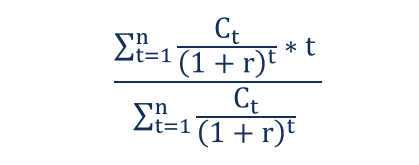
Where:
- n = Years to maturity
- c = Present value of coupon payments
- t = Each year until maturity
The formula for calculating dollar duration is:
Dollar Duration = DUR x (∆ i/1+ i) x P
Alternatively, if the change in the value of the bond and the yield is known, another formula can be used:
DV01 = – (ΔBV/10000 * Δy)
Where:
- ΔBV = Change in the value of a bond
- Δy = Change in yield
Factor of Inaccuracy in Dollar Duration
Dollar duration is not an accurate measure of the effect of interest rates on bond prices, as the relationship between the two is not linear. It means that the aforementioned formulas can accurately predict price changes in bonds for given interest rates only for small changes.
More Resources
CFI offers the Commercial Banking & Credit Analyst (CBCA)™Program Page - CBCAGet CFI's CBCA™ certification and become a Commercial Banking & Credit Analyst. Enroll and advance your career with our certification programs and courses. certification program for those looking to take their careers to the next level. To keep learning and developing your knowledge base, please explore the additional relevant resources below:
- Bond PricingBond PricingBond pricing is the science of calculating a bond's issue price based on the coupon, par value, yield and term to maturity. Bond pricing allows investors
- Interest Rate RiskInterest Rate RiskInterest rate risk is the probability of a decline in the value of an asset resulting from unexpected fluctuations in interest rates. Interest rate risk is mostly associated with fixed-income assets (e.g., bonds) rather than with equity investments.
- Treasury Bills Treasury Bills (T-Bills)Treasury Bills (or T-Bills for short) are a short-term financial instrument issued by the US Treasury with maturity periods from a few days up to 52 weeks.
- Yield to Maturity (YTM)Yield to Maturity (YTM)Yield to Maturity (YTM) – otherwise referred to as redemption or book yield – is the speculative rate of return or interest rate of a fixed-rate security.
-

Understanding Fixed Income Interest Rate Risk: A Comprehensive Guide
Fixed income interest rate risk is the risk of a fixed income assetFixed Income RisksFixed income risks occur based on the volatility of the bond market environment. Risks impact the market value of t
-

Understanding Interest: Costs & Rewards of Borrowing and Lending
Interest refers to the cost of borrowing money or the reward for lending money. Typically, banks charge interest on money borrowed on top of the expected repayment of the principal. At the same time,
invest
- Understanding Bond Duration: A Key Fixed Income Metric
- Coupon Bonds: Understanding Fixed Income & Interest Payments
- Understanding Duration Drift in Asset-Liability Management
- Effective Duration Explained: Bond Price Sensitivity
- Effective Interest Method Explained: Bond Amortization & Accounting
- Understanding Imputed Interest: Definition & Tax Implications
- Understanding Key Rate Duration: A Guide for Bond Investors
- Macaulay Duration: Understanding Bond Interest Rate Risk
- Understanding Modified Duration: A Key Bond Valuation Metric
-
Personal Bond Explained: Release from Jail Without Bail
A personal bond, which is also called personal recognizance and own recognizance, is a written contract in which a person who has been arrested agrees to appear at all required court dates and promise...
-
 Understanding Add-On Interest: How It Works & Loan Payments
Add-on interest refers to the calculation method of determining the total interest to be paid on a loan. Once the interest’s been added to the principal, the amount is divided by the number of m...