
Effective Duration Explained: Bond Price Sensitivity
Effective duration is the sensitivity of a bondBondsBonds are fixed-income securities that are issued by corporations and governments to raise capital. The bond issuer borrows capital from the bondholder and makes fixed payments to them at a fixed (or variable) interest rate for a specified period.‘s price against the benchmark yield curveYield CurveThe Yield Curve is a graphical representation of the interest rates on debt for a range of maturities. It shows the yield an investor is expecting to earn if he lends his money for a given period of time. The graph displays a bond's yield on the vertical axis and the time to maturity across the horizontal axis.. One way to assess the risk of a bond is to estimate the percentage change in the price of a bond against a benchmark yield curve such as a government par curve.
The effective duration figure is used for hybrid securitiesHybrid SecuritiesHybrid securities are investment instruments that combine the features of pure equities and pure bonds. The securities tend to offer a higher return than pure fixed income securities such as bonds but a lower return than pure variable income securities such as equities., which can be divided into a bond and an option (callable bondsCallable BondA callable bond (redeemable bond) is a type of bond that provides the issuer of the bond with the right, but not the obligation, to redeem the bond before its maturity date. The callable bond is a bond with an embedded call option. These bonds generally come with certain restrictions on the call option.). Embedded bonds increase the uncertainty of cash flows and make it difficult for investors to measure the internal rate of return. This is where the concept of effective duration comes into effect.
What is Duration?
In 1983, economist Frederick Macaulay discovered a way to determine the price volatility of a bond, which was called the “Macaulay Duration.” Although an effective tool, the strategy was not given much importance until the 1970s when interest rates became relatively unstable. During that time, many investors needed a tool that would help assess the volatility of their fixed-income investmentsFixed Income SecuritiesFixed income securities are a type of debt instrument that provides returns in the form of regular, or fixed, interest payments and repayments of the. It led to the development of “modified duration,” which provided a better way to calculate changing bond prices.
Then in the mid-1980s, interest rates fell and investment banksList of Top Investment BanksList of the top 100 investment banks in the world sorted alphabetically. Top investment banks on the list are Goldman Sachs, Morgan Stanley, BAML, JP Morgan, Blackstone, Rothschild, Scotiabank, RBC, UBS, Wells Fargo, Deutsche Bank, Citi, Macquarie, HSBC, ICBC, Credit Suisse, Bank of America Merril Lynch created “effective duration” or “options adjusted duration,” which calculated price movements based on the call features of the bond.
How to Calculate Effective Duration
When bonds offer an uncertain cash flow, the effective duration is the best way to calculate the volatility of interest rates. The formula is as follows:
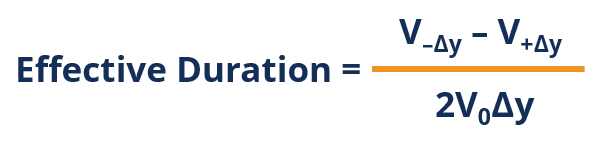
Where:
- V–Δy – The bond’s value if the yield falls by a certain percentage
- V+Δy – The bond’s value if the yield rises by a certain percentage
- V0 – The present value of cash flows (i.e. the bond’s price)
- Δy – The change in the value of the yield
Example of Effective Duration
An investor buys a bond at par for $100 with a yield of 8%. The price of the bond increases to $103 when the yield falls by 0.25%. Alternatively, the price of the bond falls to $98 when the yield increases by 0.25%. The effective duration of the bond will be calculated as:

In the example above, every 1% change in interest rates results in a change in the price of the bond by 10%.
Effective duration is a useful tool for holders of callable bonds because interest rates change and the bond can be recalled before it matures.
Effective Duration vs. Curve Duration
Effective duration differs from modified duration because the latter measures the yield duration – the volatility of the interest rates in terms of the bond’s yield to maturity – while effective duration measures the curve duration, which calculates the interest rate volatility using the yield curveYield CurveThe Yield Curve is a graphical representation of the interest rates on debt for a range of maturities. It shows the yield an investor is expecting to earn if he lends his money for a given period of time. The graph displays a bond's yield on the vertical axis and the time to maturity across the horizontal axis. as a benchmark.
Using the YTM curve as a benchmark, effective duration considers the possible fluctuations in the expected cash flowCash FlowCash Flow (CF) is the increase or decrease in the amount of money a business, institution, or individual has. In finance, the term is used to describe the amount of cash (currency) that is generated or consumed in a given time period. There are many types of CF of the bond. The cash flows remain uncertain due to the high volatility of the interest rates of the bonds. Since the internal rate of returnInternal Rate of Return (IRR)The Internal Rate of Return (IRR) is the discount rate that makes the net present value (NPV) of a project zero. In other words, it is the expected compound annual rate of return that will be earned on a project or investment. is not well defined, strategies such as modified duration and Macaulay duration do not work.
Importance of Duration for Investors
Duration is important to investors for numerous reasons. It is a helpful tool to assess the interest rate risk of a bond and can be used as part of risk assessment along with the credit riskCredit RiskCredit risk is the risk of loss that may occur from the failure of any party to abide by the terms and conditions of any financial contract, principally, and liquidityLiquidityIn financial markets, liquidity refers to how quickly an investment can be sold without negatively impacting its price. The more liquid an investment is, the more quickly it can be sold (and vice versa), and the easier it is to sell it for fair value. All else being equal, more liquid assets trade at a premium and illiquid assets trade at a discount. of the bond. In addition, it can also help the bondholder maximize profits if their predictions are accurate. If an investor believes that interest rates will fall, they will build their portfolio with a high duration to reflect this.
The effective duration shows how sensitive a bond is to changes in market returns for different bonds with the same risk. By accurately estimating the effect of a market change on bond prices, investors can construct their portfolio to capitalize on the movements of interest rates. Also, it can help them manage their future cash flows and protect their portfolios from risk.
Additional Resources
CFI is the official provider of the global Financial Modeling & Valuation Analyst (FMVA)™Become a Certified Financial Modeling & Valuation Analyst (FMVA)®CFI's Financial Modeling and Valuation Analyst (FMVA)® certification will help you gain the confidence you need in your finance career. Enroll today! certification program, designed to help anyone become a world-class financial analyst. To keep advancing your career, the additional resources below will be useful:
- Fixed Income Fundamentals
- Bond PricingBond PricingBond pricing is the science of calculating a bond's issue price based on the coupon, par value, yield and term to maturity. Bond pricing allows investors
- Inverted Yield CurveInverted Yield CurveAn inverted yield curve often indicates the lead-up to a recession or economic slowdown. The yield curve is a graphical representation of the relationship between the interest rate paid by an asset (usually government bonds) and the time to maturity.
- Treasury Bills (T-Bills)Treasury Bills (T-Bills)Treasury Bills (or T-Bills for short) are a short-term financial instrument issued by the US Treasury with maturity periods from a few days up to 52 weeks.
-

Understanding Amortizable Bond Premiums: A Comprehensive Guide
An amortizable bond premium refers to the excess amount paid for a bond over its face value or par valuePar ValuePar Value is the nominal or face value of a bond, or stock, or coupon as indicated on a
-

Amortized Bonds: Understanding Principal Repayment
An amortized bond is a bond with the principal amount – otherwise known as face value –regularly paid down over the life of the bond. The bond’s principal is divided up according to
invest
- Understanding Bond Duration: A Key Fixed Income Metric
- Coupon Bonds: Understanding Fixed Income & Interest Payments
- Understanding Dollar Duration: A Guide for Bond Investors
- Understanding Duration Drift in Asset-Liability Management
- Effective Interest Method Explained: Bond Amortization & Accounting
- Effective Yield: Understanding Compounding for Bond Investments
- Understanding Key Rate Duration: A Guide for Bond Investors
- Macaulay Duration: Understanding Bond Interest Rate Risk
- Understanding Modified Duration: A Key Bond Valuation Metric
-
 Understanding Effective Rent: A Guide for Renters & Landlords
Close-up of rental agreement. Effective rent is a common real estate term, though its exact meaning varies with context. The concept of effective rent has significant implications for renters...
-
 Understanding Bond Accretion: A Comprehensive Guide
Accretion is a finance term that refers to the increment in the value of a bond after purchasing it at a discount and holding it until the maturity date. A bond is said to be purchased at a discount p...