
Macaulay Duration: Understanding Bond Interest Rate Risk
Macaulay duration is the weighted average of the time to receive the cash flows from a bond. It is measured in units of years. Macaulay duration tells the weighted average time that a bond needs to be held so that the total present value of the cash flows received is equal to the current market price paid for the bond. It is often used in bond immunization strategies.

Summary
- Macaulay duration measures the weighted average of the time to receive the cash flows from a bond so that the present value of cash flows equals the bond price.
- A bond’s Macaulay duration is positively related to the time to maturity and inversely related to the bond’s coupon rate and interest rate.
- Modified duration measures the sensitivity of a bond’s price to the change in interest rates.
How to Calculate Macaulay Duration
In Macaulay duration, the time is weighted by the percentage of the present value of each cash flow to the market priceBond PricingBond pricing is the science of calculating a bond's issue price based on the coupon, par value, yield and term to maturity. Bond pricing allows investors of a bond. Therefore, it is calculated by summing up all the multiples of the present values of cash flows and corresponding time periods and then dividing the sum by the market bond price.

Where:
- PV(CFt) – Present value of cash flow (coupon) at period t
- t – Time period for each cash flow
- C – Periodic coupon payment
- n – Total number of periods to maturity
- M – Value at maturity
- Y – Periodic yield
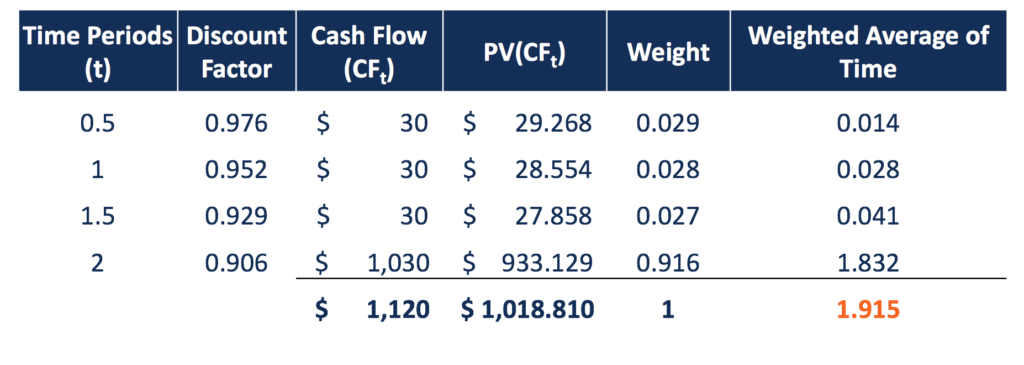
For example, a 2-year bond with a $1,000 par pays a 6% coupon semi-annually, and the annual interest rate is 5%. Thus, the bond’s market price is $1,018.81, summing the present values of all cash flows. The time to receive each cash flow is then weighted by the present value of that cash flow to the market price.
The Macaulay duration is the sum of these weighted-average time periods, which is 1.915 years. An investor must hold the bond for 1.915 years for the present value of cash flows received to exactly offset the price paid.
Factors that Affect Macaulay Duration
The Macaulay duration of a bond can be impacted by the bond’s coupon rateCoupon RateA coupon rate is the amount of annual interest income paid to a bondholder, based on the face value of the bond., term to maturity, and yield to maturityYield to Maturity (YTM)Yield to Maturity (YTM) – otherwise referred to as redemption or book yield – is the speculative rate of return or interest rate of a fixed-rate security.. With all the other factors constant, a bond with a longer term to maturity assumes a greater Macaulay duration, as it takes a longer period to receive the principal payment at the maturity. It also means that Macaulay duration decreases as time passes (term to maturity shrinks).
Macaulay duration takes on an inverse relationship with the coupon rate. The greater the coupon payments, the lower the duration is, with larger cash amounts paid in the early periods. A zero-coupon bond assumes the highest Macaulay duration compared with coupon bonds, assuming other features are the same. It is equal to the maturity for a zero-coupon bondZero-Coupon BondA zero-coupon bond is a bond that pays no interest and trades at a discount to its face value. It is also called a pure discount bond or deep discount bond. and is less than the maturity for coupon bonds.
Macaulay duration also demonstrates an inverse relationship with yield to maturity. A bond with a higher yield to maturity shows a lower Macaulay duration.
Macaulay Duration vs. Modified Duration
Modified duration is another frequently used type of duration for bonds. Different from Macaulay duration, which measures the average time to receive the present value of cash flows equivalent to the current bond price, Modified duration identifies the sensitivity of the bond price to the change in interest rate. It is thus measured in percentage change in price.
Modified duration can be calculated by dividing the Macaulay duration of the bond by 1 plus the periodic interest rate, which means a bond’s Modified duration is generally lower than its Macaulay duration. If a bond is continuously compounded, the Modified duration of the bond equals the Macaulay duration.
In the example above, the bond shows a Macaulay duration of 1.915, and the semi-annual interest is 2.5%. Therefore, the Modified duration of the bond is 1.868 (1.915 / 1.025). It means for each percentage increase (decrease) in the interest rate, the price of the bond will fall (raise) by 1.868%.
Another difference between Macaulay duration and Modified duration is that the former can only be applied to the fixed income instruments that will generate fixed cash flows. For bonds with non-fixed cash flows or timing of cash flows, such as bonds with a call or put option, the time period itself and also the weight of it are uncertain.
Therefore, looking for Macaulay duration, in this case, does not make sense. However, Modified duration can still be calculated since it only takes into account the effect of changing yield, regardless of the structure of cash flows, whether they are fixed or not.
Macaulay Duration and Bond Immunization
In asset-liability portfolio management, duration-matching is a method of interest rate immunization. A change in the interest rate affects the present value of cash flows, and thus affects the value of a fixed-income portfolio. By matching the durations between the assets and liabilities in a company’s portfolio, the change in interest rate will move the value of assets and the value of liabilities by exactly the same amount, but in opposite directions.
Therefore, the total value of this portfolio remains unchanged. The limitation of duration-matching is that the method only immunizes the portfolio from small changes in interest rate. It is less effective for large interest rate changes.
Related Readings
To keep learning and developing your knowledge of financial analysis, we highly recommend the additional resources below:
- Discount RateDiscount RateIn corporate finance, a discount rate is the rate of return used to discount future cash flows back to their present value. This rate is often a company’s Weighted Average Cost of Capital (WACC), required rate of return, or the hurdle rate that investors expect to earn relative to the risk of the investment.
- Effective DurationEffective DurationEffective duration is the sensitivity of a bond's price against the benchmark yield curve. One way to assess the risk of a bond is to estimate the
- Yield CurveYield CurveThe Yield Curve is a graphical representation of the interest rates on debt for a range of maturities. It shows the yield an investor is expecting to earn if he lends his money for a given period of time. The graph displays a bond's yield on the vertical axis and the time to maturity across the horizontal axis.
- Modified DurationModified DurationModified duration, a formula commonly used in bond valuations, expresses the change in the value of a security due to a change in interest rates. In other
-

Asset Swap Explained: Definition, OTC Trading & Key Concepts
An asset swap is a derivative contract between two parties that swap fixed and floating assets. The transactions are done over-the-counterOver-the-Counter (OTC)Over-the-counter (OTC) is the trading of
-

Understanding Bond Pricing: Key Factors & Valuation
Bond pricing is an empirical matter in the field of financial instrumentsPublic SecuritiesPublic securities, or marketable securities, are investments that are openly or easily traded in a market. The
invest
- Understanding Bond Duration: A Key Fixed Income Metric
- Coupon Bonds: Understanding Fixed Income & Interest Payments
- Discount Bonds: Understanding Pricing & Secondary Markets
- Understanding Dollar Duration: A Guide for Bond Investors
- Understanding Duration Drift in Asset-Liability Management
- Effective Duration Explained: Bond Price Sensitivity
- Understanding Key Rate Duration: A Guide for Bond Investors
- Understanding Modified Duration: A Key Bond Valuation Metric
- Understanding Noncallable Securities: A Comprehensive Guide
-
 Amortized Bonds: Understanding Principal Repayment
An amortized bond is a bond with the principal amount – otherwise known as face value –regularly paid down over the life of the bond. The bond’s principal is divided up according to ...
-
 ASCOT Options: Understanding Asset-Swapped Convertible Options
The term ASCOT is short for Asset Swapped Convertible Option Transaction. It is an American style call option to buy back a convertible bond. It falls under the category of financial products called s...