
Understanding Options & Futures Expiration Dates
The expiration date, in derivatives trading, refers to the date in which options or futures contractsFutures ContractA futures contract is an agreement to buy or sell an underlying asset at a later date for a predetermined price. It’s also known as a derivative because future contracts derive their value from an underlying asset. Investors may purchase the right to buy or sell the underlying asset at a later date for a predetermined price. expire. In other words, the expiration date is the last day that a derivative contract is valid. On the date of expiration, the derivative contract is settled between the buyer and seller.

What are Derivatives?
A derivative is a contract between two parties and whose value is derived from the performance of an underlying asset (e.g., stocks, commodities, bonds, indexes, currency, etc.). Derivatives are commonly used for hedging (reducing risk) or speculation. The three main types of derivatives are (1) forwards and futuresFutures and ForwardsFuture and forward contracts (more commonly referred to as futures and forwards) are contracts that are used by businesses and investors to hedge against risks or speculate., (2) options, and (3) swaps. An example of a derivative follows:
ABC Company operates a farm and is a large consumer of soybean (which is subject to volatile price movements). The company enters into an option contract with a farmer to purchase 100 bushels of soybeans at a strike priceStrike PriceThe strike price is the price at which the holder of the option can exercise the option to buy or sell an underlying security, depending on of $900 on the expiration date of January 19, 2025. If the price of 100 bushels of soybeans exceed $900, ABC Company can exercise the option to purchase 100 bushels of soybeans at the strike price of $900.
Expiration Dates for Options Contracts
The expiration date varies depending on the type of derivative being traded. In the United States, the date of expiration for listed stock options is the third Friday of the contract month. For example:
- Stock options expiring January 2020 have an expiration date on Friday, January 17;
- Stock options expiring February 2020 have an expiration date on Friday, February 21; and
- Stock options expiring March 2020 have an expiration date on Friday, March 20.
Expiration Date and Option Value
Regardless of whether you are buying a put or call optionOptions: Calls and PutsAn option is a derivative contract that gives the holder the right, but not the obligation, to buy or sell an asset by a certain date at a specified price., options with a longer expiration date have a higher time value. The longer the expiration date, the more time an option has to reach its strike price and the higher the time value of the option. Consider two options:
- A May 2020 Call Option (“Call Option 1”) on ABC Stock with a Strike Price of $10
- A September 2020 Call Option (“Call Option 2”) on ABC Stock with a Strike Price of $10
Currently, shares of ABC Company trades at a price of $7. The expiration dates of Call Option 1 and Call Option 2 are shown below:
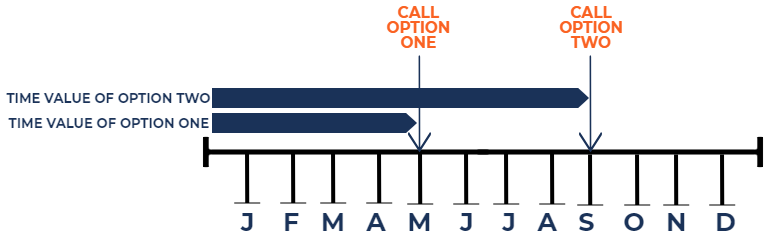
Since Call Option 2 has a later expiration date, the time value of Call Option 2 is greater. Therefore, Call Option 2 would be valued at a higher option price than Call Option 1.
Options and Futures Nearing the Expiration Date
For American options, the owner can choose to exercise the option on any date up to the expiration date. If the owner of the option does not exercise the option (i.e., if the option is out-of-the-money) on the date of its expiration, the option expires worthless.
For European options, the owner can only exercise the option on the expiration date. If the owner of the option does not exercise the option (i.e., if the option is out-of-the-money) on the date of expiration, the option expires worthless.
For futures contracts, they must be closed on or before the date of their expiration. Alternatively, the contract owner can hold the contract and fulfill the contract by buying/selling the underlying asset of which the contract represents.
Additional Resources
To keep learning and developing your knowledge of financial analysis, we highly recommend the additional resources below:
- Guide to Commodity TradingGuide to Commodity Trading SecretsSuccessful commodity traders know the commodity trading secrets and distinguish between trading different types of financial markets. Trading commodities is different from trading stocks.
- LEAPSLEAPSLEAPS (Long-Term Equity Anticipation Security) are options for terms that are longer than those of the most common options on equities and indices.
- Option Pricing ModelsOption Pricing ModelsOption Pricing Models are mathematical models that use certain variables to calculate the theoretical value of an option. The theoretical value of an
- Trading MechanismsTrading MechanismsTrading mechanisms refer to the different methods by which assets are traded. The two main types of trading mechanisms are quote driven and order driven trading mechanisms
-

Bandwagon Effect: Understanding Social Influence & Conformity
The bandwagon effect is the tendency of people to take certain actions or arrive at a conclusion primarily because other people are doing so. The phenomenon is observed in various fields, such as econ
-
Understanding Call Dates: What You Need to Know
A call date refers to the date when a callable bondCallable BondA callable bond (redeemable bond) is a type of bond that provides the issuer of the bond with the right, but not the obligation, to rede
invest
- Understanding At-The-Money (ATM) Options: A Comprehensive Guide
- Barrier Options: Understanding and Trading Strategies
- Dow 30 Explained: Understanding the Dow Jones Industrial Average
- Understanding the Ex-Dividend Date: A Comprehensive Guide
- Understanding Gamma in Finance: A Comprehensive Guide
- Iron Condor Strategy: A Comprehensive Guide for Options Traders
- Rule of 72: Calculate Investment Doubling Time | [Your Brand Name]
- Understanding Strike Price: Options Trading Explained
- Understanding Option Expiration Dates: A Crucial Guide
-
 What is Value Date?
Value date refers to the date when a transaction takes place or when the value of assets or money becomes effective. it is also used to determine the present value of a product with a fluctuating pric...
-
 Understanding the Investment Accumulation Phase: Building Wealth Over Time
The accumulation phase refers to the time in the life cycle of an investment when an individual or an investor builds up the value of their annuity or investment. It is the second phase in the process...