
Forward Premium Explained: Understanding Currency Expectations
Forward premium occurs when the forward exchange rate is quoted higher than the spot exchange rate. The expectation of the market is that the domestic currency will be worth less in the future or will depreciate in value versus the foreign currency.

To determine the forward premium, the difference between the spot rate and the forward rateForward RateThe forward rate, in simple terms, is the calculated expectation of the yield on a bond that, theoretically, will occur in the immediate future, usually a few months (or even a few years) from the time of calculation. The consideration of the forward rate is almost exclusively used when talking about the purchase of Treasury bills must be estimated. This calculation assumes that the future spot rate and the current futures rate will be equivalent.
This assumption is supported by pragmatic studies around the expectation’s theory of exchange rates, the current spot futures rate is expected to be the future spot rate.
Summary
- A forward premium occurs when the forward exchange rate is quoted higher than the spot exchange rate.
- A forward contract will have a premium when the expectation in the market is for the domestic currency to depreciate in value in the future versus the foreign currency
- To find the forward premium for a currency pair, the forward exchange rate must be calculated.
Determining the Forward Premium
To find the forward premium for a currency pair, the forward rate must be calculated. It is found by using the predominant interest rates of both the local and foreign currencies and the current spot rate and is adjusted for time until expiration. The forward rate is found with the use of forward points.
Forward points are the basis points that are added to or deducted from the current spot rate to determine the future forward rate . Forward currency contracts tend to be quoted in forward points. Forward points are estimated predominant interest ratesInterest RateAn interest rate refers to the amount charged by a lender to a borrower for any form of debt given, generally expressed as a percentage of the principal. of the two currencies and with the consideration of the contract length.
The addition of forward points to a spot rate is known as a forward premium, and the subtraction of forward points to a spot rate is known as a forward discount.
A forward point is equivalent to 1/10,000 of a spot rate. For example, a forward contract is believed to include 170 forward points. It is written as 170/10,000 and is added to the spot price to estimate the forward rate.
The fraction 170/10,000 equates to 0.017 units. Hence, the forward rate will be computed by adding the 0.017 unit to the current spot rate. If the situation is reversed and the 170 forward points are to be subtracted from the spot rate, the future rate will be 0.017 units fewer than the spot rate.
Example
The Canadian dollarCanadian Dollar (CAD)The Canadian Dollar refers to Canada’s domestic currency and is abbreviated as CAD. A Canadian dollar consists of 100 cents and is also and the Namibian Dollar are currently quoted at CAD/NAD = 8.96, with annual interest rates of 4.00% and 7.00%, respectively.
The forward rate can be determined as follows:

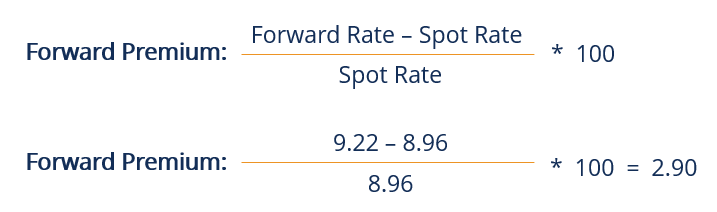
To find the forward premium, the forward exchange rate (as computed above) and the spot exchange rate are needed to satisfy the following equation:
Forward Points, Interest Rates, and Forward Rates
Generally, forward points tend to mirror or reflect interest rate disparities between currency pairs. The points can either be positive or negative, in conjunction with lower or higher interest rates.
The adjustment of a spot rate through the addition or subtraction of forward points is done to represent and account for the interest rate differentials between a currency pair. In essence, the currency with a higher yield will be discounted and the currency with a lower yield may have a premium.
The Forward Premium Puzzle
The forward premium puzzle/anomaly (also known as the FAMA puzzle) is a common term in currency trading. The anomaly is based on studies that found that a local or domestic currency may appreciate against a foreign currency if the domestic interest rate is higher than the foreign nominal interest rate.
It is viewed as perplexing, based on the hypothesis that the projected future fluctuations in the exchange rate between nations is equivalent to the interest-rate differences between the respective countries.
The theory assumes that in a case where all currencies are comparably risky, investors will seek higher interest rates on currencies projected to decline in value.
More Resources
CFI is the official provider of the Commercial Banking & Credit Analyst (CBCA)™Program Page - CBCAGet CFI's CBCA™ certification and become a Commercial Banking & Credit Analyst. Enroll and advance your career with our certification programs and courses. certification program, designed to transform anyone into a world-class financial analyst.
In order to help you become a world-class financial analyst and advance your career to your fullest potential, these additional resources will be very helpful:
- Forward ContractForward ContractA forward contract, often shortened to just "forward", is an agreement to buy or sell an asset at a specific price on a specified date in the future
- Exchange RateExchange RateAn exchange rate is the rate at which one currency can be exchanged for another between nations or economic zones. It is used to determine the
- Spot PriceSpot PriceThe spot price is the current market price of a security, currency, or commodity available to be bought/sold for immediate settlement. In other words, it is the price at which the sellers and buyers value an asset right now.
- Currency ForwardCurrency ForwardA currency forward is a customized, written contract between parties that sets a fixed foreign currency exchange rate for a transaction
-

Understanding Amortizable Bond Premiums: A Comprehensive Guide
An amortizable bond premium refers to the excess amount paid for a bond over its face value or par valuePar ValuePar Value is the nominal or face value of a bond, or stock, or coupon as indicated on a
-

Annualized Rate of Return: Definition & Calculation
Annualized rate of return is a way of calculating investment returns on an annual basis. As we invest, we often want to know how much we are earning from our investments. When we calculate our investm
invest
- Understanding the Maturity Risk Premium in Fixed-Income Investments
- Forward Rates: Definition & Calculation - Investopedia
- Understanding Forward Rates: A Comprehensive Guide
- Call Premium Explained: Understanding Issuer Redemptions & Option Pricing
- Understanding Dividend Yield: A Comprehensive Guide
- Ex-Ante: Understanding Predictions in Finance
- Understanding Forward Points: A Guide for Investors
- Understanding Forward Prices: Definition & How They Work
- Non-Deliverable Forward (NDF): Definition & How It Works
-
 Understanding Option Premiums: A Comprehensive Guide
The option premium is the amount of money that an investor pays in order to secure a contract. When an individual investor purchases an option, it gives them the right to buy or sell a specific ...
-
LIBOR Explained: Understanding the London Interbank Offered Rate
LIBOR is an acronym for London Interbank Offered Rate, and is the most important benchmark for the short-term interest rate that the world’s largest banks charge one another to loan money internationa...