
Understanding Amortizable Bond Premiums: A Comprehensive Guide
An amortizable bond premium refers to the excess amount paid for a bond over its face value or par valuePar ValuePar Value is the nominal or face value of a bond, or stock, or coupon as indicated on a bond or stock certificate. It is a static value. Over time, the amount of premium is amortized until the bond reaches its maturity.

What are Bonds?
A bond is a type of fixed-income investment that represents a loan made from a lender (investor) to a borrower. It is an agreement to borrow money from the investor and pay the investor back at a later date.
An investor will agree to lend their money because a bond specifies compensation in the form of interest. The interest terms on a bond will vary, but essentially the lender will demand interest to compensate for the opportunity costOpportunity CostOpportunity cost is one of the key concepts in the study of economics and is prevalent throughout various decision-making processes. The of providing the funding and the credit riskCredit RiskCredit risk is the risk of loss that may occur from the failure of any party to abide by the terms and conditions of any financial contract, principally, of the borrower.
Bond Pricing
Generally, a bond will come with a face value of $1,000 or some other round number. It is the amount that is promised to be repaid by the borrower. However, the actual price paid to purchase the bond usually is not $1,000. Based on market conditions, the price could be less than or greater than $1,000.
Bond prices are represented as a percentage of the face value. So, a bond trading at 100 would be priced at $1,000. A bond trading for less than 100 would be priced for less than $1,000; it is considered a discount. A bond trading for more than 100 would be priced for more than $1,000; it is considered a premium.
Bonds come with an associated coupon rate, which indicates the amount of cash paid in the form of interest payments to investors. The coupon rate is an important factor in pricing the bond.
Bond prices are inversely related to market interest rates. If market interest rates increase, bond prices fall. If market interest rates decrease, then bond prices increase. It is because stated coupon rates are fixed and do not fluctuate.
When market interest rates rise, for any given bond, the fixed coupon rate is lower relative to other bonds in the market. It makes the bond more unattractive, and it is why the bond is priced at a discount.
When market interest rates decrease, for any given bond, the fixed coupon rate is higher relative to other bonds in the market. It makes the bond more attractive, and it is why the bond is priced at a premium.
Bond Premiums
As mentioned earlier, if market interest rates fall, any given bond with a fixed coupon rate will appear more attractive, and it will result in the bond trading at a premium. So, if a bond comes with a face value of $1,000, and is trading at $1,080, it offers an $80 premium.

As the bond reaches maturity, the premium will be amortized over time, eventually reaching $0 on the exact date of maturity.
Amortizing the Bond
A method of amortizing a bond premium is with the constant yield method. The constant yield method amortizes the bond premium by multiplying the purchase price by the yield to maturity at issuance and then subtracting the coupon interest.
In order to calculate the premium amortization, you must determine the yield to maturity (YTM) of a bond. The yield to maturity is the discount rate that equates the present value of all coupons and principal payments to be made on the bond to its initial purchase price.
Example
For example, consider that an investor purchases a bond for $1,050. The bond comes with five years until maturity and a par value of $1,000. It offers a 5% coupon rate that is paid semi-annually and with a yield to maturity of 3.89%
Since the coupon rate is paid semi-annually, it means that every six months, a coupon of $25 ($1,000 x 5/2) will be paid. Also, the yield to maturity is stated in annual terms, so semi-annually the yield to maturity is 1.945% (3.89% / 2).
Plugging into the constant yield method formula, we get:
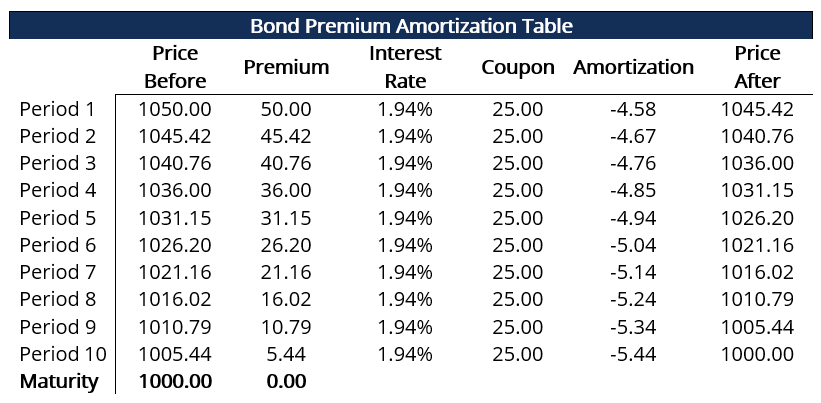
($1,050 x 1.945%) – $25 = –$4.58
The bond amortizes by $9.25 in the first period of six months. The bond’s value is now at $1,045.52 ($1,050 – $4.58).
If you continue it for the remaining nine periods, the bond will eventually be valued at $1,000 exactly. It is shown in the amortization table below:
More Resources
CFI offers the Commercial Banking & Credit Analyst (CBCA)™Program Page - CBCAGet CFI's CBCA™ certification and become a Commercial Banking & Credit Analyst. Enroll and advance your career with our certification programs and courses. certification program for those looking to take their careers to the next level. To keep learning and developing your knowledge base, please explore the additional relevant resources below:
- Bond PricingBond PricingBond pricing is the science of calculating a bond's issue price based on the coupon, par value, yield and term to maturity. Bond pricing allows investors
- Debtor vs. CreditorDebtor vs. CreditorThe key difference between a debtor vs. creditor is that both concepts denote two counterparties in a lending arrangement. The distinction also results in a
- Discount RateDiscount RateIn corporate finance, a discount rate is the rate of return used to discount future cash flows back to their present value. This rate is often a company’s Weighted Average Cost of Capital (WACC), required rate of return, or the hurdle rate that investors expect to earn relative to the risk of the investment.
- Fixed Income GlossaryFixed Income GlossaryThis fixed income glossary covers the most important bond terms and definitions required for financial analysts. These terms are covered in detail in CFI's Fixed Income Fundamentals Course.. Constant Perpetuity, Correlation, Coupon Rate, Covariance, Credit Spread
-
Bullet Bond Portfolios: A Comprehensive Guide
A bullet bond portfolio, commonly referred to as a bullet portfolio, is made up of a range of bullet bonds, from short-term to long-term bullet bonds. A bullet bond is a non-callable bondNon-Callable
-
Understanding Call Dates: What You Need to Know
A call date refers to the date when a callable bondCallable BondA callable bond (redeemable bond) is a type of bond that provides the issuer of the bond with the right, but not the obligation, to rede
invest
- Call Premium Explained: Understanding Issuer Redemptions & Option Pricing
- Coupon Bonds: Understanding Fixed Income & Interest Payments
- Discount Bonds: Understanding Pricing & Secondary Markets
- Understanding Noncallable Securities: A Comprehensive Guide
- Samurai Bonds: A Guide to Understanding Yen-Denominated Corporate Debt
- Treasury Bonds: A Comprehensive Guide to U.S. Government Debt
- Zero-Coupon Bonds: Definition, How They Work & Examples
- Understanding Conversion Premium: A Guide for Investors
- Understanding Bonds: A Comprehensive Guide for Investors
-
 Understanding Bond Pricing: Key Factors & Valuation
Bond pricing is an empirical matter in the field of financial instrumentsPublic SecuritiesPublic securities, or marketable securities, are investments that are openly or easily traded in a market. The...
-
 Understanding Bonds: A Comprehensive Guide for Investors
Bonds are fixed-income securitiesTrading & InvestingCFIs trading & investing guides are designed as self-study resources to learn to trade at your own pace. Browse hundreds of articles on trad...