
Hindenburg Omen: Predicting Stock Market Crashes - A Comprehensive Guide
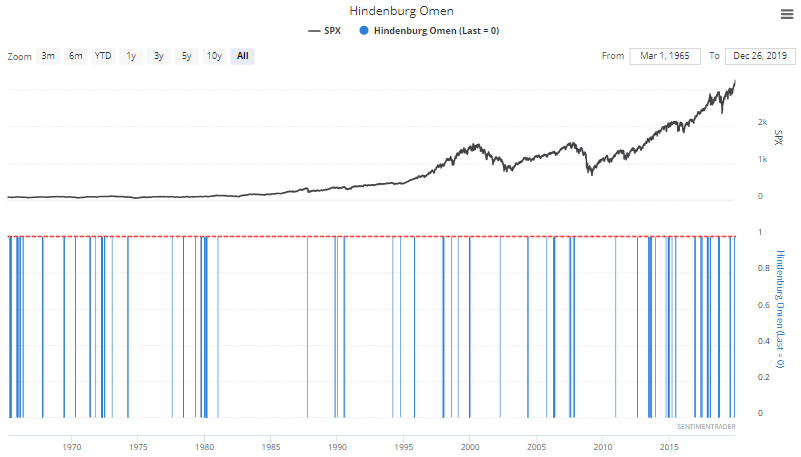
Hindenburg Omen, derived from Germany’s Hindenburg airship crash on May 6, 1937, is a technical indicator that foreshadows an increased probability of a looming stock market crashStock Market CrashA stock market crash refers to a drastic, often unforeseen, drop in the prices of stocks in the stock market. The sudden drop in stock prices.
The term was coined by James R. Miekka, and it derives its essence from the tragic crash of the airship that once stood as a pillar of hope for aviation, air travel, and the future of humanity. With 36 people killed in the accident, the Hindenburg crash brought upon a wave of sadness and catastrophe, thus resembling the relative nature of the world when a stock market crashes.
Understanding the Hindenburg Omen
Capital markets are fraught with a selection of technical indicators, categorized into the following four buckets:
- Volume indicators
- Volatility indicators
- Momentum indicatorsMomentum IndicatorsMomentum indicators are tools utilized by traders to get a better understanding of the speed or rate at which the price of a security changes. Momentum
- Trend indicators
The Hindenburg omen – using a combination of the above – is one such bearish indicator that is based on the assumption that stock market declines are preceded by breadth divergences.
A healthy bullish stock market rally is said to abide by the principles of unity – most stocks within a said index are performing well and contributing to the booming stock market. However, breadth divergences occur when the advancing stock market is due to a few big players overshadowing the bearish Bullish and BearishProfessionals in corporate finance regularly refer to markets as being bullish and bearish based on positive or negative price movements. A bear market is typically considered to exist when there has been a price decline of 20% or more from the peak, and a bull market is considered to be a 20% recovery from a market bottom.nature of the rest of the stocks in the index.
The concept is reflected quantitatively through the 52-week highs and lows in an index. When there are many highs and lows in a market, it signals a certain market sentiment, i.e., the market seems to be at a turning point in its rally.
Conditions of the Hindenburg Omen
- Volume: If the number of issues in a specific exchange hits 52-week highs and lows and exceed 2.8% of the total number of issues in the exchange, it acts as what one would call entering the ‘early phase’ of the Hindenburg Omen
- Benchmark index: The benchmark index (an index created to represent the total market including several securities) for the exchange must be greater than its value 50 trading days ago
- McClellan Oscillator: The McClellan Oscillator is a market breadth technical indicator used to evaluate the number of advancing and declining stocks in an exchange. Once the first two conditions are met, the signal is ‘active’ when MCO is negative and vice versa.
Other characteristics that define the Hindenburg Omen:
- The stock market must be rallying, typically measured by the 10-day moving average.
- 52-week highs must not be twice as much as 52-week lows.
Reactions to the Hindenburg Omen
Traders react varyingly to the Hindenburg Omen, but two typical actions following an “active signal” are:
- Shorting Short SellingShort selling is the practice of selling borrowed securities – such as stocks – hoping to be able to make a profit by buying them back at athe market when MCO is negative
- Refraining from buying stocks / exiting the market when the signal is active due to a negative MCO
Criticisms of the Hindenburg Omen
Despite its accolades and a fool-proof logic, the Hindenburg Omen is said to come with certain caveats. Claimed by some to offer a 25% accuracy, the validity of the Hindenburg Omen remains debatable. Some unfortunate consequences of the indicator are:
- False signals: It is very possible that the stock market remains bullish despite signaling an active Hindenburg Omen, although it’s been mostly accurate for the past 35 years. The consequences of several traders interpreting the omen and preparing for a crash when there isn’t going to be one can be severe and affect several people’s financial livelihoods.
- Skewed data: It is also argued that several non-cap stocks and non-stock exchange-traded funds often skew the data by misinforming the market about its true breadth and volume.
- Outside Effect: Several ETFs within an exchange track foreign stocks and are also found in the NYSE or NASDAQ. If the nature of international stocks is bearish, it may wrongfully misinform investors about the U.S. market despite U.S. stocks being in good condition.
All in all, the Hindenburg Omen is an important technical indicator that’s proven its worth over the years. However, there is always a certain amount of caution that must go into interpreting signals in a stock market, so the Hindenburg Omen is not the only one a trader must rely on.
More Resources
CFI is the official provider of the Capital Markets & Securities Analyst (CMSA)®Program Page - CMSAEnroll in CFI's CMSA® program and become a certified Capital Markets &Securities Analyst. Advance your career with our certification programs and courses. certification program, designed to transform anyone into a world-class financial analyst.
In order to help you become a world-class financial analyst and advance your career to your fullest potential, these additional resources will be very helpful:
- 2010 Flash Crash2010 Flash CrashThe 2010 Flash Crash is the market crash that occurred on May 6, 2010. During the 2010 crash, leading US stock indices, including the Dow
- High-Low IndexHigh-Low IndexA high-low index is an index that tracks the new 52-week highs and new 52-week lows between stocks in a prevailing index.
- McClellan OscillatorMcClellan Oscillator - Technical AnalysisThe McClellan Oscillator is a type of momentum oscillator. The McClellan Oscillator is calculated using exponential moving averages, and is designed to indicate the strength or weakness of price movement, rather than its direction.
- Technical IndicatorTechnical IndicatorA technical indicator is a mathematical pattern derived from historical data used by technical traders or investors to predict future price
-

National Market System (NMS): Understanding US Securities Trading
The National Market System (NMS) is a regulatory mechanism that governs the operations of securities trading in the United States. It covers all entities and facilities, both public and private, that
-

NIFTY 50 Index: Understanding India's Top 50 Stocks | NSE
NIFTY 50 is the most important index of the National Stock Exchange of India Limited (NSE)National Stock Exchange of India Limited (NSE)The National Stock Exchange of India Limited (NSE) is the larges
invest
- Understanding the Call Market: Trading Hours & Price Determination
- Understanding Market Support: What is 'Holding the Market'?
- Understanding the Money Market: Short-Term Debt & Lending
- NASDAQ Explained: A Comprehensive Guide to the Stock Market Exchange
- Nasdaq Capital Market: A Guide to Small-Cap Investing
- NASDAQ Composite: Understanding the US Stock Market Index
- Understanding the Primary Market: A Comprehensive Guide
- Understanding the S&P 500: A Comprehensive Guide
- Understanding the Stock Market: A Beginner's Guide
-
 Understanding Derivatives: A Comprehensive Overview
The derivatives market refers to the financial market for financial instruments such as futures contracts or options that are based on the values of their underlying assets. SummaryThe deri...
-
 Nasdaq Global Select Market: Definition & Key Information
The Global Select Market includes companies with the largest market capitalization within the Nasdaq Composite Index and comprises 1,200 stocks. It is one of the three tiers within the Nasdaq Composit...