
Understanding Homemade Leverage: A Guide for Investors
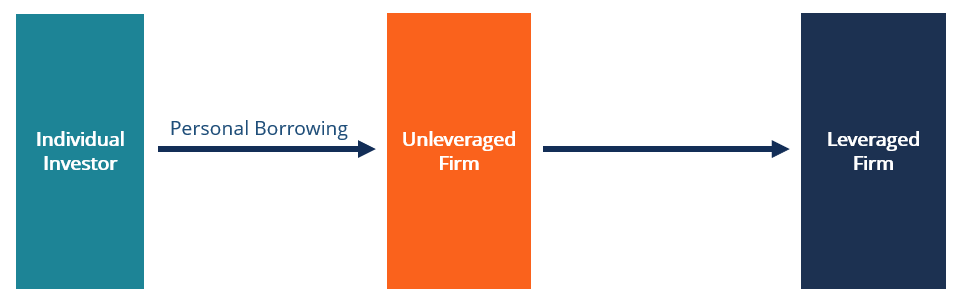
Homemade leverage is a financial concept that holds that as long as investors borrow on the same terms as the company, they can artificially duplicate the effects of corporate leverage.

Investors use the idea to recreate a leverage scenario using a portion of their investments. The argument works under the assumption that corporate taxes and bankruptcyBankruptcyBankruptcy is the legal status of a human or a non-human entity (a firm or a government agency) that is unable to repay its outstanding debts costs are absent, which would otherwise disrupt an investor’s ability to produce the leverage scenario accurately.
The idea is that there is an optimal and unique market portfolio for every investor who plays a crucial role in homemade leverage.
Summary
- Homemade leverage is a concept which states that if investors integrate cash flows from the investment in the risk-free assets and investment in a firm with no leverage, they can create their own leverage effect.
- Homemade leverage renders a company’s capital structure and financial decision irrelevant to investors’ investment decisions.
- The founding philosophy of homemade leverage is the Modigliani-Miller theory, which assumes an efficient market and the absence of corporate taxes and bankruptcy costs.
Understanding Homemade Leverage
Homemade leverage only focuses on the returns of the aggregate portfolio but increases the investment riskiness. All else equal, firms that practice homemade leverage can generate higher returns for shareholders than non-leveraged companies.
Leveraged firms tend to take on riskier investments than firms with no leverage. In theory, investors can earn a rate of return per dollar invested closer to that of a leveraged firm if they borrow at the same rate as the firm and invest in a non-leveraged company. The objective of an investor is to replicate the return compounding effects of corporate leverage while investing in lower-risk, non-leveraged firms.
Modigliani-Miller (M-M) Theorem
The underlying philosophy of homemade leverage is found in the Modigliani-Miller (M-M) TheoremM&M TheoremThe M&M Theorem, or the Modigliani-Miller Theorem, is one of the most important theorems in corporate finance. The theorem was developed by economists Franco Modigliani and Merton Miller in 1958. The main idea of the M&M theory is that the capital structure of a company does not affect its overall value.. The theory implies that investors dismiss capital structure for the benefit of their own homemade leverage. It means that a company’s stock price is not affected by the capital structure.
The M-M theory posits that a firm’s financing decisions are irrelevant to investors. Such an analogy states that investors’ portfolios reflect leverage on the assumption of an efficient market and the absence of corporate taxes and bankruptcy costs.
Investors integrate the cash flows from various investments and focus only on the returns on their aggregate portfolio. So, managers are not concerned with the degree of leverage in their fund since investors can use homemade leverage to increase or undo borrowing set by the management.
Most investors cannot apply homemade leverage effectively, leaving the task of determining the capital structure (to increase value) to the firm.
Homemade Leverage in Pension Plans
While investors can borrow at a firm’s rate and replicate the leverage effects on their own, mutual fundsMutual FundsA mutual fund is a pool of money collected from many investors for the purpose of investing in stocks, bonds, or other securities. Mutual funds are owned by a group of investors and managed by professionals. Learn about the various types of fund, how they work, and benefits and tradeoffs of investing in them are also important, as they help investors achieve efficient portfolios. Thus, managers should consider the degree of a company’s leverage, as it affects its dividend policy.
Offering a wide range of mixed funds guarantees an optimal portfolio. The concept is used by pension designers, where plan participants are subjected to multiple funds to facilitate efficient decisions. The pension plan’s value also depends on the market structure.
Pension plans are usually restructured to avoid the inefficient allocation of resources as much as possible. Most investors diversify between the offered classes of funds and may not select the bond-equity preferences that match their actual preferences.
Pros and Cons of Homemade Leverage
Pros
Homemade leverage is a powerful tool to enable access to capital. Investors can use homemade leverage to integrate cash flows from risk-free assets and risky assets without depending on the fund managers’ decision. It allows them to borrow and lend at a certain risk-free interest rate to create a leveraged company’s exact return.
However, challenges abound when replicating the exact leverage scenario because of taxes, which makes the cost of individual and corporate leverage differ. Investors can also adjust their portfolio appropriately to maintain the designed leverage.
Cons
Investors can use homemade leverage to undo the unfavorable capital structure of a company. For example, an investor may decide to reverse the effects of leverage on a company in which he invests if it decides to raise capital through debt.
Homemade leverage is an idea for acquisition. It is best suited for investors’ portfolios with specific growth objectives because of the risks and costs associated with accumulating debts.
Homemade loans are costly. High-yield bonds and leveraged loans come with higher interest rates, which compensate investors for making high-risk investments.
Special Considerations
A firm’s market price, which reflects the market condition, can provide sufficient feedback to investors and determine the frequency with which they can invest in risky investment companies and those with non-risky investments.
Since the capital structure can impact its value, a capital structure that produces return distribution can be attractive to investors to make homemade leverage. The firm assumes the ultimate role in determining the capital structure because most investors are incapable of effectively applying home leverage.
More Resources
CFI is the official provider of the global Commercial Banking & Credit Analyst (CBCA)™Program Page - CBCAGet CFI's CBCA™ certification and become a Commercial Banking & Credit Analyst. Enroll and advance your career with our certification programs and courses. certification program, designed to help anyone become a world-class financial analyst. To keep advancing your career, the additional CFI resources below will be useful:
- Leverage RatiosLeverage RatiosA leverage ratio indicates the level of debt incurred by a business entity against several other accounts in its balance sheet, income statement, or cash flow statement. Excel template
- Investment PortfolioInvestment PortfolioAn investment portfolio is a set of financial assets owned by an investor that may include bonds, stocks, currencies, cash and cash equivalents, and commodities. Further, it refers to a group of investments that an investor uses in order to earn a profit while making sure that capital or assets are preserved.
- Pension FundPension FundA pension fund is a fund that accumulates capital to be paid out as a pension for employees when they retire at the end of their careers.
- Capital StructureCapital StructureCapital structure refers to the amount of debt and/or equity employed by a firm to fund its operations and finance its assets. A firm's capital structure
-

High-Yield Investment Programs (HYIPs): Risks & Scams
A high-yield investment program (HYIP) is an unregistered investment vehicle that promises significantly higher returns with little or no risk. They are typically run by unlicensed individuals and are
-
PrimeXBT: Your Leading Bitcoin Margin Trading Platform | Crypto, Forex & More
Serving clients in more than 150 countries, PrimeXBT is a Bitcoin-based margin trading platform that offers instant access to over 30+ assets, including Crypto, Forex, Commodities, and Indices with re
invest
- Leverage in Finance: Strategies, Types & Risks
- Coattail Investing: How to Follow Successful Investors
- Understanding Cognitive Bias: How It Impacts Decisions
- Dark Pools Explained: A Guide for Investors
- HODL Explained: Understanding the Cryptocurrency Investment Strategy
- Understanding Homemade Leverage: A Guide for Investors
- Institutional Investors: Definition, Types & Key Players
- Non-Accredited Investors: Definition, Requirements & Investment Options
- Leverage in Investing: A Beginner's Guide to Amplifying Returns
-
 Safe Haven Investments: Protecting Your Portfolio During Economic Uncertainty
A safe haven is a term that refers to an investment that is anticipated to maintain or increase in value during times of economic downturn. Such investments are believed to be a safe option for invest...
-
 Understanding Stock Promoters: How They Influence Investment
Stock promoters are individuals or institutions that help companies to raise capitalCapital Raising ProcessThis article is intended to provide readers with a deeper understanding of how the capital ra...