
Safe Haven Investments: Protecting Your Portfolio During Economic Uncertainty
A safe haven is a term that refers to an investment that is anticipated to maintain or increase in value during times of economic downturn. Such investments are believed to be a safe option for investors, as they are not correlated to the economy – meaning that a financial crisis would not reduce the value of the investments. Therefore, safe-haven investments offer more protection and diversification in investors’ portfolios, which is advantageous if the market is volatile.
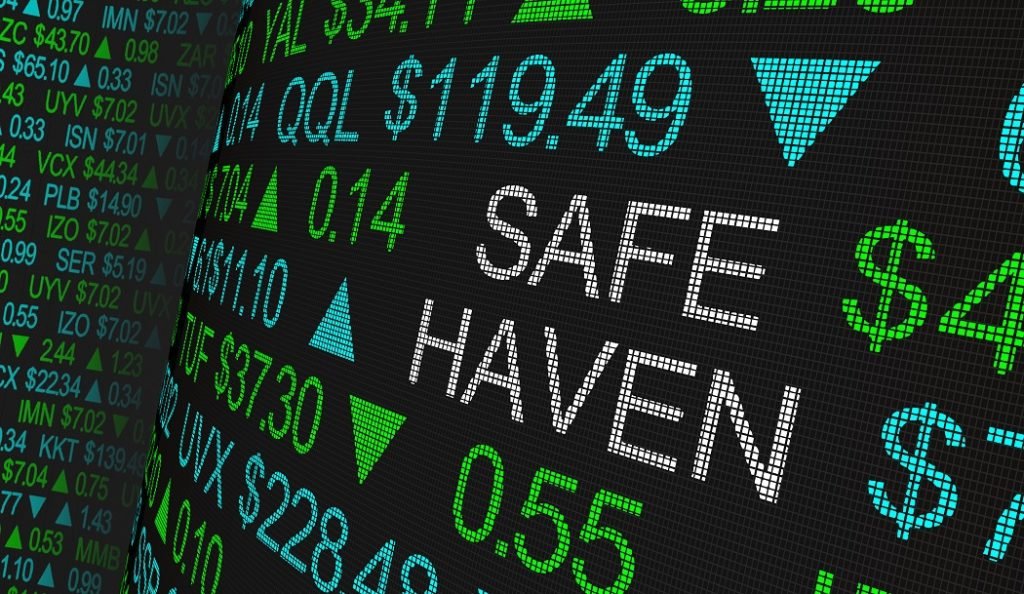
Trade wars, natural disasters, the Global Financial Crisis in 2008, and the COVID-19 pandemic are all events that prompted investors to buy safe-haven assets in order to mitigate their losses from a potential stock market crashStock Market CrashA stock market crash refers to a drastic, often unforeseen, drop in the prices of stocks in the stock market. The sudden drop in stock prices. Investors looked to purchase “safe” assets, such as gold, treasury bills, government bonds, and defensive stocks.
Characteristics of a Safe Haven Asset
- High liquidity: Investments need to be able to convert to cash easily.
- Limited supply: The asset’s supply must be less than its demand in order to maintain its value due to the scarcityScarcityScarcity, also known as paucity, is an economics term used to refer to a gap between availability of limited resources and the theoretical of the asset.
- Continuous demand: The asset should be able to maintain high demand in the long-term, which makes the asset hard to replace by another investment.
- Endured performance: The asset must continue to provide good use for the long term in order to keep up demand. For example, metals are a type of safe-haven asset that is continuously used for infrastructure.
- Permanence: The asset does not decline in quality. It does not rot or decay.
Examples of Safe Haven Investments
Gold
Gold is often regarded as one of the most popular choices to invest in during times of economic instability. Historically, the value of gold increased significantly during the 2008-2009 Global Financial Crisis2008-2009 Global Financial CrisisThe Global Financial Crisis of 2008-2009 refers to the massive financial crisis the world faced from 2008 to 2009. The financial crisis took its toll on individuals and institutions around the globe, with millions of American being deeply impacted. Financial institutions started to sink, many were absorbed by larger entities, and the US Government was forced to offer bailouts. It gave investors a return of approximately 20% between 2008 and 2009.
The high liquidity associated with gold makes it an easy investment for individuals to buy and sell. Unlike other assets, gold is also an important safe-haven investment because it is a physical commodity, so it will not be impacted by economic factors, such as currencies, interest rates, and inflation. Therefore, investors see gold as a safe investment because it can still retain its value even in the midst of inflation.
Government Bonds
A government bond is a fixed-income financial instrument. Bonds are issued by the government or corporations when they want to raise more capital. They are similar to a loan in the sense that an investor would lend their money to the government, and the amount would be paid back by the government at the maturity date.
A government bond is a safe-haven asset because it is considered to be risk-free and has low volatility. This is because investors will be paid back the principal, along with any outstanding interest at the date of maturity. Investors also prefer to invest in government bonds because the government is considered to have high creditworthiness, which also provides more security and confidence for investors.
Currencies
The U.S. dollar, Japanese yen, and the Swiss franc are noteworthy currencies that investors consider a safe investment. The currencies are attractive investments during an economic downturn because of their high liquidity, independence from other countries, the country’s stable political system, and also securing the support of a country with positive economic growth expectations.
There is also a tendency for foreign countries to store the currencies in their reserves, which indicates the security in holding such currencies and the high confidence in the creditworthiness of the currency’s country of origin.
Defensive Stocks
Defensive stocks refer to shares of companies that sell products that are considered to be necessities. They are part of sectors such as utilities, healthcare, consumer goods, and food and beverages.
They are safe-haven investments because there will always be a constant level of demand for these products regardless if there is economic turmoil. For example, people will still need access to gas, water, electricity, and healthcare, even when the economy is performing poorly.
More Resources
If you would like to gain valuable skills that can help develop your journey in corporate finance, CFI is the official provider of the Capital Markets & Securities Analyst (CMSA)™Program Page - CMSAEnroll in CFI's CMSA® program and become a certified Capital Markets &Securities Analyst. Advance your career with our certification programs and courses. certification program. CFI also offers a variety of courses and related readings for you to continue learning about topics related to investing:
- Bonds vs. StocksBonds vs StocksFor prospective investors and many others, it is important to distinguish between bonds vs. stocks. Two of the most common asset classes for investments are
- Defensive IndustriesDefensive IndustriesDefensive industries comprise businesses that are relatively stable or relatively immune to economic fluctuations, i.e., economic expansions and recessions
- InflationInflationInflation is an economic concept that refers to increases in the price level of goods over a set period of time. The rise in the price level signifies that the currency in a given economy loses purchasing power (i.e., less can be bought with the same amount of money).
- DiversificationDiversificationDiversification is a technique of allocating portfolio resources or capital to a variety of investments.The goal of diversification is to mitigate losses
-
Understanding Down Rounds: What They Are and Why They Happen
The term “down round” is used to refer to a scenario where the value of a business at a time of investment is below the value of the same business during a previous period or financing rou
-
Equity Financing: A Comprehensive Guide for Business Growth
Equity financing refers to the sale of company shares in order to raise capital. Investors who purchase the shares are also purchasing ownership rights to the company. Equity financing can refer to th
invest
- Understanding Economic Deficits: Causes & Effects
- Coattail Investing: How to Follow Successful Investors
- Understanding Cognitive Bias: How It Impacts Decisions
- Dark Pools Explained: A Guide for Investors
- HODL Explained: Understanding the Cryptocurrency Investment Strategy
- Understanding Homemade Leverage: A Guide for Investors
- Institutional Investors: Definition, Types & Key Players
- Non-Accredited Investors: Definition, Requirements & Investment Options
- Understanding Sophisticated Investors: Definition & Implications
-
 High-Yield Investment Programs (HYIPs): Risks & Scams
A high-yield investment program (HYIP) is an unregistered investment vehicle that promises significantly higher returns with little or no risk. They are typically run by unlicensed individuals and are...
-
Safe Harbor 401(k): Simplify Retirement Plans & Avoid Non-Discrimination Testing
A safe harbor 401(k) is a retirement plan that allows a company to avoid the regulations and expenses associated with nondiscrimination tests typically required of a 401(k) or other retirement accou...