
Understanding LIBOR: What It Is and How It Works
LIBOR, which is an acronym of London Interbank Offer Rate, refers to the interest rateInterest RateAn interest rate refers to the amount charged by a lender to a borrower for any form of debt given, generally expressed as a percentage of the principal. that UK banks charge other financial institutions for short-term loans. The loan maturities vary from one day to one year. LIBOR acts as a benchmarking base for short-term interest rates for prices of securities such as currency swapsUSD/CAD Currency CrossThe USD/CAD currency pair represents the quoted rate for exchanging US to CAD, or, how many Canadian dollars one receives per US dollar. For example, a USD/CAD rate of 1.25 means 1 US dollar is equivalent to 1.25 Canadian dollars. The USD/CAD exchange rate is affected by economic and political forces on both, interest rate swapsInterest Rate SwapAn interest rate swap is a derivative contract through which two counterparties agree to exchange one stream of future interest payments for another, or mortgages.
The London Interbank Offer Rate is an important measure in assessing the health of different financial systems. When the rate is weak, the UK economy is usually underperforming. When the rate is higher, it usually indicates the economy is doing well. It is commonly used by various central banksFederal Reserve (The Fed)The Federal Reserve is the central bank of the United States and is the financial authority behind the world’s largest free market economy. as a reference in crafting policies affecting interest rates in other countries.
ICE LIBOR: Is it similar to LIBOR?
In the earlier days, before the great scandal of 2008-2012, the London Interbank Offer Rate was known as BBA (British Bankers Association) LIBOR). During this period, the BBA became involved in a scandal when it was found to be guilty of interest rate manipulations. Therefore, to eliminate the bad memories and put a fresh face on things, BBA LIBOR was renamed ICE (Intercontinental Exchange) LIBOR. Thus, ICE LIBOR is the same as LIBOR.
How LIBOR Works
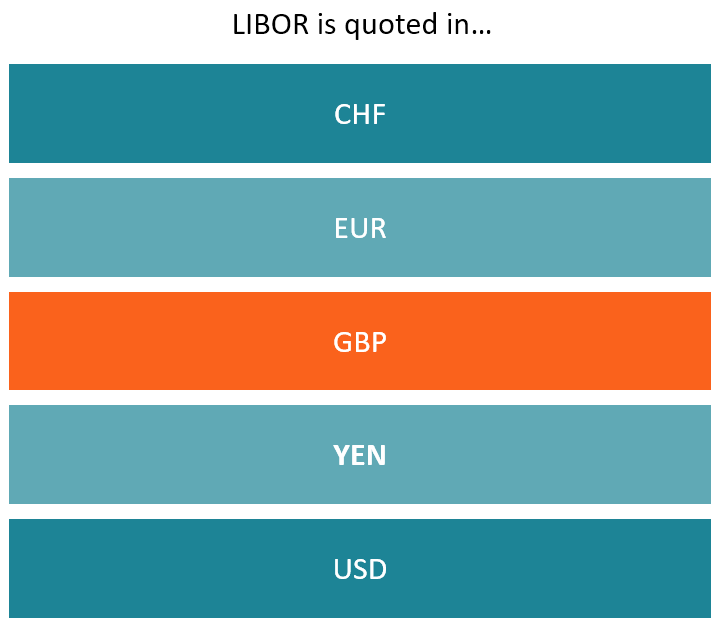
LIBOR rates are mere benchmarks instead of tradable rates. Therefore, throughout the day, banks may trade at different rates than the LIBOR rate listed early in the morning, usually at 11 AM (London Time). The maturity period of these rates may vary from a single day to a stretch of 12 months. Overall, LIBOR comprises seven maturities, quoted for deposits of each of five major currencies – CHF (Swiss Franc), EUR (Euro), GBP (Pound Sterling), JPY (Japanese Yen), and USD (US Dollar).
The Process of Setting LIBOR
To produce 35 rates on every business day, the ICE Benchmark committee maintains an administration panel of between 11 to 16 bank contributors.
- The process of setting interest rates begins by asking the panel the rate which they are willing to lend to other financial institutions. Usually, this occurs earlier in the day, well before the official hours of publishing the benchmarked rate.
- After they provide their desired rates, the contributions are listed in top-down order.
- Outlying quotes are eliminated by removing 25% of the higher and lower quoted rates. Once outliers are eliminated, the remaining rates are averaged and rounded to five decimal places. The process is repeated across the five currencies for each maturity to produce a total of 35 LIBORs.
IBOR as a Benchmarking Tool for Interest Rates
The LIBOR is watched closely by not only banks and financial institution but also by private institutions and individuals. Below are some of the key benefits of watching the LIBOR rates.
1. Lending rates stability
The London Interbank Offer Rate provides a stable pool of 35 rates calculated daily under a monitored environment. As a result, fluctuations in the rate are not tied to a single market but to the global market. Despite past controversies, it’s important to acknowledge the LIBOR’s intentions to bring stability in lending rates.
2. Low risks
As a general rule, during difficult economic times, many conservative investors will opt in LIBOR to create a safe-haven investment to reduce their investment risks.
Is LIBOR Reliable?
In early 2014, the ICE took the oversight function from the BBA and started working to restore the reputation of the LIBOR. One noticeable change was to change the way it calculates the interbank rate. Earlier along, BBA calculated its interest estimates from 200-odd member banks. Unfortunately, to favor some few individuals, the interest rates were manipulated under the watch of the then BBA chairman. Therefore, ICE now calculates its LIBOR from respected reference banks, which number less than 20.
The activities are under the watch of a robust governing committee of IBA that embodies honesty. The committee is comprised of benchmark submitters, independent non-executive directors, benchmark users, and other relevant experts, such as financial analysts. Therefore, LIBOR, under the watch of ICE, is considered safer than it used to be prior to 2014.
The Fate of LIBOR in the US Market
In July 2017, the FCA expressed its dissatisfaction by declaring that USD LIBOR is unsustainable and undesirable due to lack of active markets to base its benchmark on. As a result, the future of the USD LIBOR stands on shaky ground. In fact, the FCA and its panel will support its rate until 2021. Afterward, the Secured Overnight Financing Rate will replace it and the Alternative Reference Rates Committee will oversee it.
Related Readings
CFI offers the Financial Modeling & Valuation Analyst (FMVA)™Become a Certified Financial Modeling & Valuation Analyst (FMVA)®CFI's Financial Modeling and Valuation Analyst (FMVA)® certification will help you gain the confidence you need in your finance career. Enroll today! certification program for those looking to take their careers to the next level. To keep learning and advancing your career, the following resources will be helpful:
- Floating Interest RateFloating Interest RateA floating interest rate refers to a variable interest rate that changes over the duration of the debt obligation. It is the opposite of a fixed rate.
- Coupon RateCoupon RateA coupon rate is the amount of annual interest income paid to a bondholder, based on the face value of the bond.
- Trade-Weighted Exchange RateTrade-Weighted Exchange RateThe Trade-Weighted Exchange Rate is a complex measure of a country's currency exchange rate. It measures the strength of a currency weighted by the amount of trade with other countries.
- Trading MechanismsTrading MechanismsTrading mechanisms refer to the different methods by which assets are traded. The two main types of trading mechanisms are quote driven and order driven trading mechanisms
-
Short Rate Models: Understanding Interest Rate Dynamics
A short rate model is a mathematical model used in the evaluation of interest rate derivatives to illustrate the evolution of interest ratesInterest RateAn interest rate refers to the amount charged b
-

Interest Rate Caps: Understanding Protection for Adjustable-Rate Loans
An interest rate cap is a limit to the amount of interest that a lender can charge on an adjustable-rate loan. Adjustable-rate mortgages have an interest rate cap to provide a maximum payment am
invest
- Hurdle Rate: Definition, Calculation & Importance for Investors
- Understanding Interest Rates: A Comprehensive Guide
- Understanding Rate of Return: A Comprehensive Guide
- Annualized Rate of Return: Definition & Calculation
- Bermuda Swaptions: Definition, Function & Key Features
- Understanding Dividend Yield: A Comprehensive Guide
- Ex-Ante: Understanding Predictions in Finance
- Understanding Burn Rate: A Key Metric for Startup Success
- LIBOR Explained: Understanding the London Interbank Offered Rate
-
 Par Bonds Explained: Understanding Face Value and Market Interest Rates
A par bond refers to a bond that currently trades at its face value. The bond comes with a coupon rateCoupon RateA coupon rate is the amount of annual interest income paid to a bondholder, based on th...
-
 Put Swaption: Understanding Payer Swaptions and Rate Swaps
A put swaption, also referred to as a payer swaption, involves the buyer being given the opportunity to enter into a rate swap, acting as the floating-rate payer. The party selling the swaption is the...