
Understanding Market Efficiency: A Comprehensive Guide
Market efficiency is a relatively broad term and can refer to any metric that measures information dispersion in a market. An efficient market is one where all information is transmitted perfectly (everyone receives the information), completely (everyone receives the entire information), instantly (everyone receives the information at once), and for no cost (everyone receives the information for free).

The notion of market efficiency is closely tied to the Efficient Market HypothesisEfficient Markets HypothesisThe Efficient Markets Hypothesis is an investment theory primarily derived from concepts attributed to Eugene Fama's research work., which was developed by Eugene Fama, an American financial economist. Fama built on the work done by other financial economists such as Harry Markowitz, Fischer Black, Myron Scholes, Jack Treynor, William Sharpe, Merton Miller, Franco Modigliani, John Lintner, Jan Mossin, and Robert Merton.
Summary
- Market efficiency is a relatively broad term and can refer to any metric that measures information dispersion in a market. An efficient market is one where all information is transmitted perfectly, completely, instantly, and for no cost.
- Asset prices in an efficient market fully reflect all information available to market participants. As a result, it is impossible to ex-ante make money by trading assets in an efficient market.
- Market efficiency DOES NOT say that the price of an asset is its true price. It only says that it is impossible to consistently estimate whether the asset price will move up or down.
What is an Efficient Market?
An efficient market is characterized by a perfect, complete, costless, and instant transmission of information. Asset prices in an efficient market fully reflect all information available to market participants. As a result, it is impossible to ex-ante make money by trading assets in an efficient market.
The result provides an alternate definition of market efficiency, which is particularly popular among financial markets participants – An efficient market is any market where asset price movements can’t be consistently estimated, i.e., it is impossible for an investor to consistently make money in an efficient market by trading financial assetsFinancial AssetsFinancial assets refer to assets that arise from contractual agreements on future cash flows or from owning equity instruments of another entity. A key.
Implications of Market Efficiency – An Illustrative Example
Company ABC is a publicly-traded technology company listed on the New York Stock Exchange (NYSE)New York Stock Exchange (NYSE)The New York Stock Exchange (NYSE) is the largest securities exchange in the world, hosting 82% of the S&P 500, as well as 70 of the biggest. The company releases a new product that is more advanced than anything on the market. If all the markets that Company ABC operates in are efficient, then the release of the new product should not affect the company’s share price.
- Company ABC hires workers from an efficient labor market. All workers are, therefore, paid the exact amount that they contribute to the company.
- Company ABC rents capitalCapitalCapital is anything that increases one’s ability to generate value. It can be used to increase value across a wide range of categories, such as financial, social, physical, intellectual, etc. In business and economics, the two most common types of capital are financial and human. from an efficient capital market. Therefore, the rental paid to capital owners is exactly equal to the amount contributed by capital to the company.
- If the New York Stock Exchange is an efficient market, then Company ABC’s share price perfectly reflects all information about the company. Therefore, all participants on the NYSE could predict that Company ABC would release the new product. As a result, the company’s share price does not change.
Market Efficiency – What It Does Not Imply?
1. Asset prices never deviate from their true price
The above statement represents a fundamental misunderstanding of the notion of market efficiency. Market efficiency DOES NOT say that the price of an asset is its true price. It only says that it is impossible to consistently estimate whether the asset price will move up or down.
2. All market participants are perfectly rational
Perfectly rational market participants is not a necessary condition for an efficient market. If market participants demonstrate independent and uncorrelated deviations from rationality, then an efficient market can be achieved.
More Resources
CFI is the official provider of the global Financial Modeling & Valuation Analyst (FMVA)™Become a Certified Financial Modeling & Valuation Analyst (FMVA)®CFI's Financial Modeling and Valuation Analyst (FMVA)® certification will help you gain the confidence you need in your finance career. Enroll today! certification program, designed to help anyone become a world-class financial analyst. To keep advancing your career, the additional resources below will be useful:
- Asymmetric InformationAsymmetric InformationAsymmetric information is, just as the term suggests, unequal, disproportionate, or lopsided information. It is typically used in reference to some type of business deal or financial arrangement where one party possesses more, or more detailed, information than the other.
- Random Work TheoryRandom Walk TheoryThe Random Walk Theory is a mathematical model of the stock market. The theory posits that the price of securities moves randomly
- Segmented Markets TheorySegmented Markets TheoryThe segmented markets theory states that the market for bonds is “segmented” on the basis of the bonds’ term structure, and that they operate independently.
- Three Best Stock SimulatorsThree Best Stock SimulatorsThe best stock simulators allow the user to practice and refine their investment techniques. Stock trading simulators allow trading fake cash with real time data, enabling traders to test out various trading strategies prior to risking any real money on them.
-

Understanding Secular Markets: Long-Term Trends & Investment Strategies
A secular market is predominantly driven and impacted by elements or forces that are likely to be present in the foreseeable future. The forces can impact the price or value of a financial assetFinanc
-
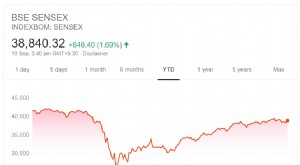
Sensex Explained: Understanding India's Key Stock Market Index
Sensex, also known as the S&P BSE Sensex Index, is the benchmark index that tracks India’s Bombay Stock Exchange (BSE). The Sensex is composed of the 30 largest and most-traded stocks within
invest
- Understanding Auction Markets: How Prices Are Determined
- Doji Candlestick Pattern: Meaning & Trading Signals
- Understanding Frothy Markets: Risks & Opportunities
- Understanding Inefficient Markets: Causes & Implications
- Understanding Market Cycles: Trends & Economic Environments
- Understanding Market Depth: A Guide for Traders
- Understanding Market Efficiency: A Comprehensive Guide
- Understanding Market Exposure: Risk & Portfolio Allocation
- Allocative Efficiency: Understanding Optimal Resource Allocation
-
 Understanding Quote-Driven Markets: A Guide for Investors
A quote-driven market is a type of secondary market trading structure where investors trade with dealers. Nearly all bonds, currenciesCurrencyCurrency refers to money, that which is used as a medium o...
-
 Understanding Stock Rallies: Definition & What Causes Them
A rally refers to a period of continuous increase in the prices of stocks, indexes or bondsBondsBonds are fixed-income securities that are issued by corporations and governments to raise capital. The ...