
Understanding the Net Interest Rate Differential (NIRD)
Net interest rate differential (NIRD) occurs when there is a difference in interest rates between two countries or regions. It normally takes place in the international foreign exchangeForeign ExchangeForeign exchange (Forex or FX) is the conversion of one currency into another at a specific rate known as the foreign exchange rate. The conversion rates for almost all currencies are constantly floating as they are driven by the market forces of supply and demand. markets when a person takes a long position in one currency and a short position in another currency. The difference between the interest received and the interest paid for the currency pair is the NIRD.

NIRD is specifically used in currency markets and is an important aspect of carry trade. Carry trade is a strategy that is employed to benefit from arbitrageArbitrageArbitrage is the strategy of taking advantage of price differences in different markets for the same asset. For it to take place, there must be a situation of at least two equivalent assets with differing prices. In essence, arbitrage is a situation that a trader can profit from, or simply put, the difference between the interest rates in two regions. If a person holds a long position on a currency pair, they will benefit if their position appreciates.
Similarly, a short position on a currency pair will gain when it depreciates. Traders normally use the interest rate parity to set an expectation of future exchange rates for a currency pair. A currency can either be trading at a premium, discount, or at par with the current market rates.
Summary
- Net interest rate differential (NIRD) occurs when there is a difference in interest rates between two countries or regions.
- NIRD is specifically used in currency markets and is an important aspect of carry trade.
- Foreign currencies are generally traded in the form of pairs, which is denoted as ABC/XYZ. The interest rate differential on the currency position is called the cost of carrying or rolling over the position.
Interest Rate Differential
Interest rate differential is a related concept that is used to generally define the variance in interest rates between two similar assets that include an interest rate attached to them. The assets can take the form of currencies, commoditiesCommoditiesCommodities are another class of assets just like stocks and bonds. Most commodities are products that come from the earth that possess, fixed-income assets, etc. NIRD is used only for currency markets.
Interest Rate Parity
Interest rate parity states that the interest rate differential between two regions is equal to the difference between the spot exchange rate and the forward exchange rate. The formula for interest rate parity is given below:
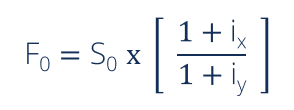
Where:
- F0 = Forward Rate
- S0 = Spot Rate
- ix = Interest Rate in Country X
- iy = Interest Rate in Country Y
Spot exchange rates are current exchange rates, whereas future exchange rates are exchange rates that will prevail at some time in the future. The idea of arbitration emerges from the IRP, as people can exploit the interest rate differential (or the difference between the spot and future exchange rates) and generate a profit.
In a perfect world, IRP should not allow for any profits, as the equation above holds true. However, in the real world, traders find mispriced currencies and benefit from the trade.
Currency Carry Trade
Foreign currencies are generally traded in the form of pairs, which is denoted as ABC/XYZ. If a person buys the currency pair CAD/USDUSD/CAD Currency CrossThe USD/CAD currency pair represents the quoted rate for exchanging US to CAD, or, how many Canadian dollars one receives per US dollar. For example, a USD/CAD rate of 1.25 means 1 US dollar is equivalent to 1.25 Canadian dollars. The USD/CAD exchange rate is affected by economic and political forces on both, they are actually buying the Canadian dollar and selling the US dollar. Interest is received on the currency you buy, and interest is paid on the currency you sell. Because the interest rate in the U.S. and Canada will most likely be different, the positions traded during the day in the foreign exchange market will achieve a net position of either interest payable or interest receivable.
Normally, all positions are closed at the end of the day, but if a person continues to hold the position, it is technically closed and then reopened the next day. The interest rate differential is charged to your account then. It is known as the cost of carrying or rolling over the position.
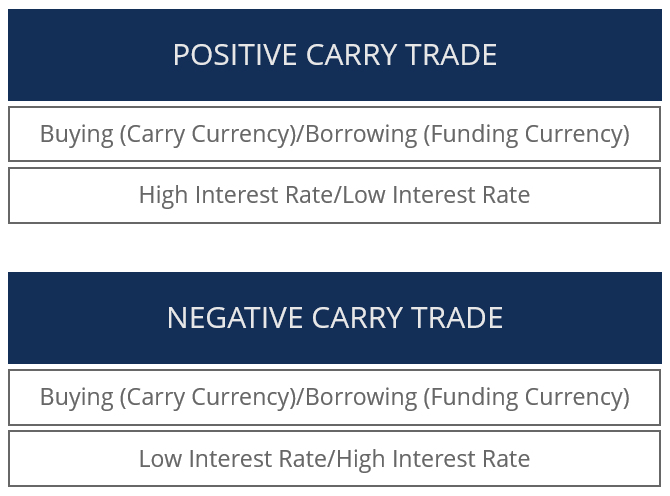
Positive Carry
Positive carry occurs when the net interest rate differential on the currency pair held is positive. For example, a person is long AUD/JPY, which means they buy the Australian dollar and sell the Japanese yen. The AUD interest rate is 5%, and the JPY interest rate is 3%. If the spot rate remains constant, the person will make a profit of 2% in the interest rate spread (which is also called positive carry).
Negative Carry
Negative carry occurs when the net interest rate differential on the currency pair held is negative. Taking the same example above, the person is long AUD/JPY, which means they buy the Australian dollar and sell the Japanese yen. The AUD interest rate is 1%, and the JPY interest rate is 4%. If the spot rate remains constant, the person will make a loss of 3% in the interest rate spread (which is also called negative carry).
It is important to note that positive and negative carry will be realized if interest rates do not change in the spot market.
Related Readings
CFI is the official provider of the Commercial Banking & Credit Analyst (CBCA)™Program Page - CBCAGet CFI's CBCA™ certification and become a Commercial Banking & Credit Analyst. Enroll and advance your career with our certification programs and courses. certification program, designed to transform anyone into a world-class financial analyst.
To keep learning and developing your knowledge of financial analysis, we highly recommend the additional resources below:
- Foreign Exchange Gain/LossForeign Exchange Gain/LossA foreign exchange gain/loss occurs when a company buys and/or sells goods and services in a foreign currency, and that currency fluctuates
- Interest Rate Parity (IRP) Excel Calculator
- Purchasing Power ParityPurchasing Power ParityThe concept of Purchasing Power Parity (PPP) is a tool used to make multilateral comparisons between the national incomes and living standards
- EUR/CAD Currency CrossEUR/USD Currency CrossThe Euro to Dollar exchange rate (EUR/USD or €/$ for short) is the number of U.S. dollars for every 1 Euro. It is the convention for quoting the exchange rate between the two currencies. This guide will provide an overview of the factors that impact the FX rate, and what investors and speculators need to know
-

Interbank Rate Explained: Understanding Foreign Exchange Rates
The interbank rate or interbank exchange rate is a financial concept used to express foreign exchange rates, which are paid by banks when they conduct currency trading with other banks. Interbank, or
-

Interest Rate Call Options: Understanding & Benefits
An interest rate option is a derivative whose contract value is based on interest rates. There are two types of interest rate options, calls and puts. An interest rate call option gives the individual
invest
- Binomial Interest Rate Tree: Definition, Uses & Applications
- Effective Annual Interest Rate (EAR): Understanding & Calculation
- Effective Annual Rate (EAR): Understanding & Calculation
- Fisher Equation Explained: Understanding Inflation & Interest Rates
- Net Interest Margin (NIM): Definition & Importance
- Nominal Interest Rate Explained: Definition & Implications
- Swap Rate Explained: Understanding Fixed Exchange Rates in Derivatives
- Uncovered Interest Rate Parity (UIRP): Explained & Implications
- Understanding the Policy Interest Rate: Its Impact on the Economy
-
 Net Present Value (NPV) Rule: A Comprehensive Guide
The net present value rule is an investment concept stating that projects should only be engaged in if they demonstrate a positive net present value (NPV). Additionally, any project or investment with...
-
 Savings Account Interest Rates: What to Expect & How to Maximize Your Returns
When it comes to the interest rate paid on savings accounts, you don't want to be ...