
Understanding Blockage Discounts in Stock Trading
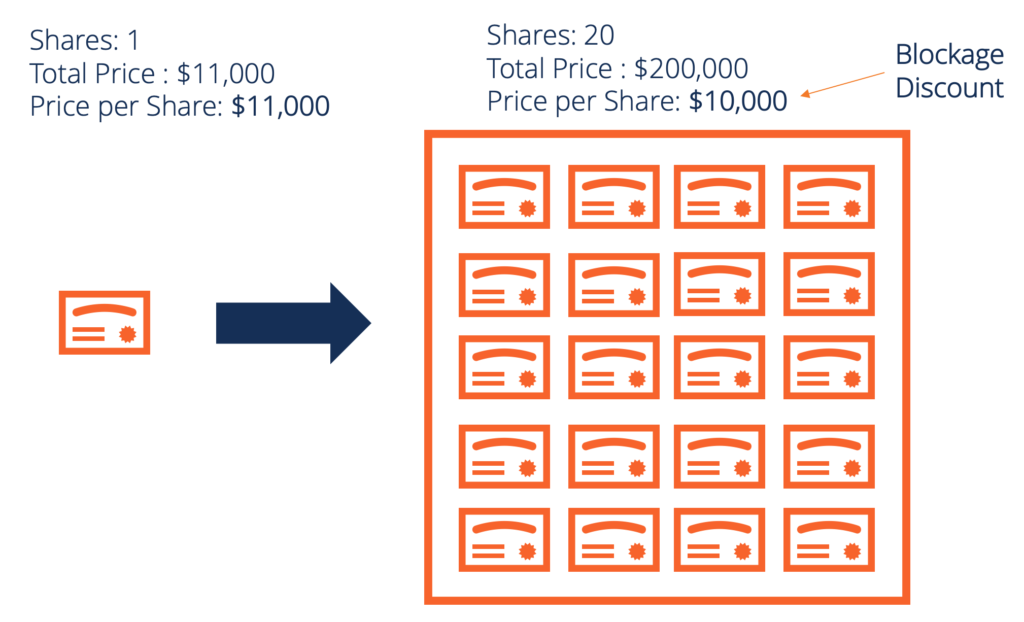
Blockage discount – also sometimes referred to as the blockage factor – is the discounted price or value the market gives stocks when a block of shares is sold. The exact number of shares constituting a block varies. However, any time more than 10,000 shares of a company’s stockCommon StockCommon stock is a type of security that represents ownership of equity in a company. There are other terms – such as common share, ordinary share, or voting share – that are equivalent to common stock. are introduced into the market at once, the blockage discount typically comes into effect. In the bondBondsBonds are fixed-income securities that are issued by corporations and governments to raise capital. The bond issuer borrows capital from the bondholder and makes fixed payments to them at a fixed (or variable) interest rate for a specified period. market, a “block” is characterized by $200,000 worth or more of securitiesTrading SecuritiesTrading securities are securities purchased by a company for the purpose of realizing a short-term profit. The securities are issued within the company's industry, being introduced into the market at one time.
How a Blockage Discount Works
A blockage discount is closely tied to supply and demandSupply and DemandThe laws of supply and demand are microeconomic concepts that state that in efficient markets, the quantity supplied of a good and quantity. The law of supply and demand says that within the market there is a certain amount of demand for a good, service – or in this case, shares of a company. When the market is flooded with a significant increase in the supply of shares, the value per share goes down. This is because of the greater access and availability of the shares without a corresponding increase in demand. In reality, it means that demand also decreases because the shares are so readily available.
Sellers looking to cash in on their large block of shares must recognize the imbalance created when they flood the market with a surplus of shares. For this reason, the seller also must recognize that the market will lower the value of shares, meaning the original share price goes out the window. Sellers looking for a quick turnaround are often penalized for their hastiness to earn a huge sum, and it often forces them to take a significantly discounted cut per share.
Blockage Discount Percentages
In most cases, the market will discount a block of shares anywhere between 1% and 15%, although there is the potential for a 0% discount as well if the stock is in particularly high demand. Market analysts and tradersSix Essential Skills of Master TradersJust about anyone can become a trader, but to be one of the master traders takes more than investment capital and a three-piece suit. Keep in mind: there is a sea of individuals looking to join the ranks of master traders and bring home the kind of money that goes with that title. – in order to accurately determine the size of the discount – must effectively study all historical information about the company, the market’s response to similar block offers in the past, and discounts given to blocks of shares from similar companies.
It’s also important for such individuals to study the economy as a whole, as well as the industry the company operates in. Understanding the market’s response to the industry and companies within it in the near-recent past is a helpful bit of information for analysts to get a better understanding of the scope of the potential blockage discount for a company within a given sector.
Final Word
Blockage discounts – while not destined to occur – are a fairly common response from the market. When a seller changes the supply and demand balance by introducing a large group of shares into the marketplace, it is a nearly foregone conclusion that the market will respond by assigning less value to each share. Sellers should keep this fact in mind and avoid selling large blocks of shares when possible.
Related Readings
CFI offers the Financial Modeling & Valuation Analyst (FMVA)™Become a Certified Financial Modeling & Valuation Analyst (FMVA)®CFI's Financial Modeling and Valuation Analyst (FMVA)® certification will help you gain the confidence you need in your finance career. Enroll today! certification program for those looking to take their careers to the next level. To keep learning and advancing your career, the following resources will be helpful:
- Conglomerate DiscountConglomerate DiscountPerhaps the simplest way to understand a conglomerate discount is to understand how it is calculated. It is a discounted valuation of the stocks associated
- Founders StockFounders StockFounders stock refers to the equity that is given to the early founders of an organization. This type of stock differs in a few important ways from common stock sold in the secondary market. Key differences are (1) that founders stock can only be issued at face value, and (2) it comes with a vesting schedule.
- Minority InterestMinority InterestMinority interest refers to having a stake in a company that is less than 50% of the total shares in terms of voting rights.
- Mosaic TheoryMosaic TheoryMosaic theory is an approach to financial security analysis that involves the analysis of a variety of resources, including public and non-public material and non-material information, to determine the underlying value of a security.The theory provides a more comprehensive and meticulous approach to the valuation of financial securities
-

Understanding Stock Rallies: Definition & What Causes Them
A rally refers to a period of continuous increase in the prices of stocks, indexes or bondsBondsBonds are fixed-income securities that are issued by corporations and governments to raise capital. The
-

Understanding Secular Markets: Long-Term Trends & Investment Strategies
A secular market is predominantly driven and impacted by elements or forces that are likely to be present in the foreseeable future. The forces can impact the price or value of a financial assetFinanc
invest
- Understanding Auction Markets: How Prices Are Determined
- Discount Bonds: Understanding Pricing & Secondary Markets
- Discount Yield Explained: Calculating Returns on Discounted Bonds
- Doji Candlestick Pattern: Meaning & Trading Signals
- Understanding Frothy Markets: Risks & Opportunities
- Understanding Inefficient Markets: Causes & Implications
- Understanding Market Cycles: Trends & Economic Environments
- Understanding Market Depth: A Guide for Traders
- NIFTY 50 Index: Understanding India's Top 50 Stocks | NSE
-
 Prediction Markets: Understanding How They Work & Their Applications
A prediction market or betting market is an exchange-traded market where individuals can bet on the outcome of a variety of events with an unknown future. The events range from future commodity prices...
-
 Understanding Quote-Driven Markets: A Guide for Investors
A quote-driven market is a type of secondary market trading structure where investors trade with dealers. Nearly all bonds, currenciesCurrencyCurrency refers to money, that which is used as a medium o...