
Trading Ranges Explained: How to Identify and Trade Them
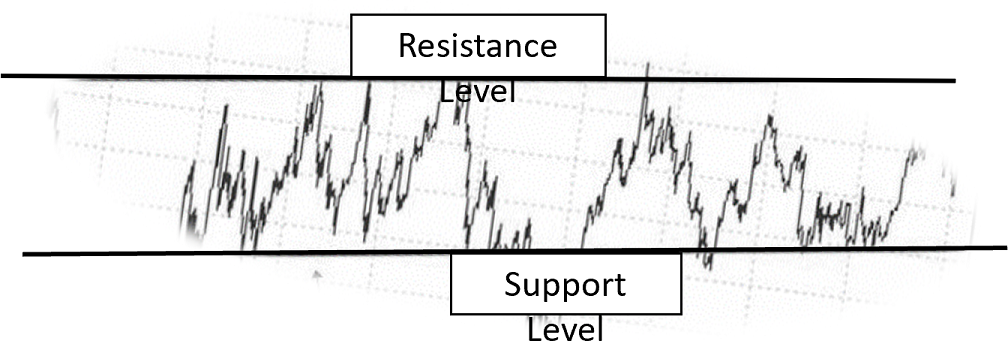
A trading range is the vertical price movements between a resistant ceiling and a support floor for a period of time. Trading range often occurs in all financial marketsFinancial MarketsFinancial markets, from the name itself, are a type of marketplace that provides an avenue for the sale and purchase of assets such as bonds, stocks, foreign exchange, and derivatives. Often, they are called by different names, including "Wall Street" and "capital market," but all of them still mean one and the same thing. in which the price resistance is provided by the top of a security’s trading range, while the price support is offered by the bottom of the trading range.
Such horizontal consolidations offer opportunities to traders where they can sell near resistance and buy near support. To some traders, the trading range may signal a breakthrough trading opportunity where a breakout occurs above the ceiling and a breakdown occurs below the support floor.
Summary
- Trading range occurs when price actions consistently bounce between established highs and lows for a certain period.
- In a trading range, traders use various technical analysis approaches to identify major support and resistance levels before entering the market.
- A trading range offers an opportunity for traders to confirm their market entry either through support and resistance or breakouts and breakdowns.
Understanding Trading Range
Reversion to the mean
Price behavior can be construed as a distribution that moves toward or away from its average price over time. The moving averageMoving AverageA moving average is a technical indicator that market analysts and investors may use to determine the direction of a trend. It sums up the data points is the most popular method used to establish the market’s average price. Essentially, the slope of the moving average is monitored to confirm the occurrence of a trading range.
The price is more likely to revert toward its average price when it moves above or below its moving average. The idea is to capitalize on the price’s tendency to return to the mean.
Several factors influence the prices of securities, such as the type of security and the sector where the security operates. For example, tradable instruments with fixed income demonstrate a smaller trading range than commoditiesCommoditiesCommodities are another class of assets just like stocks and bonds. Most commodities are products that come from the earth that possess and equities with high price volatility.
Range-bound trading
Investors who intend to profit from range-bound trading go for instruments with lower volatility since higher volatility indicates turmoil in the market. A high price serves as a major resistance level in a range-bound market, which can be considered a ceiling for price action and cannot be broken.
Similarly, low price acts as a major support level, which can be considered a floor for price action. Still, both the high price and low price can be broken. To use a range-bound trading strategy, a trader must first identify the market conditions, which entails major support and resistance levels, using various technical analysis approaches.
How to determine a ranging market
Traders can avoid false bounces or breaks by adopting various methods, such as trade filters or trade triggers, to enter a trading range. There are various range-bound trading strategies, including key technical tools such as Bollinger BandsBollinger Bands®"Bollinger Bands" are a technical analysis tool developed by John Bollinger in the 1980s for trading stocks. The bands comprise a volatility indicator that measures the relative high or low of a security's price in relation to previous trades., oscillators, and moving averages, among others.
With Bollinger Bands, the slope of the moving average that runs through the middle of the bands can be monitored to determine if the market is range-bound. A flat or almost flat slope indicates potential trading.
On the other hand, oscillators are used to determine the range of trading by confirming turns or resistance near or at support and resistance. If the oscillator line(s) crosses the oversold boundary, a potential long trade is in the offering. Conversely, if the oscillator line crosses the overbought boundary, a potential short trade is near.
Trading Range Strategies
Support and Resistance
To correctly interpret price charts and trade successfully, traders must identify and measure the support and resistance’s strength. A downtrend can be interrupted or reversed at the support level where the buying is strong. Horizontal or near-horizontal lines connecting several bottoms are used to represent support.
Also, a downtrend can be interrupted or reversed at the resistance level where selling is strong. Horizontal or near-horizontal lines connecting several tops are used to represent resistance.
Factors such as height, length, and trading volume at a specific zone determine the strength of support and resistance of regions. Therefore, a security in a range-bound market can either be bought when the price approaches a support level or be sold when the price reaches a resistance level.
Breakouts and Breakdowns
A breakout from a trading range can also offer traders an opportunity to enter a range-bound market. Traders would need to confirm the entry using indicators such as price or volume action.
For example, there should be an increase in volume outside the trading range on the initial breakout. Traders may choose to wait for a retracement before entering the market rather than going after the price.
Trading Set-Up
Range trading seeks to exploit the price action between the support and resistance levels. After identifying favorable market conditions, a trader can purchase a security near or at the overbought zone and sell near or at the oversold level.
Long-term success in a trading range would require a trader to enter the market where the stop loss is lower and the profit target is higher. The strategy can work well in a trending financial market.
Learn More
CFI is the official provider of the Capital Markets & Securities Analyst (CMSA)®Program Page - CMSAEnroll in CFI's CMSA® program and become a certified Capital Markets &Securities Analyst. Advance your career with our certification programs and courses. certification program, designed to transform anyone into a world-class financial analyst.
To keep learning and developing your knowledge of financial analysis, we highly recommend the additional resources below:
- Advanced Technical AnalysisAdvanced Technical AnalysisAdvanced technical analysis usually involves using either multiple technical indicators or a rather sophisticated (i.e., complex) indicator. "Sophisticated"
- Horizontal LineHorizontal LineA horizontal line is a line drawn touching the support or resistance level on a price chart in technical analysis.
- Six Essential Skills of Master TradersSix Essential Skills of Master TradersJust about anyone can become a trader, but to be one of the master traders takes more than investment capital and a three-piece suit. Keep in mind: there is a sea of individuals looking to join the ranks of master traders and bring home the kind of money that goes with that title.
- How to Read Stock ChartsHow to Read Stock ChartsIf you’re going to actively trade stocks as a stock market investor, then you need to know how to read stock charts. Even traders who primarily use fundamental analysis to select stocks to invest in still often use technical analysis of stock price movement to determine specific buy and sell, stock charting
-
Understanding Trading Sessions: Hours & Global Markets
A trading session refers to the active trading hours of an asset or a given locale. Usually, different markets follow different trading hours, and a single trading day of a market is the trading sessi
-
Trading Software: A Comprehensive Guide for Traders
Trading software are computer programs that traders use to trade and analyze financial products such as currencies, stocks, bonds, and derivatives over a network with a financial intermediaryFinancial
invest
- Algorithmic Trading: A Comprehensive Guide
- Understanding Algorithms: A Guide to Algorithmic Trading
- CFD Trading Explained: A Comprehensive Guide for Investors
- Understanding Daily Trading Limits: A Comprehensive Guide
- Day Trading Explained: Strategies, Risks & How It Works
- Understanding Divergence in Technical Analysis: A Guide
- Understanding Forward Prices: Definition & How They Work
- Volatility Quote Trading: A Deep Dive for Investors
- Options Trading Explained: Risks & Rewards for Investors
-
 Trading Channels: Understanding Uptrends & Downtrends
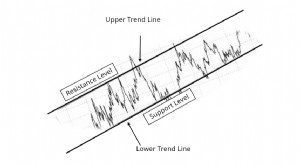
A trading channel is a chart pattern highlighted by two parallel lines bordering resistance and support within which a security trades during a period. Within a valid uptrend trading channel, an oppor...
-
 Trading Plan: A Comprehensive Guide to Successful Trading
A trading plan refers to a systematic approach used to identify and trade securities based on several variables, such as investment objectives, risks, and time. A trading plan lays out procedures and ...