
Treasury Bills (T-Bills): Definition, Types & How They Work
Treasury Bills (or T-Bills for short) are a short-term financial instrumentMarketable SecuritiesMarketable securities are unrestricted short-term financial instruments that are issued either for equity securities or for debt securities of a publicly listed company. The issuing company creates these instruments for the express purpose of raising funds to further finance business activities and expansion. that is issued by the US Treasury with maturity periods ranging from a few days up to 52 weeks (one year). They are considered among the safest investments since they are backed by the full faith and credit of the United States Government.
When an investor buys a Treasury Bill, they are lending money to the government. The US Government uses the money to fund its debt and pay ongoing expensesFixed and Variable CostsCost is something that can be classified in several ways depending on its nature. One of the most popular methods is classification according such as salaries and military equipment. T-Bills are sold in denominations ranging from $1,000 (standard) up to a maximum of $5 million.
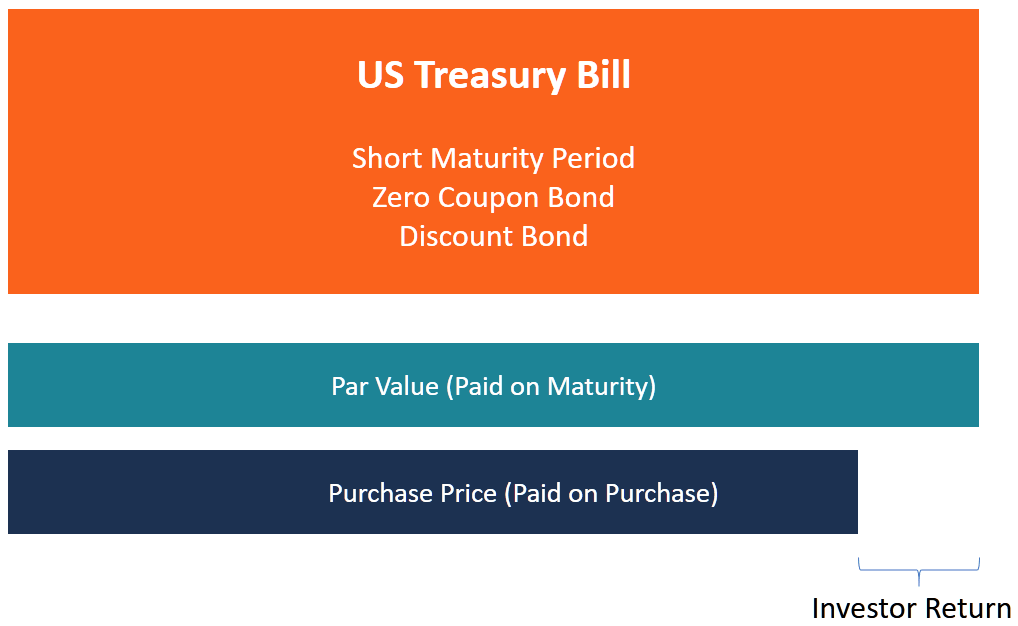
Example of Treasury Bills
Treasury bills are sold at a discount to the par valuePar ValuePar Value is the nominal or face value of a bond, or stock, or coupon as indicated on a bond or stock certificate. It is a static value, which is its actual value. For example, a Treasury bill with a par value of $10,000 may be sold for $9,500. The US Government, through the Department of Treasury, promises to pay the investor the full face value of the T-bill at its specified maturity date.
Upon maturity, the government will pay the investor $10,000, resulting in a profit of $500. The amount of profit earned from the payment is considered the interest earned on the T-bill.
The difference between the face value of the T-bill and the amount that an investor pays is called the discount rate, which is calculated as a percentage. In this case, the discount rate is 5% of the face value.
Get T-Bill rates directly from the US Treasury website.
How to Purchase Treasury Bills
Treasury bills can be purchased in the following three ways:
1. Non-competitive bid
In a non-competitive bid, the investor agrees to accept the discount rate determined at auction. The yield that an investor receives is equal to the average auction price for T-bills sold at auction. Individual investors prefer this method since they are guaranteed to receive the full amount of the bill at the expiry of the maturity period. Payment is made through TreasuryDirect or the investor’s bank or broker.
2. Competitive bidding auctions
In a competitive bidding auction, investors buy T-bills at a specific discount rate that they are willing to accept. Every submitted bid states the lowest rate or discount margin that the bidder/investor is willing to accept. Bids accepting the lowest discount rate are accepted first.
If there are not enough bids at that level to make the issue fully subscribed, then bids at the next lowest rate are accepted. The process continues until the entire issue has been sold. Purchase payments must be made either through a bank or a broker.
3. Secondary market
Investors can buy or sell Treasury bills on the secondary marketSecondary MarketThe secondary market is where investors buy and sell securities from other investors. Examples: New York Stock Exchange (NYSE), London Stock Exchange (LSE).. Also, there are mutual fundsMutual FundsA mutual fund is a pool of money collected from many investors for the purpose of investing in stocks, bonds, or other securities. Mutual funds are owned by a group of investors and managed by professionals. Learn about the various types of fund, how they work, and benefits and tradeoffs of investing in them and Exchange-Traded Funds (ETFs)Exchange Traded Fund (ETF)An Exchange Traded Fund (ETF) is a popular investment vehicle where portfolios can be more flexible and diversified across a broad range of all the available asset classes. Learn about various types of ETFs by reading this guide. that hold previously issued T-bills.
Factors that Affect Treasury Bill Prices
Like other types of debt securities, the price of T-bills and the return for investors may be affected by various factors such as macroeconomic conditions, investor risk tolerance, inflation, monetary policy, and specific supply and demand conditions for T-bills.
Monetary Policy
The Federal Reserve’s monetary policy is likely to affect the T-bill price. T-bill interest rates tend to move closer to the interest rate set by the Fed, known as the Fed(eral) Funds rate. However, a rise in the Federal Funds rate tends to attract investment in other debt securities, resulting in a drop in the T-bill interest rate (due to lower demand). The decline continues until the T-bill interest rate rises above the Federal Funds rate.
Maturity Period
The maturity period of a T-bill affects its price. For example, a one-year T-bill typically comes with a higher rate of return than a three-month T-bill. The explanation for this is that longer maturities mean additional risk for investors.
For example, a $1,000 T-bill may be sold for $970 for a three-month T-bill, $950 for a six-month T-bill, and $900 for a twelve-month T-bill. Investors demand a higher rate of return to compensate them for tying up their money for a longer period of time.
Risk Tolerance
An investor’s risk tolerance levels also affect the price of a T-bill. When the U.S. economy is going through an expansion and other debt securities are offering a higher return, T-bills are less attractive and will, therefore, be priced lower. However, when the markets and the economy are volatile and other debt securities are considered riskier, T-bills command a higher price for their “safe haven” quality.
Inflation
The price of T-bills can also be affected by the prevailing rate of inflation. For example, if the inflation rate stands at 5% and the T-bill discount rate is 3%, it becomes uneconomical to invest in T-bills since the real rate of return will be a loss. The effect of this is that there is less demand for T-bills, and their prices will drop.
Difference between T-Bills, T-Notes, and T-Bonds
T-bills, T-notes, and T-bonds are fixed-income investments issued by the US Department of the Treasury when the government needs to borrow money. They are all commonly referred to as “Treasuries.”
T-Bills
Treasury bills have a maturity of one year or less, and they do not pay interest before the expiry of the maturity period. They are sold in auctions at a discount from the par value of the bill. They are offered with maturities of 28 days (one month), 91 days (3 months), 182 days (6 months), and 364 days (one year).
T-Notes
Treasury notes have a maturity period of two to ten years. They come in denominations of $1,000 and offer coupon payments every six months. The 10-year T-note is the most frequently quoted Treasury when assessing the performance of the bond market. It is also used to show the market’s take on macroeconomic expectations.
T-Bonds
Treasury bonds have the longest maturity among the three Treasuries. They have a maturity period of between 20 years and 30 years, with coupon payments every six months. T-bond offerings were suspended for four years between February 2002 and February 2006. T-bond offerings resumed due to demand from pension funds and other long-term institutional investors.
More Resources
We hope you’ve enjoyed reading CFI’s explanation of Treasury Bills. To continue learning and advancing your career, these additional resources will be helpful:
- Debt Capital MarketsDebt Capital Markets (DCM)Debt Capital Markets (DCM) groups are responsible for providing advice directly to corporate issuers on the raising of debt for acquisitions, refinancing of existing debt, or restructuring of existing debt. These teams operate in a rapidly moving environment and work closely with an advisory partner
- Fixed Income TradingFixed Income TradingFixed income trading involves investing in bonds or other debt security instruments. Fixed income securities have several unique attributes and factors that
- Bond PricingBond PricingBond pricing is the science of calculating a bond's issue price based on the coupon, par value, yield and term to maturity. Bond pricing allows investors
- Coupon RateCoupon RateA coupon rate is the amount of annual interest income paid to a bondholder, based on the face value of the bond.
-

Understanding Commodities: A Beginner's Guide to Investing
Commodities are another class of assets just like stocks and bondsBondsBonds are fixed-income securities that are issued by corporations and governments to raise capital. The bond issuer borrows capit
-

Cross Rates Explained: Understanding Currency Valuation
A cross rate is a foreign exchange market quote between two currencies (not involving the U.S. dollar) that are then both valued against a third currency. If used as a base currency, the U.S. dollar i
invest
- Understanding Dividend Yield: A Comprehensive Guide
- Ex-Ante: Understanding Predictions in Finance
- Understanding Forward Points: A Guide for Investors
- Understanding Forward Rates Models: Analysis & Prediction
- Interest Rate Derivatives (IRDs): A Comprehensive Guide
- Interest Rate Futures: Definition, How They Work & Investing
- Understanding Interest Rate Options: A Comprehensive Guide
- Understanding Off-the-Run US Treasury Bonds: A Comprehensive Guide
- What are Swap Contracts?
-
 Understanding Bonds: A Comprehensive Guide for Investors
Bonds are fixed-income securitiesTrading & InvestingCFIs trading & investing guides are designed as self-study resources to learn to trade at your own pace. Browse hundreds of articles on trad...
-
 Call Swaptions: Understanding Receiver Options for Tax Rate Swaps
A call swaption, also known as a receiver swaption, is an option that allows the holder to take part in a private tax rate swap. All swaptions are conducted over-the-counter (OTC)Over-the-Counter (OTC...