
Understanding Asset Disposition: Definition & Tax Implications
A disposition refers to the disposal of assets or securities through assignment, sale, or another transfer method. It is simply the transfer of an asset’s ownership, where the asset is either given away or sold.
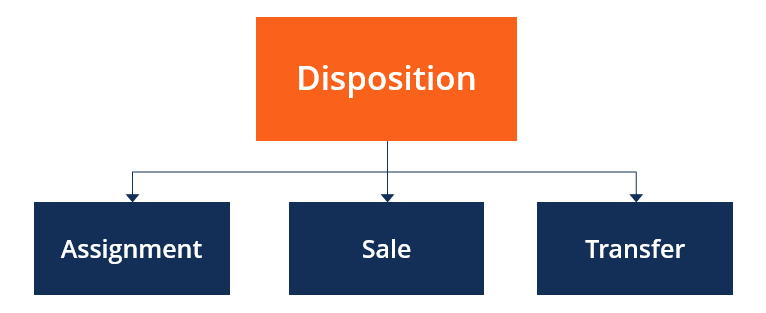
Dispositions involving an assignment and/or transfer can also be completed for accounting and tax purposes to get relief from any associated taxes or any other liability. It can also refer to the disposal of an asset held as a security against a loan.
Disposition occurs in many ways. For example, the sale of stocks or bonds in the exchange market by an investor is called the disposition of stocks. A company reports the insider trades as a disposition of shares to executives and the board of directorsBoard of DirectorsA board of directors is a panel of people elected to represent shareholders. Every public company is required to install a board of directors.. When banks review the loans and sell the collateral in the event of default by the borrowers, it is called the disposition of loan assets. Certain types of donations to trusts or charities can also be referred to as a disposition.
Summary
- Disposition refers to the disposal of assets through a sale, assignment, or transfer where the ownership of the asset is transferred.
- The sale of shares in the exchange market, insider trades reported in a company’s records, the sale of loan collateral by banks, and donations are other forms of disposition.
- When a company sells an asset by any method of disposition, the related balance needs to be removed from the company books.
Disposition Example
Suppose an investor owns some stocks in a particular company. Recently, the company’s not been performing well. If the investor decides to move out of the investment, he/she will sell his/her shares on the exchange market via a broker. Thus, the investor disposes of his/her investment in the company.
Recording a Disposition
When companies decide to discard their assets through an exchange or sale, it is referred to as a disposition. It may also occur when companies need to end the life of damaged or stolen assets involuntarily. However, regardless of the method of disposition, the accounts related to the discarded assets should be removed from the company records.
As an asset’s book value is rarely the same as its market valueMarket ValueMarket value is usually used to describe how much an asset or company is worth in a financial market. Itis mutually determined by market participants and, companies experience either a loss or gain on an asset’s sale or disposal.
For example, suppose Company X decides to sell its equipment Z for $75,000. The original cost of the equipment was $100,000, with the asset being depreciated over three years. The accumulated depreciation on the equipment was $50,000. The profit or loss on the disposition of the equipment will be calculated as below:
Cost of Equipment Z = $100,000
Accumulated Depreciation = $50,000
Net Book ValueNet Book ValueNet book value (NBV) refers to a company’s assets or how the assets are recorded by the accountant. NBV is calculated using the asset’s = $100,000 – $50,000 = $50,000
Proceeds from Sale = $75,000
Gain from the Disposition of Equipment Z = $75,000 – $50,000 = $25,000
The equipment needs to be removed from the company’s records. To do it, $75,000 cash will be debited, the equipment account of $100,000 will be credited, the accumulated depreciation of $50,000 will be debited, and a gain on disposition of $25,000 will be credited. The journal entriesJournal Entries GuideJournal Entries are the building blocks of accounting, from reporting to auditing journal entries (which consist of Debits and Credits) will be reflected in the period in which the agreement was made.
More Resources
CFI is the official provider of the global Commercial Banking & Credit Analyst (CBCA)™Program Page - CBCAGet CFI's CBCA™ certification and become a Commercial Banking & Credit Analyst. Enroll and advance your career with our certification programs and courses. certification program, designed to help anyone become a world-class financial analyst. To keep advancing your career, the additional CFI resources below will be useful:
- Accumulated DepreciationAccumulated DepreciationAccumulated depreciation is the total amount of depreciation expense allocated to a specific asset since the asset was put into use.
- Debt SecurityDebt SecurityA debt security is any debt that can be bought or sold between parties in the market prior to maturity. Its structure represents a debt owed
- Insider TradingInsider TradingInsider trading refers to the practice of purchasing or selling a publicly-traded company’s securities while in possession of material information that is
- Three Financial StatementsThree Financial StatementsThe three financial statements are the income statement, the balance sheet, and the statement of cash flows. These three core statements are
-

Allowance for Doubtful Accounts: Definition & Purpose
The allowance for doubtful accounts is a contra-asset account that is associated with accounts receivableAccounts ReceivableAccounts Receivable (AR) represents the credit sales of a business, which ha
-

Profitability Index (PI): Definition, Formula & Investment Ranking
The Profitability Index (PI) measures the ratio between the present value of future cash flows and the initial investment. The index is a useful tool for ranking investment projects and showing the va
Accounting
- EBIAT Explained: Understanding Earnings Before Interest and Taxes
- Understanding Net Debt: A Key Financial Metric
- Initial Margin Explained: A Comprehensive Guide for Investors
- Accounting Profit Explained: Calculation & Importance
- Understanding Depreciation Expense: A Comprehensive Guide
- Flat Tax Explained: How It Works & Its Implications
- Gross Income Explained: Definition, Sources & Examples
- Understanding Step Costs: A Guide for Business Growth
- Variable Costing Explained: A Clear Guide for Businesses
-
 Understanding Journal Entries in Accounting: A Comprehensive Guide
In an accounting careerAccountingPublic accounting firms consist of accountants whose job is serving business, individuals, governments & nonprofit by preparing financial statements, taxes, journa...
-
 Percentage of Completion Method: Accounting Explained
The percentage of completion method is a revenue recognition accounting concept that evaluates how to realize revenue periodically over a long-term project or contract. Revenue, expenses, and gross pr...