
Understanding Net Debt: A Key Financial Metric
Net debt is a financial liquidity metricProfitability RatiosProfitability ratios are financial metrics used by analysts and investors to measure and evaluate the ability of a company to generate income (profit) relative to revenue, balance sheet assets, operating costs, and shareholders' equity during a specific period of time. They show how well a company utilizes its assets to produce profit that measures a company’s ability to pay all its debts if they were due today. In other words, net debt compares a company’s total debt with its liquid assetsCurrent AssetsCurrent assets are all assets that a company expects to convert to cash within one year. They are commonly used to measure the liquidity of a. Net debt is the amount of debt that would remain after a company had paid off as much debt as possible with its liquid assets. It is used to determine if a company can repay its obligationsDebt CapacityDebt capacity refers to the total amount of debt a business can incur and repay according to the terms of the debt agreement. if they were all due today and whether the company is able to take on more debt.

Formula for Net Debt
Net debt = Short-term debt + Long-term debt – Cash and equivalents
Where:
- Short-term debts are financial obligations that are due within 12 months. Common examples of short-term debt include accounts payableAccounts PayableAccounts payable is a liability incurred when an organization receives goods or services from its suppliers on credit. Accounts payables are, short-term bank loans, lease payments, wages, and income taxes payable.
- Long-term debts are financial obligations that are due beyond a 12-month period. Common examples of long-term debt include bonds, lease obligations, contingent obligations, notes payableNotes PayableNotes payable are written agreements (promissory notes) in which one party agrees to pay the other party a certain amount of cash., and convertible bonds.
- Cash and cash equivalents are the most liquid assets of a company. Common examples of cash and cash equivalents include marketable securities, commercial paper, treasury bills, and bank accounts.
Example Calculation of Net Debt
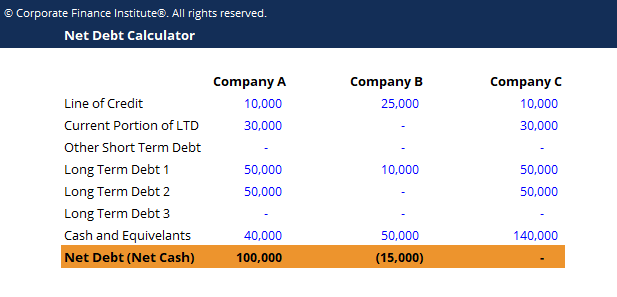
Company A reported a drawn line of credit of $10,000 and a current portion of long-term debt of $30,000. Long-term liabilities of Company A consist of a $50,000 long-term bank loan, and $50,000 in bonds. Current assets of Company A include $15,000 in cash, $10,000 in Treasury bills, and $15,000 in marketable securities.
The net debt of Company A would be calculated as follows:
- Short-term debt: $10,000 + $30,000 = $40,000
- Long-term debt: $50,000 + $50,000 = $100,000
- Cash and cash equivalents: $15,000 + $10,000 + $15,000 = $40,000
($30,000 + $10,000) + ($50,000 + $50,000) – ($15,000 + $10,000 + $15,000) = $100,000
Below is a screenshot of the above calculation for Company A, along with two other companies. Company B has a net cash position and Company C has a zero balance.
Download the Free Template
Enter your name and email in the form below and download the free template now!
Interpretation of Net Debt
Net debt is simply the total debts of a company subtracted from a company’s most liquid assets. Essentially, it gives analysts and investors insight into whether a company is under- or overleveraged. A negative net debt implies that the company possesses more cash and cash equivalents than its financial obligations, and hence is more financially stable.
However, the debt metric should not be used alone to determine a company’s financial health. It should be used in conjunction with other liquidity and leverage ratios such as the current ratio, quick ratio, debt ratio, debt-equity ratio, etc.
Negative Net Debt (Net Cash)
Companies that have little to no debt will often have a negative net debt (or positive net cash) position. A negative amount indicates that a company possesses enough cash and cash equivalentsCash EquivalentsCash and cash equivalents are the most liquid of all assets on the balance sheet. Cash equivalents include money market securities, banker's acceptances to pay off its short and long-term debts and still have excess cash remaining.
The Importance of Net Debt
This metric is used to measure a company’s financial stability and gives analysts and investors an indication of how leveraged a company is. Companies with a negative net debt are generally in a better position to withstand adverse economic changes, volatile interest rates, and recessions. As it can be a helpful indicator of financial health, investors use it when determining whether to buy or sell shares of a company. Nonetheless, it should be used in conjunction with other financial ratios to provide an accurate representation of a company’s financial health.
Use in Enterprise Value
The Enterprise ValueEnterprise Value (EV)Enterprise Value, or Firm Value, is the entire value of a firm equal to its equity value, plus net debt, plus any minority interest of a business is equal to its equity value plus its net debt. The reason that cash is deducted from debt is that it can be used to net out any amounts that are owed to creditors. For business valuation purposes, enterprise value is typically used. Learn more about enterprise value vs equity valueEnterprise Value vs Equity ValueEnterprise value vs equity value. This guide explains the difference between the enterprise value (firm value) and the equity value of a business. See an example of how to calculate each and download the calculator. Enterprise value = equity value + debt - cash. Learn the meaning and how each is used in valuation.
Related Readings
CFI is the global provider of the financial modeling and valuation analystBecome a Certified Financial Modeling & Valuation Analyst (FMVA)®CFI's Financial Modeling and Valuation Analyst (FMVA)® certification will help you gain the confidence you need in your finance career. Enroll today! designation. To continue learning and advancing your career, these additional CFI resources and guides will be helpful:
- Debt to Equity RatioFinanceCFI's Finance Articles are designed as self-study guides to learn important finance concepts online at your own pace. Browse hundreds of articles!
- Capital StructureCapital StructureCapital structure refers to the amount of debt and/or equity employed by a firm to fund its operations and finance its assets. A firm's capital structure
- Debt CapacityDebt CapacityDebt capacity refers to the total amount of debt a business can incur and repay according to the terms of the debt agreement.
- Senior and Subordinated DebtSenior and Subordinated DebtIn order to understand senior and subordinated debt, we must first review the capital stack. Capital stack ranks the priority of different sources of financing. Senior and subordinated debt refer to their rank in a company's capital stack. In the event of a liquidation, senior debt is paid out first
-

Understanding Net Change: Definition & Calculation
Net change is the difference between the closing price of a prior trading period and the closing price of the current trading period for a financial security. Net change is generally used for stock pr
-
Understanding Bad Debt: Definition and Financial Statement Impact
First, let’s determine what the term bad debt means. Sometimes, at the end of the fiscal periodFiscal Year (FY)A fiscal year (FY) is a 12-month or 52-week period of time used by governments and
finance
- Understanding Capital: Types, Categories & Value Creation
- Understanding Debt: Types, Obligations & Financial Implications
- Understanding Debt Capacity: A Guide for Businesses
- Debt Consolidation: Simplify Payments & Lower Interest Rates
- Understanding Debt Default: Causes, Consequences, and Prevention
- Debt Financing: A Comprehensive Guide for Businesses
- Debt Refinancing: A Comprehensive Guide to Lowering Your Payments
- Debt Restructuring: A Comprehensive Guide for Financial Distress
- Net Debt to EBITDA Ratio: Understanding Financial Leverage
-
 Understanding Delinquent Debt: Causes, Consequences, and Solutions
Credit card charge-offs and overdue medical bills are examples of delinquent debts. Debts become delinquent when a consumer neglects to make previously agreed upon payments to a lender. Delin...
-
 Margin Debt Explained: Understanding Brokerage Loans for Investing
Margin debt represents the amount that an investor owes a broker in their margin account. When a broker approves a margin account for an investor, the margin account is granted a line of credit that c...