
Commodity Swaps: Definition, Uses & Hedging Strategies
A commodity swap is a type of derivative contract that allows two parties to exchange (or swap) cash flows that are dependent on the price of an underlying asset. In this case, the underlying asset is a commodity.
Commodity swaps are very important in many commodity-based industries, such as oil and livestock. They are used to hedge against swings in the market price of the product in question. The swaps allow commodity producers and end-users to lock in at a set price for the underlying commodity.

Summary
- A commodity swap is a type of derivative contract that allows two parties to exchange cash flows, dependent on the price of an underlying commodity
- Commodity swaps are customized, over-the-counter deals, often created through financial service companies
- Commodity swaps can be used to hedge a market position and create a stable price point for buyers or sellers of the commodity
How do Commodity Swaps Work?
Commodity swaps are not traded on centralized exchanges. They are customized, over-the-counterOver-the-Counter (OTC)Over-the-counter (OTC) is the trading of securities between two counter-parties executed outside of formal exchanges and without the supervision of an exchange regulator. OTC trading is done in over-the-counter markets (a decentralized place with no physical location), through dealer networks. deals between two parties. Many of these over-the-counter deals are created through financial service companies. Most often, such companies don’t actually swap the underlying commodity and will only use the price of the commodity to determine the cash flows that will be exchanged.
There are two types of commodity swaps that are generally used: fixed-floating commodity swaps and commodity-for-interest swaps.
Fixed-Floating Commodity Swaps
Fixed-floating swaps are very similar to interest rate swaps. The difference is that commodity swaps are based on the underlying commodity price rather than on a floating interest rateFloating Interest RateA floating interest rate refers to a variable interest rate that changes over the duration of the debt obligation. It is the opposite of a fixed rate.. In this type of swap contract, there are two legs, the floating-leg, which is tied to the market price of the commodity, and the fixed-leg, which is the agreed-upon price specified in the contract.
The party looking to hedge their position will enter into the swap contract with a swap dealer to pay a fixed price for a certain quantity of the underlying commodity on a periodic basis. The swap dealer will, in turn, agree to pay the party the market price of the commodity. These cash flows will net out each period, and the party who must pay more will pay the difference.
On the other side, the swap dealer will also find a party looking to pay the floating price of the commodity. The swap dealer will enter into a contract with this party to accept the floating market price and pay the fixed price, which will again net out.
Swap dealers such as financial service companies play the role of a market makerMarket MakerMarket maker refers to a firm or an individual that engages in two-sided markets of a given security. It means that it provides bids and asks in tandem with and profit from the bid-ask spread of these transactions.
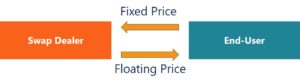
Here, we can see that an end-user of a commodity and a swap dealer have entered into a commodity swap. Often, end-users of a commodity, such as fuel-intensive industries, will look to pay a fixed price. In this example, the end-user will pay a fixed price and receive the market price of the commodity.
Commodity-For-Interest Swaps
A commodity-for-interest swap is very similar to an equity swap, however, the underlying asset is a commodity. One leg will pay a return based on the commodity price while the other leg is tied to a floating interest rate such as LIBORLIBORLIBOR, which is an acronym of London Interbank Offer Rate, refers to the interest rate that UK banks charge other financial institutions for, or an agreed-upon fixed rate. The swap involves a notional principal or face value, specified duration, and pre-specified payment periods.
Like the fixed-floating swap, the periodic payments will net out against each other and the party who must pay more based on the commodity return, interest rate, and face value will pay the difference.
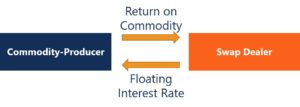
Here we see an example of a commodity-for-interest swap. The commodity-producer will pay a rate based on the return of the commodity and receive a floating rate such as LIBOR. It can help the commodity-producer reduce the downside risk of a poor return based on the commodity market price.
What are Commodity Swaps Used For?
Commodity swaps are important tools used for a few purposes. The most common reason for using this swap is to accommodate the risk a party is willing to take. For a party looking to hedge their position against the volatility of a commodity price, they will enter into a swap to pay or receive a fixed price.
On the commodity-producer side, this will guarantee a stable selling price for them. On the end-user side, this will guarantee a stable buying price for them. For example, airline companies have significant fuel costs. They are highly exposed to swings in the price of oil. A commodity swap is one way for them to reduce this exposure.
Alternatively, a party may be looking for more exposure to the underlying commodity. For example, an investor who can borrow at LIBORLIBORLIBOR, which is an acronym of London Interbank Offer Rate, refers to the interest rate that UK banks charge other financial institutions for may enter into a commodity-for-interest swap looking to profit from high returns based on the commodity price. Since commodity swaps are financial instruments, these contracts will be cash-settled and an investor will not have to be involved with any physical delivery of the commodity.
Commodity Swap – Worked Example
Let us now work through an example. An airline has entered into a contract to pay a fixed rate of $5.00/gallon for a proportion of its fuel needs. If at the payment period, the price of fuel is $5.20/gallon, how much has the airline saved, given the contract is for 200,000 gallons of fuel?
Here we see that the airline company wants to pay a fixed rate of $5.00 per gallon of fuel. At this point in time, the difference would be $5.20/gallon – $5.00/gallon = $0.20/gallon.
In total, the other party would pay the airline company 200,000 gallons x $0.20/gallon = $40,000
This $40,000 would offset the increase in the price of fuel paid by the airline. If the airline had to pay $5.20/gallon for 200,000 gallons of fuel, this would cost them $1,040,000. However, due to the swap contract the net amount is: $1,040,000 – $40,000 = $1,000,000.
If the price had been $5.00/gallon, the airline company would have paid $5.00/gallon x 200,000 gallons = $1,000,000.
We can see that through the swap contract, the airline company is able to ensure a price of $5.00 per gallon for the specified 200,000 gallons of fuel.
Additional Resources
Thank you for reading CFI’s article on commodity swaps. If you would like to learn about related topics, check out CFI’s other resources:
- DerivativesDerivativesDerivatives are financial contracts whose value is linked to the value of an underlying asset. They are complex financial instruments that are
- Currency Swap ContractCurrency Swap ContractA currency swap contract (also known as a cross-currency swap contract) is a derivative contract between two parties that involves the
- Equity Swap ContractEquity Swap ContractAn equity swap contract is a derivative contract between two parties that involves the exchange of one stream (leg) of equity-based cash flows linked to the performance of a stock or an equity index with another stream (leg) of fixed-income cash flows.
- Interest Rate SwapInterest Rate SwapAn interest rate swap is a derivative contract through which two counterparties agree to exchange one stream of future interest payments for another
-
Swap Rate Explained: Understanding Fixed Exchange Rates in Derivatives
The swap rate is the fixed rate of a swapSwapA swap is a derivative contract between two parties that involves the exchange of pre-agreed cash flows of two financial instruments. The cash flows a
-
Understanding Swap Rate Curves: A Comprehensive Guide
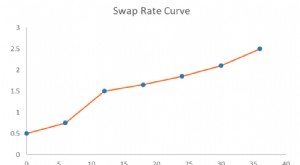
The swap rate curve is a chart that depicts the relationship between swap rates and all available corresponding maturities. Essentially, it indicates the expected returnsExpected ReturnThe expected re
finance
- Equity Swap Contracts: Definition, Mechanics & Applications
- Interest Rate Swaps: A Comprehensive Guide
- Swap Spreads: Understanding the Difference and its Significance
- ASCOT Options: Understanding Asset-Swapped Convertible Options
- Asset Swap Explained: Definition, OTC Trading & Key Concepts
- Commodity Valuation: Understanding Intrinsic Value & Market Pricing
- Cross Currency Swaps: Definition, Mechanics & Benefits
- Foreign Exchange Swaps: Definition, Mechanics & Uses
- Swaptions Explained: Understanding Interest Rate Option Contracts
-
 Currency Swap Contracts: Definition & How They Work
A currency swap contract (also known as a cross-currency swap contract) is a derivative contract between two parties that involves the exchange of interest payments, as well as the exchange of princip...
-
 Debt/Equity Swap: Understanding Financial Restructuring
A debt/equity swap is a mechanism a company utilizes for financial restructuring. It can also be viewed as a renegotiation of debt. In a debt/equity swap, a lender receives an equity interest such as ...