
Understanding Common Equity Tier 1 (CET1) Capital
Common Equity Tier 1 (CET1) is a component of Tier 1 Capital, and it encompasses ordinary shares and retained earnings. The implementation of CET1 started in 2014 as part of Basel III regulations relating to cushioning a local economy from a financial crisis.

The Basel IIIBasel IIIThe Basel III accord is a set of financial reforms that was developed by the Basel Committee on Banking Supervision (BCBS), with the aim of strengthening accord introduced a regulation that requires commercial banks to maintain a minimum capital ratio of 8%, 6% of which must be Common Equity Tier 1. The Tier 1 capital ratio should comprise at least 4.5% of CET1. The Basel III accord was introduced in 2009 as a response to the 2008 Global Financial Crisis and as part of continuous efforts to improve the banking regulatory framework.
Summary
- Common Equity Tier 1 (CET1) capital includes the core capital that a bank holds in its capital structure.
- CET1 ratio compares a bank’s capital against its risk-weighted assets to determine its ability to withstand financial distress.
- The core capital of a bank includes equity capital and disclosed reserves such as retained earnings.
Understanding Common Equity Tier 1
The 2008 Global Financial Crisis 2008-2009 Global Financial CrisisThe Global Financial Crisis of 2008-2009 refers to the massive financial crisis the world faced from 2008 to 2009. The financial crisis took its toll on individuals and institutions around the globe, with millions of American being deeply impacted. Financial institutions started to sink, many were absorbed by larger entities, and the US Government was forced to offer bailoutsoccurred during the period when the Basel II accord was being implemented. Basel II established risk and capital management requirements that ensured that banks maintained adequate capital equivalent to the risk they were exposed to through their core activities, i.e., lending, investments, and trading.
However, the financial crisis happened before Basel II could become fully effective, prompting calls for more stringent regulations to cushion against the effects of the crisis. The regulations later became part of the Basel III accord, which compared a bank’s assets to its capital to determine its adequacy to survive a period of financial distress.
One of the regulations introduced under the Basel III accord was limiting the type of capital that banks could hold in their capital structureCapital StructureCapital structure refers to the amount of debt and/or equity employed by a firm to fund its operations and finance its assets. A firm's capital structure. Banks use the different forms of capital to absorb losses that occur during the regular operations of the business.
The main forms of capital included in the capital structure of a bank include Common Equity Tier 1 Capital, Tier 1 Capital, and Tier 2 Capital. CET1 represents the bank’s core capital. It includes ordinary shares, retained earnings, stock surpluses from the issue of common shares and common shares held by the subsidiaries of the company.
Understanding the Tier 1 Capital Ratio
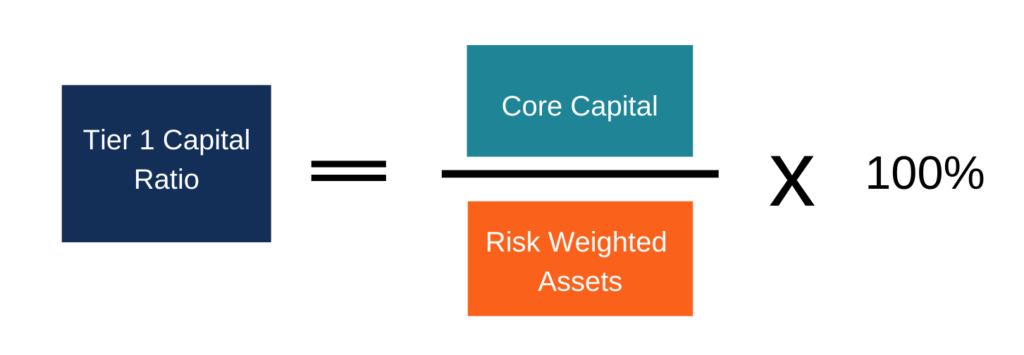
The Tier 1 Capital Ratio is calculated by taking a bank’s core capital relative to its risk-weighted assets. The risk-weighted assets are the assets that the bank holds and that are evaluated for credit risks. The assets are assigned a weight according to their level of credit risk. For example, cash on hand would be weighted 0%, while a mortgage loan would carry weights of 20%, 50%, or 100%.
The Tier 1 Capital Ratio was introduced in 2010 after the financial crisis as a measure of a bank’s ability to withstand financial distress. Most banks held too much debt and low levels of equity, and they lacked adequate capital to absorb losses resulting from the financial crisis. Basel III requires that the equity component of Tier 1 capital should be at least 4.5% of risk-weighted assets.
How to Calculate the Tier 1 Capital Ratio?
The formula for calculating Tier 1 capital ratio is as follows:
Example
Assume that ABC Bank holds $2 million in core capital and lends out $10 million to XYZ Limited. The outstanding loan comes with a risk weighting of 80%. The bank’s Tier 1 capital ratio can be calculated as follows:
Tier 1 Capital Ratio = [$2,000,000 / ($10,000,000 x 80%)] x 100 = 25%
Therefore, the Tier 1 capital ratio for ABC Bank is 25%. The following are the two main ways of expressing the ratio:
- Tier 1 Total Capital Ratio (bank’s core capital)
- Tier 1 Common Capital Ratio – Excludes preferred sharesPreferred SharesPreferred shares (preferred stock, preference shares) are the class of stock ownership in a corporation that has a priority claim on the company’s assets over common stock shares. The shares are more senior than common stock but are more junior relative to debt, such as bonds. and non-controlling interest from Tier 1 total capital amount
Basel III Capital Adequacy Requirements
Basel III tightened the capital adequacy requirements that banks are required to observe. The accord categorizes regulatory capital into Tier 1 and Tier 2. Tier 1 comprises Common Equity Tier 1 and an additional Tier 2. Common Equity Tier 1 includes instruments with discretionary dividends, such as common stocks, while additional Tier 1 includes instruments with no maturity and whose dividends can be canceled at any time.
Under Basel III, the minimum Common Equity Tier 1 increased to 4.5%, down from 4% in Basel II. It also increased the minimum Tier 1 capital to 6% from 4% in Basel II. The overall minimum regulatory capital ratio was left unchanged at 8%, out of which 6% is Tier 1 capital. By the end of 2019, banks were required to hold a conservation buffer of 2.5% of the risk-weighted assets, which brings the total Common Equity Tier 1 capital to 7%, i.e., 4.5% + 2.5%.
Additional Resources
CFI is the official provider of the Commercial Banking & Credit Analyst (CBCA)™Program Page - CBCAGet CFI's CBCA™ certification and become a Commercial Banking & Credit Analyst. Enroll and advance your career with our certification programs and courses. certification program, designed to transform anyone into a world-class financial analyst.
In order to help you become a world-class financial analyst and advance your career to your fullest potential, these additional resources will be very helpful:
- Bank-Specific RatiosBank-Specific RatiosBank-specific ratios, such as net interest margin (NIM), provision for credit losses (PCL), and efficiency ratio are unique to the banking industry. Similar to companies in other sectors, banks have specific ratios to measure profitability and efficiency that are designed to suit their unique business operations.
- Basel IIBasel IIBasel II is the second set of international banking regulations defined by the Basel Committee on Bank Supervision (BCBS). It is an extension of the regulations for minimum capital requirements as defined under Basel I. The Basel II framework operates under three pillars: Capital adequacy requirements, Supervisory review, and Market discipline.
- Capital Adequacy Ratio Calculator
- Risk-Weighted AssetsRisk-Weighted AssetsRisk-weighted assets is a banking term that refers to an asset classification system that is used to determine the minimum capital that banks should keep as a reserve to reduce the risk of insolvency. Maintaining a minimum amount of capital helps to mitigate the risks.
-

Capital Employed: Definition, Calculation & Importance
Capital employed refers to the amount of capital investment a business uses to operate and provides an indication of how a company is investing its money. Although capital employed can be defined in d
-

Understanding Capital Gains: A Comprehensive Guide
A capital gain is an increase in the value of an asset or investment resulting from the price appreciation of the asset or investment. In other words, the gain occurs when the current or sale price of
finance
- Understanding Tier 1 Capital: A Key Indicator of Bank Financial Health
- Backstop: Understanding Financial Safety Nets and Contingency Funding
- Basel I: Understanding Core Banking Regulations & Capital Requirements
- Understanding Capital: Types, Categories & Value Creation
- Capital Rationing: Definition, Strategy & Impact on Investment Decisions
- Equity Capital Market: Definition & How It Works
- Return on Common Equity (ROCE): Definition & Importance
- Share Capital: Definition, Types & Importance for Businesses
- Understanding Common Equity Tier 1 (CET1) Capital
-
 Capital Appropriation: Definition, Process & Examples
Appropriation is the process of allocating capital for specific purposes. Companies, governments, and individuals all appropriate capital for specific objectives. The budgeting process involves approp...
-
 Basel II: Understanding International Banking Regulations
Basel II is the second set of international banking regulations defined by the Basel Committee on Bank Supervision (BCBS). It is an extension of the regulations for minimum capital requirements as def...