
ASCOT Options: Understanding Asset-Swapped Convertible Options
The term ASCOT is short for Asset Swapped Convertible Option Transaction. It is an American style call option to buy back a convertible bond. It falls under the category of financial products called structured products, which are a combination of two more financial products combined to meet the needs of the buyer.
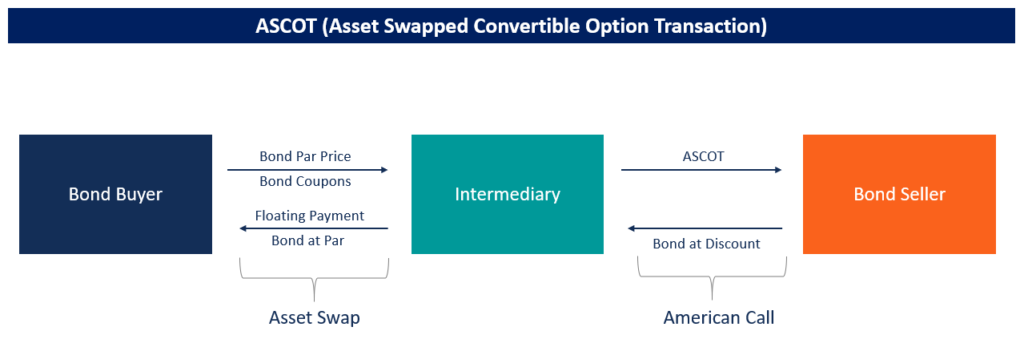
The purpose of using an ASCOT is to separate the two risk components of a convertible bond – equityEquityIn finance and accounting, equity is the value attributable to a business. Book value of equity is the difference between assets and liabilities and credit. The coupon payments from the convertible bond constitute the credit or fixed income part of a convertible bond, while the option to convert to shares of the issuing company is the equity part.
If an investor in a convertible bond wishes to hold onto the equity part but wants some extra cash, they can initiate an ASCOT with a financial institution.
Structure of an ASCOT
An ASCOT comprises two parts – an American call with a floating strike priceStrike PriceThe strike price is the price at which the holder of the option can exercise the option to buy or sell an underlying security, depending on and an asset swap.
American Call
An American call option is the right to buy the underlying asset at a given price anytime during the life of the option. In the case of an ASCOT, the American call option is on the reference convertible bond.
An ASCOT buyer owns the right to buy back the convertible bond when they wish to convert it to equity, but they must agree to a floating strike price to buy back the bond. A floating strike implies that the strike is determined at the time when the owner of the option decides to exercise.
Asset Swap
An asset swap involves swapping an underlying asset for cash and exchanging cash flows to maintain exposure to the asset. In an asset swap, the owner of a convertible bond acts as a swap seller and sells the convertible bond at par to the swap buyer.
Over the life of the bond, the swap buyer – who owns the bond – passes on the coupons to the swap seller. The swap seller pays a floating rate given by LIBORLIBORLIBOR, which is an acronym of London Interbank Offer Rate, refers to the interest rate that UK banks charge other financial institutions for plus an asset swap spread (ASW).
The ASW depends on the credit risk of the underlying convertible bond. Hence, the swap seller maintains risk exposure to the bond via the asset swap spread.
ASCOT Purpose and Parties
Purpose
Assume a fixed income strategy fund owns a convertible bond that they do not want to carry on their balance sheet. On the other hand, they wish to continue to have exposure to the bond. To accomplish this task, they can initiate an ASCOT with a financial institution, who will be the intermediary in the transaction.
ASCOT Buyer
The ASCOT buyer is the bond seller. They sell the bond to the intermediary financial institution in exchange for an option to buy back the bond at a future date. This way, they can have exposure to the equity part of the convertible bond by being able to buy the bond back when they want to convert to equity.
The buyer also incurs reduced balance sheet risk, as they do not need to mark-to-market the value of the bond.
Bond Buyer
The bond buyer is another investor who likes to invest in the credit only part of the convertible bond. The investor enters an asset swap with an intermediary institution, where they buy the bond at par and pass on the coupon payments to the intermediary or swap seller.
In exchange, they receive a floating payment of LIBOR plus the asset swap spread. As discussed above, the asset swap spread depends on the credit risk of the bond; hence, the bond buyer gets paid for the credit risk via the spread.
The net present value of this asset swap is used to determine the price that the ASCOT buyer receives for the convertible bond.
Financial Intermediary
A financial intermediary is a counterparty between the bond seller and the bond buyer. They buy the bond at a discount to par from the ASCOT buyer – the discount to the price is determined by the net present value Net Present Value (NPV)Net Present Value (NPV) is the value of all future cash flows (positive and negative) over the entire life of an investment discounted to the present.of the asset swap between the intermediary and the bond buyer.
This discount acts as a premium paid by the ASCOT buyer for the option to buy back the underlying convertible bond. The intermediary then enters into an asset swap transaction with the credit buyer, where they sell the bond to the buyer at par and exchange payments as described in the asset swap section above.
ASCOT Valuation and Risk Management
Valuation
An ASCOT can be valued using a tree model in the same way as options since an ASCOT is essentially an option to buy back the convertible bond. It involves constructing three trees – one for the stock price to account for if the bond will be called, the second one for valuing the convertible bond, and a third one for the ASCOT.
The three-layered model above is similar to option tree models for options, where a tree for the underlying stock is created, and the option valuation tree is layered on top of it.
Risk Management
The risk management for an ASCOT is similar to managing options. The risk is managed using greeks, just like in options. In the case of an ASCOT, the two most important greeks are the delta and the rho.
Delta measures the sensitivity of the ASCOT value to the underlying stock price, while the rho measures the sensitivity to interest rates.
Additional Resources
CFI is the official provider of the Commercial Banking & Credit Analyst (CBCA)™Program Page - CBCAGet CFI's CBCA™ certification and become a Commercial Banking & Credit Analyst. Enroll and advance your career with our certification programs and courses. certification program, designed to transform anyone into a world-class financial analyst.
To keep learning and developing your knowledge of financial analysis, we highly recommend the additional resources below:
- Asset SwapAsset SwapAn asset swap is a derivative contract between two parties that swap fixed and floating assets. The transactions are done over-the-counter based on an
- Call OptionCall OptionA call option, commonly referred to as a "call," is a form of a derivatives contract that gives the call option buyer the right, but not the obligation, to buy a stock or other financial instrument at a specific price - the strike price of the option - within a specified time frame.
- Convertible BondConvertible BondA convertible bond is a type of debt security that provides an investor with a right or an obligation to exchange the bond for a predetermined number of shares in the issuing company at certain times of a bond’s lifetime. A convertible bond is a hybrid security
- Option GreeksOption GreeksOption Greeks are financial measures of the sensitivity of an option’s price to its underlying determining parameters, such as volatility or the price of the underlying asset. The Greeks are utilized in the analysis of an options portfolio and in sensitivity analysis of an option
-
Understanding Call Dates: What You Need to Know
A call date refers to the date when a callable bondCallable BondA callable bond (redeemable bond) is a type of bond that provides the issuer of the bond with the right, but not the obligation, to rede
-

Understanding Call Prices: Callable Bonds & Preferred Stocks
A call price refers to the price that a preferred stock or bond issuer would pay to buyers if they chose to redeem the callable security before the maturity date. The price is set during the issuance
invest
- Asset Swap Explained: Definition, OTC Trading & Key Concepts
- Coupon Bonds: Understanding Fixed Income & Interest Payments
- Discount Bonds: Understanding Pricing & Secondary Markets
- Understanding Noncallable Securities: A Comprehensive Guide
- Samurai Bonds: A Guide to Understanding Yen-Denominated Corporate Debt
- Swaptions Explained: Understanding Interest Rate Option Contracts
- Treasury Bonds: A Comprehensive Guide to U.S. Government Debt
- Zero-Coupon Bonds: Definition, How They Work & Examples
- Understanding Bonds: A Comprehensive Guide for Investors
-
 Understanding Bonds: A Comprehensive Guide for Investors
Bonds are fixed-income securitiesTrading & InvestingCFIs trading & investing guides are designed as self-study resources to learn to trade at your own pace. Browse hundreds of articles on trad...
-
 Bullet Bond Portfolios: A Comprehensive Guide
A bullet bond portfolio, commonly referred to as a bullet portfolio, is made up of a range of bullet bonds, from short-term to long-term bullet bonds. A bullet bond is a non-callable bondNon-Callable ...