
DRIP (Dividend Reinvestment Plan): A Comprehensive Guide for Investors
A DRIP (Dividend Reinvestment Plan) allows investors to reinvest any dividend earnings they receive back into the stock of the company paying out the dividend. DRIPs give stock market investors who own shares in a particular company the opportunity to receive dividend paymentsDividendA dividend is a share of profits and retained earnings that a company pays out to its shareholders. When a company generates a profit and accumulates retained earnings, those earnings can be either reinvested in the business or paid out to shareholders as a dividend. either in the form of additional shares of that company or as a discount towards future purchases of the company’s shares.

Dividend Reinvestment Plans are particularly popular among passive investors who don’t want to spend a lot of time studying the stock market and picking specific companies to buy or sell. They can enable such investors to grow their portfolio without necessarily exerting too much effort. However, DRIPs are very illiquid investments as they tie up capital for a longer duration than a normal equity investment. In addition, most plans don’t provide any tax advantage as the extra company stocks are treated as capital gainsCapital GainA capital gain is an increase in the value of an asset or investment resulting from the price appreciation of the asset or investment. In other words, the gain occurs when the current or sale price of an asset or investment exceeds its purchase price. and taxed accordingly.
Dividend Payments
Companies that are listed on stock exchanges are publicly heldPrivate vs Public CompanyThe main difference between a private vs public company is that the shares of a public company are traded on a stock exchange, while a private company's shares are not. companies and, as such, list millions of shareholders. Every shareholder is entitled to receive a share of the company’s profits that the company has not invested back into the business. Publicly listed companies distribute their excess profits back to shareholders using dividend payments.
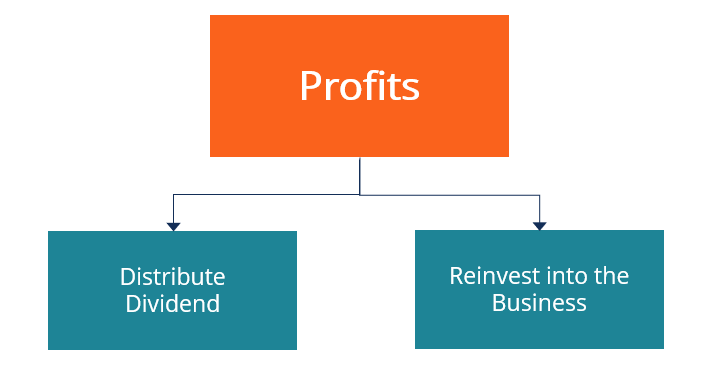
A company that is paying out a high dividend could be doing so either because it is making large profits or because it is winding down its operations and preparing to shut down. In the latter case, the dividend payments are made using proceeds from asset sales. Therefore, a high dividend can’t be seen as a sure sign of a good stock investment.
Similarly, a company that is paying out a low dividend could be doing so either because it is making small profits (or losses) or because it is expanding operations. Therefore, a low dividend can’t be seen as a sure sign of a bad stock investment.
DRIP – Illustrative Example
An investor owns 1,000 shares of Apple Inc (NASDAQ:AAPL) priced at $200 per share. The investor is confident that Apple’s stock price will rise in the future and enters into a dividend reinvestment plan with the company. Apple declares a dividend of $8 per share or 4%. Since the investor owns 1,000 shares of Apple, he would’ve received $8,000 in cash if he was not enrolled in the dividend reinvestment plan. Since he is enrolled in the DRP, he receives an additional 40 (Cash Dividend Amount / Share Price = 8,000 / 200) shares of Apple.
Additional Resources
CFI offers the Financial Modeling & Valuation Analyst (FMVA)™Become a Certified Financial Modeling & Valuation Analyst (FMVA)®CFI's Financial Modeling and Valuation Analyst (FMVA)® certification will help you gain the confidence you need in your finance career. Enroll today! certification program for those looking to take their careers to the next level. To keep learning and advancing your career, the following CFI resources will be helpful:
- Capital Gains TaxCapital Gains TaxCapital gains tax is a tax imposed on capital gains or the profits that an individual makes from selling assets. The tax is only imposed once the asset has been converted into cash, and not when it’s still in the hands of an investor.
- Dividend Payout RatioDividend Payout RatioDividend Payout Ratio is the amount of dividends paid to shareholders in relation to the total amount of net income generated by a company. Formula, example
- Dividend PolicyDividend PolicyA company’s dividend policy dictates the amount of dividends paid out by the company to its shareholders and the frequency with which the dividends are paid
- Retained EarningsRetained EarningsThe Retained Earnings formula represents all accumulated net income netted by all dividends paid to shareholders. Retained Earnings are part
-
Understanding Financial Gearing: Debt & Leverage Explained
Gearing is the amount of debtNet DebtNet debt = total debt - cash. Net debt is a financial liquidity metric that measures a company’s ability to pay all its debts if they were due today. Compare
-
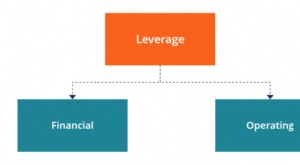
Leverage in Finance: Strategies, Types & Risks
In finance, leverage is a strategy that companies use to increase assets, cash flows, and returns, though it can also magnify losses. There are two main types of leverage: financial and operating. To
finance
- Dividend Reinvestment Plans (DRIPs): A Comprehensive Guide
- Understanding Dividend Yield: A Key Metric for Investors
- Understanding Forward Dividend Yield: A Key Metric for Investors
- Understanding Liquidating Dividends: A Comprehensive Guide
- Special Dividends: Understanding One-Time Distributions
- Understanding Dividend Policy: A Comprehensive Guide
- Dividend Recapitalization: Definition & How It Works
- Dividend Reinvestment Plans (DRIPs): A Beginner's Guide
- Dividend Reinvestment Plans (DRIPs): Benefits & Drawbacks
-
 Understanding Dividends: A Comprehensive Guide
A dividend is a share of profits and retained earningsRetained EarningsThe Retained Earnings formula represents all accumulated net income netted by all dividends paid to shareholders. Retained Earnin...
-
 Comprehensive Financial Planning: Your Path to Financial Security
A financial plan is a document that covers an individual’s current financial situation, short-term and long-term economic goals, and an in-depth strategy to achieve the goals. A finan...