
Understanding the Envy Ratio in Private Equity
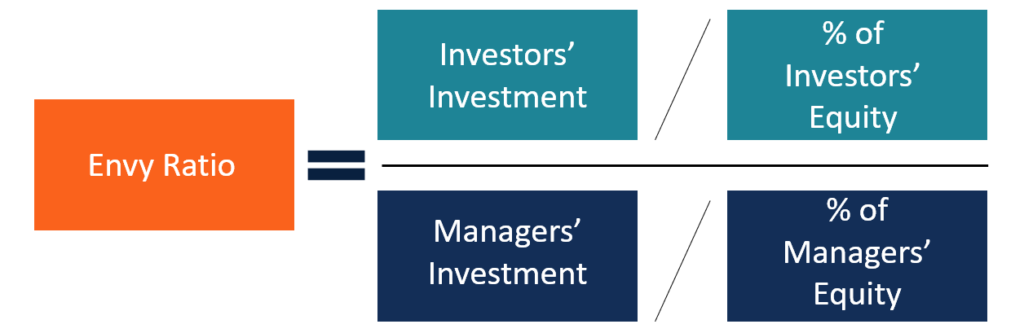
In private equity, the envy ratio is a ratio that shows the price paid by investors in relation to the price paid by the management team for their respective shares of the company’s common equity. In other words, the envy ratio indicates how much the company’s managers spent relative to private equity investorsPrivate Equity FundsPrivate equity funds are pools of capital to be invested in companies that represent an opportunity for a high rate of return. They come with a fixed for the acquisition of their respective equity shares.
The concept of the envy ratio is primarily used in the context of management buyouts (MBOs).Management Buyout (MBO)A management buyout (MBO) is a corporate finance transaction where the management team of an operating company acquires the business by borrowing money to The envy ratio can be a key metric for management when aiming to acquire a larger ownership share of the company.
In buyout deals, the success of a deal is highly dependent on the commitment of the company’s current managers. Due to this reason, the sweet equity (i.e., the equity reserved as an incentive for management) is frequently included in the buyout. Furthermore, outside investors (private equity investors) usually acquire their equity stake in the company at a higher valuation than that of the company’s managers.
Importance of the Envy Ratio
The envy ratio is a metric that can help determine the attractiveness of a deal to each investor party. The general rule is that a higher envy ratio indicates a better deal for management. A higher ratio shows that private equity investors are willing to reward the company’s management for their ability to generate value for the company. In addition, a high ratio indicates intense competition among private equity investors seeking to enter the deal.
Using the envy ratio, the company’s management can assess the commitment of private equity investors to the deal. A higher envy ratio indicates that outside investors are strongly committed to the deal.
How to Calculate the Envy Ratio
The ratio can be calculated using the formula below:

Example
The management of RedWhite Corporation considers a management buyout of the company as an exit strategy to make the company privatePrivate vs Public CompanyThe main difference between a private vs public company is that the shares of a public company are traded on a stock exchange, while a private company's shares are not.. However, the managers lack adequate capital to acquire a sufficient equity stake in the company from its current owners. Thus, they decide to finance the deal with private equity firms.
The managers approach two private equity firms: ABC Capital and XYZ Capital. ABC Capital offers the managers the following deal: ABC Capital will acquire an 85% stake in the company for $38M, and the managers will acquire 15% of equity for $2M. XYZ Capital offers to finance the purchase of 75% of equity for $35M, and the managers will acquire the other 25% for $5M.
The managers can identify the better deal by calculating the envy ratio of each offer:
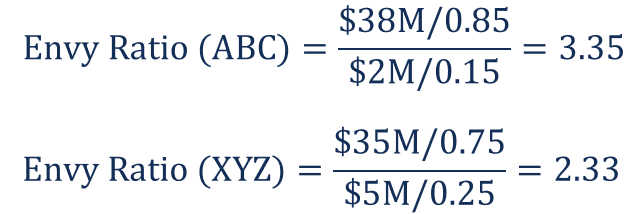
The managers choose ABC Capital’s offer because it provides a much higher ratio (3.35).
More Resources
CFI offers the Financial Modeling & Valuation Analyst (FMVA)™Become a Certified Financial Modeling & Valuation Analyst (FMVA)®CFI's Financial Modeling and Valuation Analyst (FMVA)® certification will help you gain the confidence you need in your finance career. Enroll today! certification program for those looking to take their careers to the next level. To keep learning and advancing your career, the following CFI resources will be helpful:
- Control PremiumControl PremiumControl premium refers to an amount that a buyer is willing to pay in excess of the fair market value of shares in order to gain a controlling interest
- GoodwillGoodwillIn accounting, goodwill is an intangible asset. The concept of goodwill comes into play when a company looking to acquire another company is
- Leveraged Buyout (LBO)Leveraged Buyout (LBO)A leveraged buyout (LBO) is a transaction where a business is acquired using debt as the main source of consideration.
- Top 10 Private Equity FirmsTop 10 Private Equity FirmsWho are the top 10 private equity firms in the world? Our list of the top ten largest PE firms, sorted by total capital raised. Common strategies within P.E. include leveraged buyouts (LBO), venture capital, growth capital, distressed investments and mezzanine capital.
-

Understanding the Retention Ratio: Reinvesting for Growth
The retention ratio (also known as the net income retention ratio) is the ratio of a company’s retained income to its net incomeNet IncomeNet Income is a key line item, not only in the income st
-
Sharpe Ratio: Calculate & Interpret Investment Performance
Named after American economist, William Sharpe, the Sharpe Ratio (or Sharpe Index or Modified Sharpe Ratio) is commonly used to gauge the performance of an investment by adjusting for its risk.The hig
finance
- Acid-Test Ratio: Understanding Your Company's Short-Term Liquidity
- Asset Turnover Ratio: Definition & Calculation - Financial Analysis
- Debt-to-Asset Ratio: Definition, Calculation & Significance
- Debt-to-Equity Ratio: Definition, Calculation & Importance
- Defensive Interval Ratio (DIR): Understanding Company Liquidity
- Equity Capital Market: Definition & How It Works
- Equity Ratio: Understanding Financial Leverage & Risk
- Net Debt to EBITDA Ratio: Understanding Company Solvency
- Shareholder Equity Ratio: Definition & Calculation | [Your Company Name]
-
 Quick Ratio: Understanding Your Business's Short-Term Liquidity
The Quick Ratio, also known as the Acid-test or Liquidity ratio, measures the ability of a business to pay its short-term liabilities by having assets that are readily convertible into cashCash Equiva...
-
 Reserve Ratio Explained: Understanding Bank Reserves
The reserve ratio – also known as bank reserve ratio, bank reserve requirement, or cash reserve ratio – is the percentage of deposits a financial institution must hold in reserve as cash. ...