
Understanding the Hockey Stick Effect: Causes & Implications
The hockey stick effect is characterized by a sharp rise or fall of data points after a long flat period. It is illustrated using the graphical shape of a line chart that resembles a hockey stick. The hockey stick chart formation illustrates that urgent action may be required to understand a phenomenon or find a solution for the drastic shift in data points.
In business, a hockey stick chart is used to show significant growth in revenues, EBITDAEBITDAEBITDA or Earnings Before Interest, Tax, Depreciation, Amortization is a company's profits before any of these net deductions are made. EBITDA focuses on the operating decisions of a business because it looks at the business’ profitability from core operations before the impact of capital structure. Formula, examples, and EBITDA marginsEBITDA MarginEBITDA margin = EBITDA / Revenue. It is a profitability ratio that measures earnings a company is generating before taxes, interest, depreciation, and amortization. This guide has examples and a downloadable template. It is also used to show dramatic shifts in salesSales RevenueSales revenue is the income received by a company from its sales of goods or the provision of services. In accounting, the terms "sales" and, poverty statistics, global temperatures, etc.
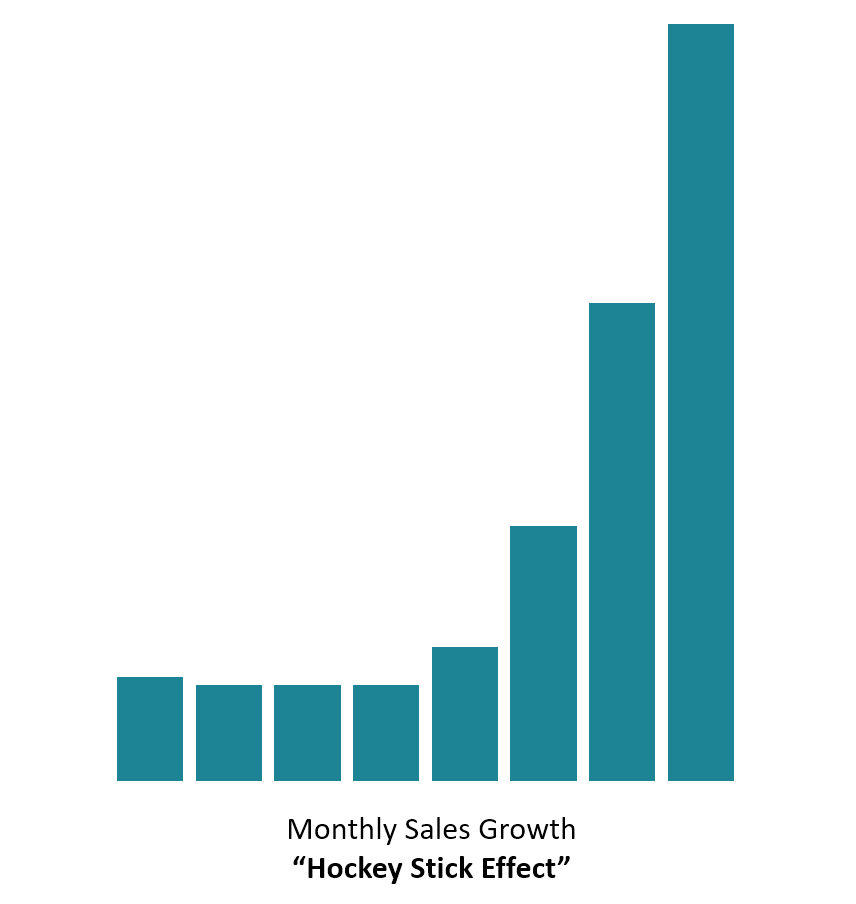
Explaining the Hockey Stick Chart
A hockey stick comprises a blade, a sharp curve, and a long shaft. The curve starts at a low-activity level on the X-axis for a short period of time. Then, there is a sudden bend followed by a long rise with a steep curve.
When such a dramatic shift occurs from a flat period with no activity to a “hockey stick” curve, it is a clear indication that action is needed to understand the causative factors. In a business, the chart may be representative of, for example, large problems within the sales processSales and Collection CycleThe Sales and Collection Cycle, also known as the revenue, receivables, and receipts (RRR) cycle, is comprised of various classes of. Some of the possible problems are misaligned goals, weak value proposition, or hands-off management style. Understanding the chart may lead to a realignment of goals, processes, or business strategies.
Impact of Hockey Stick Effect on a Company
When a hockey stick effect occurs, the majority of revenues of a company are concentrated in the last part of a period (either week, month, quarter or year). The unbalanced sales performance results in the following effects on a company:
Product delivery
When a large number of customer orders are made at the end of a sales period, it can put a strain on the customer service and delivery teams. When the company’s been performing below its usual limits, and then sales start accelerating at the end of the period, the company’s resources may be stretched to the limits.
Resulting difficulties can lead to unfulfilled orders, exhausted staff members, worker stress, and delivery mismatch. It can leave some customers unhappy because their orders were either not delivered or not properly filled. If the problem is not addressed immediately, it could result in significant, long-term customer losses.
Product returns and refunds
An influx of orders and a stretched sales team can easily lead to unhappy customers. Customers who received the wrong products or low-quality products will return the products and ask for a refund or replacement.
Either way, this leads to a loss of revenues and negative impacts on the company’s image. It’s more difficult to repair a damaged customer relationship than to establish a good relationship to start.
Discounts
After a period characterized by a low number of sales and unhappy customers, the company may offer special discounts as a way of attracting new customers and retaining existing ones. The company may offer, for example, discounts or a free item for every two items purchased.
Discounts and special terms can result in a sharp increase in sales as customers take advantage of generous promotions. This may put a strain on the sales teams as they work to ensure all the promises are fulfilled and prevent any incidences of losses from occurring. If sales still slump, the discounts and special terms will lead to a direct loss of profits.
Solving the Hockey Stick Effect
There are several steps that the management of a company can take to solve the hockey stick effect, including:
Realigning the sales process
The company can optimize the sales process to make sales forecasts more accurate. This can be achieved by getting the sales teams to generate forecasts that are based on more reliable metrics like current leads, the value of active sales cycles, close ratios, and the average sales cycle time. The forecasts should then be sent to the appropriate levels of management to combine the figures into a detailed report. Getting sales forecasts from the sales reps to upper management is more reliable than having management prepare the estimates and send them to the sales teams.
Customer Relationship Management (CRM) software
Using CRM software can help a company monitor, review and enhance sales performance in real-time. It enables management or sales representatives to identify any bottlenecks that may affect the sales process and seek immediate remedies. They can also monitor the sales process to identify stages that are taking too long to complete, pinpoint the causes, and find quick solutions. CRM software also helps to monitor customer conversion rates at various stages of the sales cycle. It can also help in testing business strategies that can then be replicated.
Proper sales analytics
The sales teams should rely on tried and proven sales analytics to track incoming sales from the beginning to the end of the sales period. If there are lapses or sudden changes in the process, the sales team can identify the causes and take corrective measures. As the end of the sales period nears, the company should not resort to unusual discounts and special terms that reduce the amount of profits.
Additional Resources
Thank you for reading CFI’s explanation of the Hockey Stick Effect. CFI is the global provider of the Financial Modeling & Valuation Analyst (FMVA)™Become a Certified Financial Modeling & Valuation Analyst (FMVA)®CFI's Financial Modeling and Valuation Analyst (FMVA)® certification will help you gain the confidence you need in your finance career. Enroll today! certification, a training program of financial modeling courses for finance professionals. To help you advance your career in the financial services industry, check out the additional CFI resources below:
- Analysis of Financial StatementsAnalysis of Financial StatementsHow to perform Analysis of Financial Statements. This guide will teach you to perform financial statement analysis of the income statement,
- Demand CurveDemand CurveThe demand curve is a line graph utilized in economics, that shows how many units of a good or service will be purchased at various prices
- Profitability RatiosProfitability RatiosProfitability ratios are financial metrics used by analysts and investors to measure and evaluate the ability of a company to generate income (profit) relative to revenue, balance sheet assets, operating costs, and shareholders' equity during a specific period of time. They show how well a company utilizes its assets to produce profit
- Yield GapYield GapThe Yield Gap is the difference between the yields of government-issued securities and the average dividend yield on stock shares.
-
Understanding the Envy Ratio in Private Equity
In private equity, the envy ratio is a ratio that shows the price paid by investors in relation to the price paid by the management team for their respective shares of the company’s common equit
-

Equity Capital Market: Definition & How It Works
The equity capital market is a subset of the broader capital market, where financial institutions and companies interact to trade financial instruments and raise capital for companies. Equity capital
finance
- Acid-Test Ratio: Understanding Your Company's Short-Term Liquidity
- Advertising to Sales Ratio: Measuring Ad Effectiveness & ROI
- Understanding the Earnings Multiplier (P/E Ratio): A Comprehensive Guide
- Understanding the IPO Process: A Comprehensive Guide
- Modigliani-Miller Theorem: Understanding Capital Structure & Firm Value
- Skin in the Game: Understanding Risk & Accountability
- Bandwagon Effect: Understanding Social Influence & Conformity
- Clientele Effect: How Investor Preferences Impact Stock Prices
- Understanding the January Effect: Stock Market Trends & Causes
-
 Understanding Degree of Operating Leverage (DOL): A Comprehensive Guide
The degree of operating leverage (DOL) is a financial ratio that measures the sensitivity of a company’s operating incomeOperating IncomeOperating income is the amount of revenue left after dedu...
-
 Understanding Total Leverage: A Comprehensive Guide
The degree of total leverage is a ratio that compares the rate of change a company experiences in earnings per share (EPS)Earnings Per Share (EPS)Earnings per share (EPS) is a key metric used to deter...