
Media for Equity: An Alternative Startup Funding Model
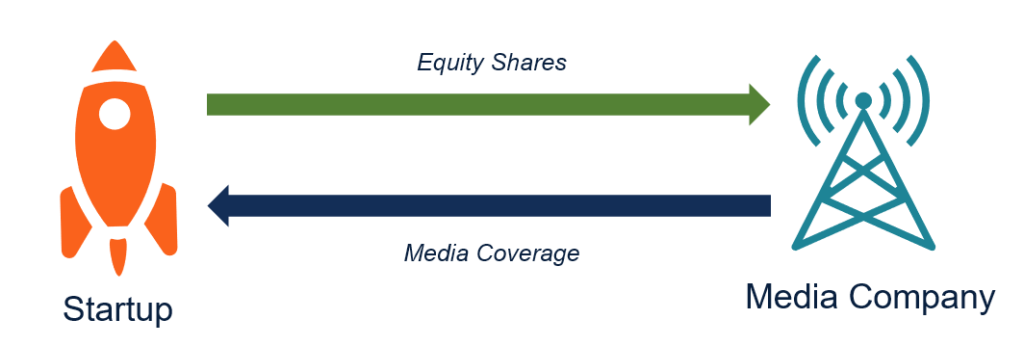
Media for equity is an alternative investment model used in the world of venture capital. The media for equity model is different from conventional methods of financing due to the fact that it does not involve the direct funding of a startupStartup Valuation Metrics (for internet companies)Startup Valuation Metrics for internet companies. This guide outlines the 17 most important e-commerce valuation metrics for internet starts to be valued. Instead, a startup obtains extensive media coverage (i.e., certain forms of advertising in the media space) in exhange for offering shares in the company to investors. Thus, the primary investors in the media for equity model are media companies.
Advantages of the Media for Equity Model
While successful marketing campaigns5 P's of MarketingThe 5 P's of Marketing – Product, Price, Promotion, Place, and People – are key marketing elements used to position a business strategically. The 5 P's of provide huge benefits to startups by helping build a customer base and raise awareness about the company among potential customers, they usually cost a lot and require professional advice. Thus, the media for equity model is beneficial to startups as it allows them to acquire advertising for their products or services without spending money, as well as providing professional support from the media company to run marketing campaigns.
At the same time, the media company that participates obtains shares in the startup that can lead to lucrative returns in the future.
Note that the media for equity model cannot be used as a primary or standalone method of financing. Instead, the model is often utilized between conventional rounds of venture financingVenture CapitalVenture capital is a form of financing that provides funds to early stage, emerging companies with high growth potential, in exchange for equity or an ownership stake. Venture capitalists take the risk of investing in startup companies, with the hope that they will earn significant returns when the companies become a success.. The model can be used to scale the business operations of a company, as well as to strengthen its performance to attract investors for the next round of venture capital raising.
Who Can Use Media for Equity?
Unlike conventional venture capital models, the media for equity model is not suitable for every company. Generally, the model can be used by companies that already have a product or service ready for sale to customers, as well as stable operations. At this stage of business development, startups aim to scale up their business and build a customer base. In other words, they are looking to attract as many new customers as possible to boost their revenues.
In addition, a startup that is willing to pursue the media for equity model must formulate a clear marketing strategy that determines the exact channels that will be most helpful in attracting new customers.
Finally, the model is suitable for companies that provide business-to-consumer (B2C) services.
Additional Resources
Thank you for reading CFI’s explanation of the media for equity financing model. CFI is the official provider of the global Financial Modeling & Valuation Analyst (FMVA)™Become a Certified Financial Modeling & Valuation Analyst (FMVA)®CFI's Financial Modeling and Valuation Analyst (FMVA)® certification will help you gain the confidence you need in your finance career. Enroll today! certification program, designed to help anyone become a world-class financial analyst. To keep advancing your career, the additional CFI resources below will be useful:
- AIDA ModelAIDA ModelThe AIDA model, which stands for Attention, Interest, Desire, and Action model, is an advertising effect model that identifies the stages that an individual
- Brand EquityBrand EquityIn marketing, brand equity refers to the value of a brand and is determined by the consumer’s perception of the brand. Brand equity can be positive or
- Capital Raising ProcessCapital Raising ProcessThis article is intended to provide readers with a deeper understanding of how the capital raising process works and happens in the industry today. For more information on capital raising and different types of commitments made by the underwriter, please see our underwriting overview.
-
![Growth Equity: Investing in Expanding Businesses | [Your Company Name]](https://www.etffin.com/article/uploadfiles/202110/2021100815235075_S.jpeg)
Growth Equity: Investing in Expanding Businesses | [Your Company Name]
Growth equity (also known as growth capital or expansion capital) is a type of investment opportunity in relatively mature companies that are going through some transformational event in their lifecyc
-
Understanding Equity Statements: A Comprehensive Guide
An equity statement – also referred to as a statement of owner’s equity or statement of changes in equity – is a financial statement that a company is required to prepare along with
finance
- Backstop: Understanding Financial Safety Nets and Contingency Funding
- Cost of Equity: Definition, Calculation & Importance
- Understanding Equity: A Comprehensive Guide for Investors
- Equity Crowdfunding: A Comprehensive Guide for Startups & Investors
- Equity Multiplier: Definition, Calculation & Financial Significance
- Equity Ratio: Understanding Financial Leverage & Risk
- Model Audit: Ensuring Accuracy and Reliability in Financial Models
- Understanding Negative Equity: Causes, Risks & Solutions
- Understanding Home Equity: A Comprehensive Guide
-
 Understanding the Yield Gap: Bonds vs. Stocks
The Yield Gap is the difference between the yields of government-issued securitiesBond IssuersThere are different types of bond issuers. These bond issuers create bonds to borrow funds from bondholder...
-
 Backtesting: A Comprehensive Guide to Strategy Validation
Backtesting involves applying a strategy or predictive model to historical data to determine its accuracy. It can be used to test and compare the viability of trading strategies so tradersSix Essentia...