
Operating Profit Margin: Definition & Calculation | [Your Company Name]
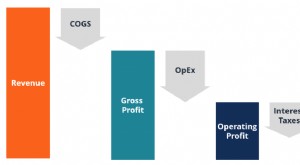
Operating Profit Margin is a profitability or performance ratio that reflects the percentage of profit a company produces from its operations, prior to subtracting taxes and interest charges. It is calculated by dividing the operating profit by total revenueSales RevenueSales revenue is the income received by a company from its sales of goods or the provision of services. In accounting, the terms "sales" and and expressing as a percentage. The margin is also known as EBIT (Earnings Before Interest and Tax)EBIT GuideEBIT stands for Earnings Before Interest and Taxes and is one of the last subtotals in the income statement before net income. EBIT is also sometimes referred to as operating income and is called this because it's found by deducting all operating expenses (production and non-production costs) from sales revenue. Margin.
![Operating Profit Margin: Definition & Calculation | [Your Company Name]](https://www.etffin.com/Article/UploadFiles/202110/2021100815165062.png)
Image: CFI’s Financial Analysis Courses.
Operating Profit Margin differs across industries and is often used as a metric for benchmarking one company against similar companies within the same industry. It can reveal the top performers within an industry and indicate the need for further research regarding why a particular company is outperforming or falling behind its peers.
How to Calculate Operating Profit Margin?
![Operating Profit Margin: Definition & Calculation | [Your Company Name]](https://www.etffin.com/Article/UploadFiles/202110/2021100815165005.png)
Operating profit is calculated by subtracting all COGSCost of Goods Sold (COGS)Cost of Goods Sold (COGS) measures the “direct cost” incurred in the production of any goods or services. It includes material cost, direct, depreciation and amortization, and all relevant operating expenses from total revenues. Operating expenses include a company’s expenses beyond direct production costs – such things as salaries and benefits, rent and related overhead expenses, research and development costsResearch and Development (R&D)Research and Development (R&D) is a process by which a company obtains new knowledge and uses it to improve existing products and introduce, etc. The operating profit margin calculation is the percentage of operating profit derived from total revenue. For example, a 15% operating profit margin is equal to $0.15 operating profit for every $1 of revenue.
![Operating Profit Margin: Definition & Calculation | [Your Company Name]](https://www.etffin.com/Article/UploadFiles/202110/2021100815165039.png)
How to Use Operating Profit Margin?
Operating Profit Margin differs from Net Profit MarginNet Profit MarginNet Profit Margin (also known as "Profit Margin" or "Net Profit Margin Ratio") is a financial ratio used to calculate the percentage of profit a company produces from its total revenue. It measures the amount of net profit a company obtains per dollar of revenue gained. as a measure of a company’s ability to be profitable. The difference is that the former is based solely on its operations by excluding the financing cost of interest payments and taxes.
An example of how this profit metric can be used is the situation of an acquirer considering a leveraged buyoutLeveraged Buyout (LBO)A leveraged buyout (LBO) is a transaction where a business is acquired using debt as the main source of consideration.. When the acquirer is analyzing the target company, they would be looking at potential improvements that they can bring into the operations. The operating profit margin provides an insight into how well the target company performs in comparison to its peers, in particular, how efficiently a company manages its expenses so as to maximize profitabilityProfitability RatiosProfitability ratios are financial metrics used by analysts and investors to measure and evaluate the ability of a company to generate income (profit) relative to revenue, balance sheet assets, operating costs, and shareholders' equity during a specific period of time. They show how well a company utilizes its assets to produce profit. The omission of interest and taxes is helpful because a leveraged buyout would inject a company with completely new debt, which would then make historical interest expense irrelevant.
A company’s operating profit margin is indicative of how well it is managed because operating expenses such as salaries, rent, and equipment leases are variable costsVariable CostsVariable costs are expenses that vary in proportion to the volume of goods or services that a business produces. In other words, they are costs that vary, rather than fixed expensesFixed and Variable CostsCost is something that can be classified in several ways depending on its nature. One of the most popular methods is classification according. A company may have little control over direct production costs such as the cost of raw materials required to produce the company’s products. However, the company’s management has a great deal of discretion in areas such as how much they choose to spend on office rent, equipment, and staffing. Therefore, a company’s operating profit margin is usually seen as a superior indicator of the strength of a company’s management team, as compared to gross or net profit margin.
Video Explanation of Operating Profit Margin
Below is a short video that explains how to calculate the ratio and why it’s important when performing financial analysisAnalysis of Financial StatementsHow to perform Analysis of Financial Statements. This guide will teach you to perform financial statement analysis of the income statement,.
Video: CFI’s Financial Analysis Fundamentals Course.
Download the Free Template
Enter your name and email in the form below and download the free template now!
![Operating Profit Margin: Definition & Calculation | [Your Company Name]](https://www.etffin.com/Article/UploadFiles/202110/2021100815165018.png)
Image: CFI’s Financial Analysis Courses.
Limitations of Using the Operating Profit Margin Ratio
As in any part of financial analysisAnalysis of Financial StatementsHow to perform Analysis of Financial Statements. This guide will teach you to perform financial statement analysis of the income statement,, any number of interest requires additional research to understand the reasons behind the number. Discrepancies in operating profit margin between peers can be attributed to a variety of factors. For instance, a company pursuing an outsourcing strategy may report a different profit margin than a company that produces in-house.
In comparing companies, the method of depreciation may yield changes in operating profit margin. A company using a double-declining balance depreciation method may report lower profit margins that increase over time even if no change in efficiency occurs. A company using a straight-line depreciationStraight Line DepreciationStraight line depreciation is the most commonly used and easiest method for allocating depreciation of an asset. With the straight line method would see a constant margin unless some other factor changes as well.
A general rule is to hold factors such as geography, company size, industry, and business model constant when using operating profit margin as a comparison analytic between peers. It is also useful to consider other profitability metrics alongside it such as Gross Profit MarginGross Margin RatioThe Gross Margin Ratio, also known as the gross profit margin ratio, is a profitability ratio that compares the gross profit of a company to its revenue. or Net Profit MarginNet Profit MarginNet Profit Margin (also known as "Profit Margin" or "Net Profit Margin Ratio") is a financial ratio used to calculate the percentage of profit a company produces from its total revenue. It measures the amount of net profit a company obtains per dollar of revenue gained., as well as other financial metrics such as leverage, efficiency, and market value ratiosMultiples AnalysisThe multiples analysis is a valuation technique that utilizes different financial metrics from comparable companies to value a target company..
You can advance your expertise in financial analysis of companies’ money management and profitability by learning about the other aspects of corporate finance that are detailed in the articles listed below.
More Resources
To continue advancing your career as a Certified Financial AnalystBecome a Certified Financial Modeling & Valuation Analyst (FMVA)®CFI's Financial Modeling and Valuation Analyst (FMVA)® certification will help you gain the confidence you need in your finance career. Enroll today!, these CFI resources will be useful:
- Profitability RatiosProfitability RatiosProfitability ratios are financial metrics used by analysts and investors to measure and evaluate the ability of a company to generate income (profit) relative to revenue, balance sheet assets, operating costs, and shareholders' equity during a specific period of time. They show how well a company utilizes its assets to produce profit
- Depreciation ExpenseDepreciation ExpenseWhen a long-term asset is purchased, it should be capitalized instead of being expensed in the accounting period it is purchased in.
- Straight-Line DepreciationStraight Line DepreciationStraight line depreciation is the most commonly used and easiest method for allocating depreciation of an asset. With the straight line
- Financial Analyst Certification ProgramBecome a Certified Financial Modeling & Valuation Analyst (FMVA)®CFI's Financial Modeling and Valuation Analyst (FMVA)® certification will help you gain the confidence you need in your finance career. Enroll today!
-

Operating Lease Explained: Benefits & How They Work
An operating lease is an agreement to use and operate an asset without the transfer of ownership. Common assetsTangible AssetsTangible assets are assets with a physical form and that hold value. Examp
-
Understanding Profit: A Key Financial Metric
Profit is the value remaining after a company’s expenses have been paid. It can be found on an income statement. If the value that remains after expenses have been deducted from revenue is posit
finance
- Understanding Gross Profit Margin: Definition & Calculation
- EBITDA Margin: Definition, Calculation & Importance
- Margin of Safety: Definition, Calculation & Importance
- Net Profit Margin: Definition, Calculation & Importance
- Understanding Operating Risk: A Key Component of Business Risk
- Profit vs. Cash Flow: Understanding the Key Difference
- Understanding Profitability Ratios: A Comprehensive Guide
- Operating Margin: Definition, Calculation & Importance
- Profit Margin Explained: Types & How to Calculate
-
 Marginal Profit: Definition, Calculation & Maximization
Marginal profit refers to the profit earned by a business when an additional unit is produced and sold. Under the mainstream economic theory, the marginal approach to profit maximization states that i...
-
 Understanding Markup: Definition, Calculation & Importance
Markup refers to the difference between the selling price of a good or service and its cost. It is expressed as a percentage above the cost. In other words, it is the premium over the total cost of th...