
Put-Call Ratio (PCR): Understanding Market Sentiment & Options Trading
The put-call ratio (PCR) is an indicator used by investors to gauge the outlook of the market. The ratio uses the volume of puts and calls over a determined time period on a market index to determine market sentiment. It can additionally be used for individual securities by looking at the volume of puts and callsOptions: Calls and PutsAn option is a derivative contract that gives the holder the right, but not the obligation, to buy or sell an asset by a certain date at a specified price. on a security over a determined time period. A high PCR is indicative of bearish sentiment while a low PCR is indicative of bullish sentiment.
Summary:
- The put-call ratio (PCR) is an indicator used by investors to gauge the outlook of the market.
- The PCR is calculated as put volume over a determined time period dividend by call volume over the same time period.
- The ratio is interpreted differently depending on the type of investor.
Formula for the Put-Call Ratio
The formula for the put-call ratio is as follows:
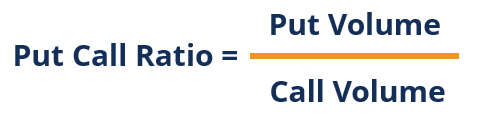
Where:
- Put Volume is the number of put options initiated over a determined time period; and
- Call Volume is the number of call options initiated over the same time period.
It is important to note that the PCR is not limited to put volume and call volume in its calculation. It is common for investors to use a variation, as shown below:

Where:
- Total Put Open Interest is the total number of outstanding puts; and
- Total Call Open Interest is the total number of outstanding calls.
Example of the Put-Call Ratio
An investor is looking to use the put-call ratio as a preliminary measure of sentiment on a securityPublic SecuritiesPublic securities, or marketable securities, are investments that are openly or easily traded in a market. The securities are either equity or debt-based.. The security showed the following puts and calls initiated over the more recent trading day:

The put-call ratio for the security is 1,250 / 1,700 = 0.7353.
How to Interpret the Put-Call Ratio
1. Interpreting the Number
A PCR below one (<1) suggests that investors are purchasing more call options than put options and signals that investors are speculating a bullish trend going forward.
A PCR above one (>1) suggests that investors are purchasing more put options than call options and signals that investors are speculating a bearish trend going forward.
A PCR at one (=1) suggests that investors are purchasing the same amount of put options as call options and signals a neutral trend going forward.
No PCR is considered ideal, but a PCR below 0.7 is typically viewed as a strong bullish sentiment while a PCR above 1 is typically viewed as a strong bearish sentiment.
2. Investment Style
It is important to note that the PCR is interpreted differently depending on the investor’s investment style. For example, consider two investment styles:
A contrarian investorContrarianA contrarian is an individual who acts in opposition to the majority. In terms of investing, a contrarian investor is someone who trades against prevailing market sentiments. When the market buys, they sell, and vice-versa. may consider a PCR as a bullish signal while a low PCR as a bearish signal.
A momentum investorMomentum InvestingMomentum investing is an investment strategy aimed at purchasing securities that have been showing an upward price trend or short-selling securities that may consider a high PCR as a bearish signal while a low PCR as a bullish signal.
Therefore, the PCR depends on the investor’s investment style, and, as such, there is no one correct way to interpret the ratio.
Put-Call Ratio in the Market
A popular website used to track the put-call ratio in the market is cboe.com. Cboe provides the PCR for a number of indexes and products. As of July 12, 2019, the index PCR was 1.15, and the exchange-traded funds PCR was 1.32.
Related Readings
CFI is the official provider of the global Financial Modeling & Valuation Analyst (FMVA)™Become a Certified Financial Modeling & Valuation Analyst (FMVA)®CFI's Financial Modeling and Valuation Analyst (FMVA)® certification will help you gain the confidence you need in your finance career. Enroll today! certification program, designed to help anyone become a world-class financial analyst. To keep advancing your career, the additional resources below will be useful:
- Bullish and BearishBullish and BearishProfessionals in corporate finance regularly refer to markets as being bullish and bearish based on positive or negative price movements. A bear market is typically considered to exist when there has been a price decline of 20% or more from the peak, and a bull market is considered to be a 20% recovery from a market bottom.
- Bull Put SpreadBull Put SpreadA bull put spread, which is an options strategy, is utilized by an investor when he believes the underlying stock will exhibit a moderate increase in price.
- Momentum IndicatorsMomentum IndicatorsMomentum indicators are tools utilized by traders to get a better understanding of the speed or rate at which the price of a security changes. Momentum
- Relative Strength Index (RSI)Relative Strength Index (RSI)The Relative Strength Index (RSI) is one of the most popular and widely used momentum oscillators. It was originally developed by the famed mechanical engineer turned technical analyst, J. Welles Wilder. The RSI measures both the speed and rate of change in price
-

Information Ratio: A Comprehensive Guide to Risk-Adjusted Returns
The information ratio measures the risk-adjusted returns of a financial asset or portfolio relative to a certain benchmarkDow Jones Industrial Average (DJIA)The Dow Jones Industrial Average (DJIA), al
-

Inventory Turnover Ratio: Definition & Calculation
The inventory turnover ratio, also known as the stock turnover ratio, is an efficiency ratio that measures how efficiently inventoryInventoryInventory is a current asset account found on the bala
invest
- Current Ratio: Definition, Calculation & Financial Health
- Operating Ratio: Definition, Calculation & Importance
- Quick Ratio: Understanding Your Business's Short-Term Liquidity
- Reserve Ratio Explained: Understanding Bank Reserves
- Understanding the Retention Ratio: Reinvesting for Growth
- Sharpe Ratio: Calculate & Interpret Investment Performance
- Calmar Ratio: Measuring Risk-Adjusted Investment Performance
- Portfolio Turnover Ratio: Definition, Calculation & Significance
- Short Interest Ratio: Understanding Investor Sentiment & Market Risk
-
 Goodwill to Assets Ratio: Definition & Analysis
The goodwill to assets ratio measures the amount of goodwill a company has recorded on its books compared to its total assetsTypes of AssetsCommon types of assets include current, non-current, ph...
-
 Gross Margin Ratio: Definition & Calculation | [Your Brand/Website]
The Gross Margin Ratio, also known as the gross profit margin ratio, is a profitability ratioProfitability RatiosProfitability ratios are financial metrics used by analysts and investors to measure an...