
Understanding Bond Accretion: A Comprehensive Guide
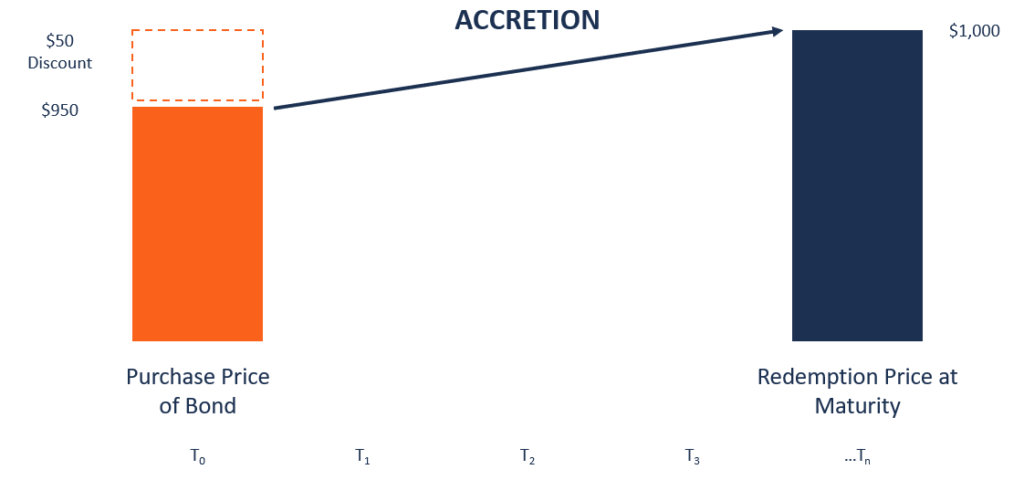
Accretion is a finance term that refers to the increment in the value of a bond after purchasing it at a discount and holding it until the maturity date. A bond is said to be purchased at a discount price when the purchase price falls below its par value. As the redemption date approaches, the value of the bond will grow until it converges with its par or face value at maturity. The acceleration in the value of the bond over time is known as the accretion discount.

A bond that is purchased at a higher price than its face value is said to be purchased at a premium. As the bond nears maturity, it declines in value until it reaches its par value on the maturity date. The decline in value of the bond over time is known as the amortization of premiums.
In acquisitions, accretion refers to the growth in earnings and assets after a particular transaction such as a merger or acquisition. The transaction is considered earnings accretive when the acquirer’s price-earnings ratioPrice Earnings RatioThe Price Earnings Ratio (P/E Ratio is the relationship between a company’s stock price and earnings per share. It provides a better sense of the value of a company. is greater than the P/E of the target company. The acquirer is interested in acquiring a target company with a low price-earnings ratio as a way of boosting the post-acquisition earnings per share (EPS)Earnings Per Share (EPS)Earnings per share (EPS) is a key metric used to determine the common shareholder's portion of the company’s profit. EPS measures each common share's profit of the combined company and increase the price of its shares.
Bond Accretion
Bond accretion is the growth in the value of the bond as time lapses. As it approaches the maturity date, the value of the bond increases until it converges with its par value, which is the amount paid to the bondholder. For example, assume that the par value of a bond is $1,000, but it is offered at a discounted price of $950. It means that the present value of the bond is $950, and the discount is $50 ($1,000 – $950). The value of the bond will increase until it reaches a face value of $1,000.
Methods of Accounting for Bond Accretion
There are two main methods of accounting for bond accretion, i.e., straight-line method and constant yield method.
1. Straight-line Method
When using the straight-line method, the increase in the value of the bond is spread evenly throughout the term of the bond. For example, if the term of the bond is 5 years and the company reports its financials every quarter, it means that there are 20 financial periods up to maturity.
The discount of $500 is divided across the 20 periods, which equals $25 per quarter. It means that there will be an accretion of $25 in each period until maturity. It will raise the bond liability balance by $25 in each period until the redemption date.
2. Constant Yield
When using the constant yield method, the increase in the value of the bond is heaviest closest to the maturity date. Unlike the straight-line method, the increment is not even and some periods tend to show bigger gains than other periods. The gains are concentrated in the last phase of the bond’s life.
When using the constant yield method, the first step is to determine the Yield to Maturity (YTM)Yield to Maturity (YTM)Yield to Maturity (YTM) – otherwise referred to as redemption or book yield – is the speculative rate of return or interest rate of a fixed-rate security.. YTM is what the bond will earn until the maturity date. When calculating the yield using a spreadsheet or calculator, you will need the par value of the bond, price, years to maturity, and the bond interest rate as inputs.
Acquisition Accretion
One of the objectives of acquiring another business and merging into the current business is to increase synergies. The new combined business enjoys greater value than the sum of the two separate entities. The combined company enjoys reduced costs, greater economies of scaleEconomies of ScaleEconomies of scale refer to the cost advantage experienced by a firm when it increases its level of output.The advantage arises due to the, and higher earnings.
The acquirer generates an acquisition accretion by adding the EBITDA/Earnings ratio of the smaller business into the larger business’ EBITDA/Earnings ratio. Acquisition accretion is a good thing for companies, as it increases the shareholders’ value.
Example of Acquisition Accretion
Assume that Company ABC wants to acquire Company XYZ as a way of increasing its EPS. Company ABC reported $200,000 in net income in the past year, and it owns 1,000,000 in outstanding shares. On the other hand, Company XYZ reported a net income of $100,000 in the past year, and 200,000 new shares were sold to raise cash to purchase the number of outstanding shares. We can use the given information to determine the acquisition accretion of the combined company.
EPS of the acquirer:
EPS = 200,000/1,000,000 = $0.20
EPS of the combined company:
= (200,000+100,000)/(1,000,000+200,000) = 300,000/1,200,000 = $0.25
The EPS of the combined company ($0.25) is $0.05 higher than the original EPS of ABC company ($0.20). It means that the acquisition accretion for the transaction is $0.05.
More Resources
CFI offers the Financial Modeling & Valuation Analyst (FMVA)™Become a Certified Financial Modeling & Valuation Analyst (FMVA)®CFI's Financial Modeling and Valuation Analyst (FMVA)® certification will help you gain the confidence you need in your finance career. Enroll today! certification program for those looking to take their careers to the next level. To keep learning and advancing your career, the following resources will be helpful:
- Discount RateDiscount RateIn corporate finance, a discount rate is the rate of return used to discount future cash flows back to their present value. This rate is often a company’s Weighted Average Cost of Capital (WACC), required rate of return, or the hurdle rate that investors expect to earn relative to the risk of the investment.
- Financial RatiosFinancial RatiosFinancial ratios are created with the use of numerical values taken from financial statements to gain meaningful information about a company
- Par ValuePar ValuePar Value is the nominal or face value of a bond, or stock, or coupon as indicated on a bond or stock certificate. It is a static value
- Types of SynergiesTypes of SynergiesM&A synergies can occur from cost savings or revenue upside. There are various types of synergies in mergers and acquisition. This guide provides examples. A synergy is any effect that increases the value of a merged firm above the combined value of the two separate firms. Synergies may arise in M&A transactions
-

Face Value Explained: Definition, Examples & Importance
The value mentioned on an instrument like a coin, stamp, or bill is called the face value of that instrument. For example, a $100 bill comes with a face value of $100. In calculus, the face value of 3
-

Understanding Fair Value: Definition & Importance
Fair value refers to the actual value of an asset – a product, stockStockWhat is a stock? An individual who owns stock in a company is called a shareholder and is eligible to claim part of the c
invest
- Understanding Bond Face Value: Definition & Importance
- Understanding Basis Points: A Guide to Bond Yield Changes
- Understanding Bond Pricing: Key Factors & Valuation
- Coupon Bonds: Understanding Fixed Income & Interest Payments
- Discount Bonds: Understanding Pricing & Secondary Markets
- Ex-Post Analysis: Understanding Outcomes After Events
- Understanding Noncallable Securities: A Comprehensive Guide
- Samurai Bonds: A Guide to Understanding Yen-Denominated Corporate Debt
- Accretion: Understanding Growth in Finance & Business
-
 Understanding Bond Duration: A Key Fixed Income Metric
Duration is one of the fundamental characteristics of a fixed-income security (e.g., a bondBondsBonds are fixed-income securities that are issued by corporations and governments to raise capital....
-
 Understanding Equity: A Comprehensive Guide for Investors
In finance and accounting, equity is the value attributable to the owners of a business. The book value of equity is calculated as the difference between assetsTypes of AssetsCommon types of assets in...