
S&P 500 Dividend Aristocrats: Definition & Investment Insights
The S&P 500 Dividend Aristocrats, also known as the Dividend Aristocrats, is an exclusive index within the Standard and Poor’s 500 that was launched in 2005. It contains companies that increased their dividend payouts for over 25 consecutive years. It is a high-performance index and consists of approximately 60 large-cap stocks over a wide variety of sectors and is often considered an attractive index to invest in, as it includes many stable growth-oriented stocks.
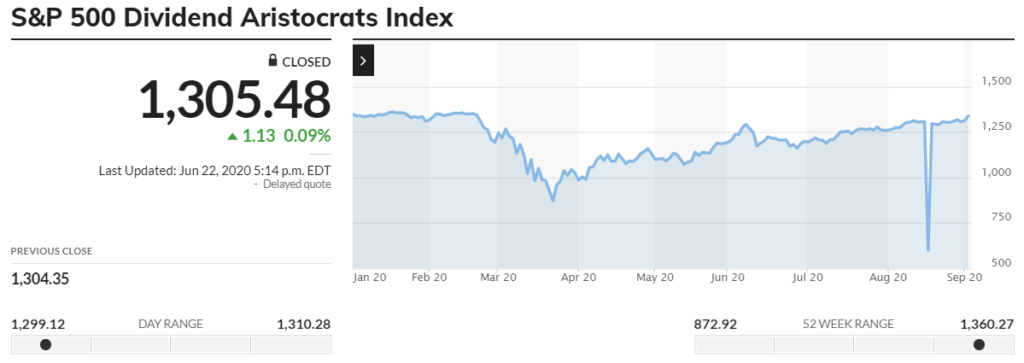
There are exchange-traded funds (ETFs)Exchange Traded Fund (ETF)An Exchange Traded Fund (ETF) is a popular investment vehicle where portfolios can be more flexible and diversified across a broad range of all the available asset classes. Learn about various types of ETFs by reading this guide. that package companies within the Dividend Aristocrats into a single-purchase investment product that is often lucrative for casual investors looking to invest in a diversified group of large-cap securities.
Summary
- The S&P 500 Dividend Aristocrats, also known as the Dividend Aristocrats, is a special index within the Standard and Poor’s 500. Companies are added or removed once yearly.
- The index was launched in 2005 and contains companies that increased their dividend payouts for over 25 consecutive years.
- The Dividend Aristocrats maintains stringent criteria when considering admittance into the index, making the index exclusive for companies and attractive index for investors.
Dividend Aristocrats Eligibility Criteria
Listed below are the eligibility criteria for a company to be listed in the Dividend Aristocrats:
- Member of the S&P 500 Index
- Maintain a total market cap of USD$3 billion (float-adjusted)
- Increase dividend payments for 25 years consecutively
- Maintain USD$5 million in daily share trade value for three months before acceptance
The Dividend Aristocrats maintains the above stringent criteria when considering admittance into the index. One of the reasons is the ability to remain an exclusive and attractive index for investors. The index also sees a generally exceptionally low turnover, giving exemplary status to companies that remain within the Dividend Aristocrats as a symbol of prominence.
Rarely a company will lose its status within the index, which generally occurs during tumultuous economic times and recessionsRecessionRecession is a term used to signify a slowdown in general economic activity. In macroeconomics, recessions are officially recognized after two consecutive quarters of negative GDP growth rates.. Only two companies were removed between 2017 and 2019 – one that occurred due to a dividend rate cut, and the other was due to an acquisition by another member company.
Companies are added or removed once yearly – generally based on the requirements. There is also a reweighting that is completed quarterly to make sure that each member company takes up an equal weighting within the index.
Example of Companies Listed in the Dividend Aristocrats
Below is a selection of companies currently listed in the Dividend Aristocrats:
- Raytheon (RTX)
- AT&T (T)
- Chubb (CB)
- Caterpillar Inc. (CAT)
- Praxair (PX)
- REIT Federal Realty Investment Trust (FRT)
How to Invest in the S&P 500 Dividend Aristocrats Index
All savvy investors are looking at unique ways to diversify their portfolios to help take some of the risks out of everyday investing. The Aristocrats Index contains income-generating companies that pay dividends, which help form a stable bedrock to many investors’ portfolios.
Another way one may choose to invest in the Dividend Aristocrats Index is through investment products like ETFs. Many ETFs and index fundsIndex FundsIndex funds are mutual funds or exchange-traded funds (ETFs) that are designed to track the performance of a market index. Currently available index funds track different market indices, including the S&P 500, Russell 2000, and FTSE 100. offer income-generating yields for investors, which can prove to be financially lucrative, predictable, and stable over the long term.
Many mutual fundsMutual FundsA mutual fund is a pool of money collected from many investors for the purpose of investing in stocks, bonds, or other securities. Mutual funds are owned by a group of investors and managed by professionals. Learn about the various types of fund, how they work, and benefits and tradeoffs of investing in them exist that mimic the index, giving less savvy investors the opportunity to invest through their local financial institution if they do not belong to a discount brokerage or do not have a stockbroker of their own.
Learn More
CFI is the official provider of the Commercial Banking & Credit Analyst (CBCA)™Program Page - CBCAGet CFI's CBCA™ certification and become a Commercial Banking & Credit Analyst. Enroll and advance your career with our certification programs and courses. certification program, designed to transform anyone into a world-class financial analyst.
To keep learning and developing your knowledge of financial analysis, we highly recommend the additional resources below:
- Capitalization-Weighted IndexCapitalization-Weighted IndexThe Capitalization-Weighted Index (cap-weighted index, CWI) is a type of stock market index in which each component of the index is weighted relative to its total market capitalization. In a capitalization-weighted index, companies with larger market capitalization exert a greater impact on the index value.
- Stable Payment PolicyStable Dividend PolicyA business with a stable dividend policy pays out a steady dividend every given period, regardless of the volatility in the market. The exact amount of dividends that are paid out depends on the long-term earnings of the company.
- SPDR S&P 500 ETFSPDR S&P 500 ETF (SPY)The Standard and Poor Depositary Receipts (SPDR) S&P 500 ETF is an exchange-traded fund that tracks the S&P 500 stock market index.
- Investing: A Beginner’s GuideInvesting: A Beginner's GuideCFI's Investing for Beginners guide will teach you the basics of investing and how to get started. Learn about different strategies and techniques for trading
-
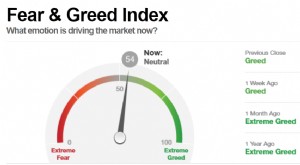
Fear & Greed Index: Understanding Investor Sentiment | CNN Business
The Fear and Greed Index, developed by CNNMoney, is used to gauge whether investors are too bullish or bearish on the stock market. The index ranges from 0 (extreme fear) to 100 (extreme greed).
-

Hang Seng Index (HSI): A Comprehensive Guide to Hong Kong's Stock Market
The Hang Seng Index (HSI) is a stock market index in Hong Kong. It records and monitors the daily changes in stock prices of the 50 largest Hong Kong stock market companies. As the companies represent
invest
- Advance-Decline Line: Understanding Market Sentiment & Trends
- EAFE Index: Understanding Developed Market Performance
- Nikkei Index: Understanding Japan's Top Stock Market Indicator
- Price-Weighted Index Explained: How It Works & Examples
- S&P 500 Dividend Aristocrats: Definition & Investment Insights
- Understanding the S&P 500: A Comprehensive Guide
- S&P 500 Ticker Symbol (^GSPC): What You Need to Know
- Understanding the S&P 500: Top Holdings & Long-Term Performance
- Dividend Aristocrats: A History of Consistent Dividend Growth | S&P 500
-
 Capitalization-Weighted Index (CWI): Explained
The Capitalization-Weighted Index (cap-weighted index, CWI) is a type of stock market index in which each component of the index is weighted relative to its total market capitalizationMarket Capitaliz...
-
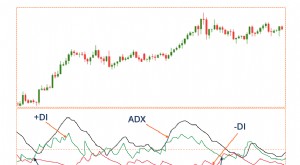 DMI: Understanding the Directional Movement Index for Trading
The Directional Movement Index (DMI) is an indicator that helps in determining the direction the asset price is moving and the strength of the price movement. It does so by comparing the current price...