
Asset Retirement Obligation (ARO): Definition & Financial Impact
An asset retirement obligation (ARO) is a legal obligation that is associated with the retirement of a tangible, long-term asset. It is generally applicable when a company is responsible for removing equipment or cleaning up hazardous materials at some agreed-upon future date.

A company must realize the ARO for a long-term asset at the point an obligating event takes place, so their financial statements accurately reflect the company’s value.
Purpose of Asset Retirement Obligations
The purpose of asset retirement obligations is to act as a fair value of a legal obligation that a company undertook when it installed infrastructure assets that must be dismantled in the future (along with remediation efforts to restore their original state). The fair value of the ARO must be recognized immediately, so the present financial position of the company is not distorted; however, it must be done reliably.
AROs ensure that known future problems are planned for and resolved. In the real world, they are utilized mainly by companies that typically use infrastructure in their operations. A good example is oil and gas companiesOil and Gas Company Balance SheetsUnique items on oil and gas company balance sheets include proved reserves, unproved reserves, asset retirement obligation, and derivative fair value..
Governing Rules for AROs
ARO calculations are governed by the Financial Accounting Standards Board’s Rule 143. The rule essentially states that a company has a legal obligation to remove the asset, and there are certain calculation rules for an accountant to follow.
Calculating AROs
When a company installs a long-term asset with future intentions of removing it, it incurs an ARO. To recognize the obligation’s fair value, CPAs use a variety of methods; however, the most common is to use the expected present value technique. To use the expected present value technique, you will need the following:
1. Discount Rate
Acquire a credit-adjusted, risk-free rate to discount the cash flows to their present value. The credit ratingCredit RatingA credit rating is an opinion of a particular credit agency regarding the ability and willingness an entity (government, business, or individual) to fulfill its financial obligations in completeness and within the established due dates. A credit rating also signifies the likelihood a debtor will default. of a business may affect the discount rate.
2. Probability Distribution
When calculating the expected values, we need to know the probability of certain events occurring. For example, if there are only two possible outcomes, then you can assume that each outcome comes with a 50% probability of happening. It is recommended you use the probability distribution method unless other information must be considered.
Then, you can follow the steps to calculate the expected present value of the ARO:
1. Estimate the timing of the future retirement costs (cash flows), along with their respective amounts.
2. Determine an appropriate discount rate based on the businesses’ credit rating and an underlying risk-free rate. You can use the Capital Asset Pricing Model (CAPM)Capital Asset Pricing Model (CAPM)The Capital Asset Pricing Model (CAPM) is a model that describes the relationship between expected return and risk of a security. CAPM formula shows the return of a security is equal to the risk-free return plus a risk premium, based on the beta of that security to find the appropriate discount rate.
3. Recognize any period-to-period increases in the ARO carrying amount (it is like an accretion expense). You can do it by multiplying the beginning balance of the liability by the original credit adjusted, risk-free rate.
4. Recognize upward liability revisions – discount any costs that may be incurred in the future that you did not originally account for.
5. Recognize downward liability revisions – remove the discounted effect of any costs that might have been overstated in your original estimate.
If you are seeking a rough estimate, you can usually acquire it by accounting only for inflation. For example, if you hold a 40-year lease on a piece of land, the cost of the ARO today is $10,000, and you expect inflation to run at 2% per year, then:
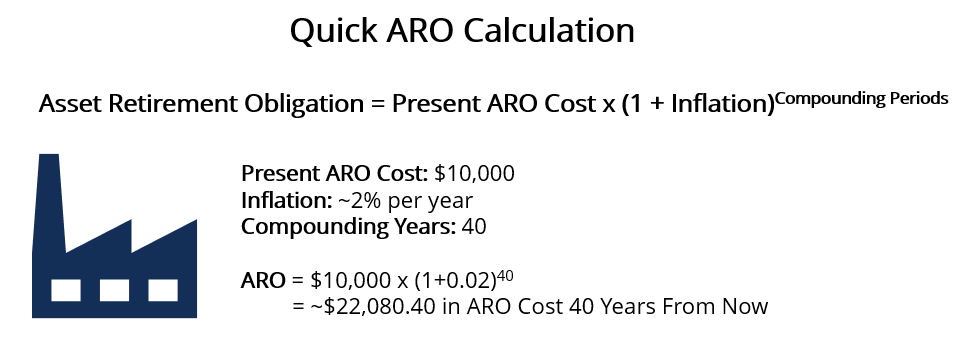
The $22,080.40 is the approximate fair value that a company will need to spend when retiring the asset in 40 years.
Subsequent ARO Measurement
A company should periodically review its AROs to account for upward or downward liability revisions. During the review, the company should use an updated discount rate that reflects current market conditions. Follow the steps below to assist in the recognition of any additional costs an ARO’s undertaken since original recognition:
1. Recognize the future costs (the liability) at fair value.
2. Allocate the ARO liability over the lifetime of the long-term asset.
3. Measure changes to the ARO (the liability) with the passage of time, using the original discount rate when each liability layer was recognized. It will be reflected in the differing balance on the balance sheet.
4. As time passes, the probabilities and amount that are associated with the ARO will improve in predictive accuracy. As such, you should continuously look at whether to adjust the liability upwards or downwards.
If you adjust upwards, use the current credit adjusted, risk-free rate to discount it. If you adjust downwards, use the original credit adjusted, risk-free rateRisk-Free RateThe risk-free rate of return is the interest rate an investor can expect to earn on an investment that carries zero risk. In practice, the risk-free rate is commonly considered to equal to the interest paid on a 3-month government Treasury bill, generally the safest investment an investor can make..
An individual will usually carry out a subsequent measure of an ARO when a portion of the liability must be paid before the asset retires. If there is no expense associated with retiring the asset, then they can write down the ARO to 0.
Additional Resources
CFI offers the Commercial Banking & Credit Analyst (CBCA)™Program Page - CBCAGet CFI's CBCA™ certification and become a Commercial Banking & Credit Analyst. Enroll and advance your career with our certification programs and courses. certification program for those looking to take their careers to the next level. To keep learning and developing your knowledge base, please explore the additional relevant resources below:
- Depreciation MethodsDepreciation MethodsThe most common types of depreciation methods include straight-line, double declining balance, units of production, and sum of years digits.
- Discount RateDiscount RateIn corporate finance, a discount rate is the rate of return used to discount future cash flows back to their present value. This rate is often a company’s Weighted Average Cost of Capital (WACC), required rate of return, or the hurdle rate that investors expect to earn relative to the risk of the investment.
- Physical DeteriorationPhysical DeteriorationPhysical deterioration refers to the loss in value of a real estate property due to the physical wearing out of a building.
- Projecting Balance Sheet Line ItemsProjecting Balance Sheet Line ItemsProjecting balance sheet line items involves analyzing working capital, PP&E, debt share capital and net income. This guide breaks down how to calculate
-
Impaired Assets: Definition, Recognition, and Accounting Standards
An impaired asset is an accounting term that describes an asset with a recoverable value or fair market valueFair Market ValueThe fair market value (of a good or service being exchanged) refers to the
-

Lessor vs. Lessee: Understanding Lease Agreements
There are two main parties in a lease agreement, and every finance professionalFP&A AnalystBecome an FP&A Analyst at a corporation. We outline the salary, skills, personality, and training you
Accounting
- Asset Turnover Ratio: Definition & Calculation - Financial Analysis
- Debt-to-Asset Ratio: Definition, Calculation & Significance
- Asset Management Companies (AMCs): A Comprehensive Guide
- Asset Retirement Obligation (ARO): Definition & Financial Impact
- EBITA Explained: Understanding Earnings Before Interest, Taxes, and Amortization
- Understanding Expenditures: Definition and Types
- Goodwill in Accounting: Definition & Value
- Understanding Leases: Types, Classifications, and Key Concepts
- OIBDA Explained: Understanding Operating Income Before Depreciation & Amortization
-
 Understanding Extraordinary Items in Financial Statements
An extraordinary item is an accounting term that refers to an abnormal gain or loss that is not generated from the ordinary business operations of a company, is infrequent in nature, and is unlikely t...
-
 Historical Cost Accounting: Definition & Importance
In accounting, the historical cost of an asset refers to its purchase price or its original monetary value. Based on the historical cost principle, the transactions of a business tend to be recorded a...