
Understanding Maintenance Expenses: A Comprehensive Guide
Maintenance expenses are costs incurred on a regular basis to keep an asset working in its optimal condition. Maintenance costs come into play when a person purchases an asset, such as a motor vehicle, speed boat, or even a condo. The asset requires ongoing maintenance during their useful life to keep them in good working condition.

When buying a fixed assetFixed AssetsFixed assets refer to long-term tangible assets that are used in the operations of a business. They provide long-term financial benefits, buyers must budget for the ongoing maintenance costs of an asset in addition to the initial purchase price that the buyer is required to pay to acquire the asset. Maintenance costs are inevitable, and the asset owner must incur such costs regularly whether or not the asset is in active use.
Summary
- Maintenance expenses are costs incurred for the routine maintenance of an asset to keep it in its optimal working condition.
- Maintenance expenses are recorded in the profit and loss account, thus reducing the profit for the year.
- The benefits of maintenance expenses are not expected to last beyond a period of 12 months.
Maintenance Expenses Explained
Maintenance costs can take various forms depending on the type of asset involved. For example, the maintenance costs of a motor vehicle vary from the maintenance cost of a real estate propertyReal EstateReal estate is real property that consists of land and improvements, which include buildings, fixtures, roads, structures, and utility systems. Property rights give a title of ownership to the land, improvements, and natural resources such as minerals, plants, animals, water, etc.. The owner of a truck will incur costs in oil changes, engine repairs, tire replacement, engine tune-ups, radiator flushing, etc.
The expenses are usually debited in the repairs and maintenance account of the motor vehicle. However, if a truck owner adds a hydraulic lift to the truck, it increases the performance level of the asset, and the cost is capitalized. It means that the cost will not be expensed, and it is instead depreciated over the truck’s useful life.
On the other hand, the maintenance costs of a purchased home may include expenses, such as lawn care, electrical repairs, roof repairs, plumbing, replacement of worn-out house appliances, fixing damaged fixtures, etc. Hazard insurance against losses from natural events, such as tornadoes, earthquakes, wildfires, and storms, is also included as part of the maintenance costs of a property.
However, major repairs, such as replacing the entire roof of a building, are not treated as maintenance expenses. The expense extends the useful life of the asset, and the cost incurred in roof replacement is capitalized and depreciated over the property’s useful life.
Maintenance Expenses for Leased Properties
The maintenance expenses for a property that an individual owns vary from the maintenance costs of a leased or rented property. The maintenance expenses of a rented property are shared between the landlord and the tenant. The rental agreementModified Gross LeaseA modified gross lease is a unique method of property ownership and maintenance, where the landlord and tenant are both responsible for paying operating should disclose the expenses that fall on the tenant or landlord’s side.
Major expenses – such as snow removal, window glass replacement, roof replacement, lawn care, and other exterior expenses – should be paid for by the landlord. For a furnished property, the landlord bears the cost of replacing and repairing furniture, fixtures, and carpeting and painting the property. In most states, the government requires landlords to install heating, cooling, and ventilation equipment to make the house habitable throughout the year.
Tenants may be required to meet certain maintenance costs during the period of their tenancy. However, the costs that tenants must meet vary depending on their length of stay and location. For example, tenants who occupy a house for an extended period may be required to pay a regular maintenance fee to cover the cost of cleaning and lawn care, which may be included in the monthly rental payments.
They may also be required to meet the cost of replacing worn-out appliances, repairing broken fixtures, etc. Short-term renters who rent a property for a few days to a month may only be required to meet the cost of replacing appliances and fixtures that are damaged during their stay.
Maintenance Expenses vs. Capital Expenditures
Maintaining assets like buildings and motor vehicles requires owners or renters to incur certain costs to keep them working properly. Maintenance expenses and capital expenditures are costs incurred to keep an asset working properly, but they come with different meanings.
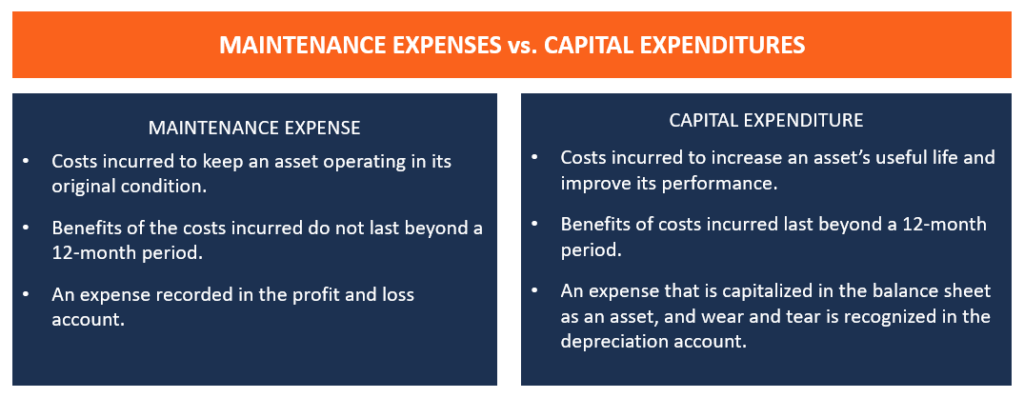
Maintenance expenses are costs incurred when performing routine actions to keep an asset in its original condition. Examples of maintenance costs include simple electrical repairs, bulb replacement, paint touch-ups, pool cleaning, lawn care, etc.
Capital expenditures, on the other hand, involve major repairs, replacements, and upgrading of components, and such activities require time, effort, and money to achieve. Examples of capital expenditures include carpet replacement, security system upgrades, building exterior painting, pool deck refurbishment, and roof replacement.
The main difference between the two expenses is that, while maintenance expenses are incurred to keep assets working in their original condition, capital expenditures are incurred to increase an asset’s useful life. The benefit of maintenance expenses is not expected to go beyond 12 months, whereas capital expenditures are expected to benefit the asset owner for a period exceeding 12 months.
Therefore, maintenance expenses are expensed in the profit and loss (P&L) statementProfit and Loss Statement (P&L)A profit and loss statement (P&L), or income statement or statement of operations, is a financial report that provides a summary of a for the year, impacting the profit reported. On the other hand, capital expenditures are capitalized in the balance sheet as an asset, and wear and tear are recognized as depreciation in the profit and loss account.
Additional Resources
CFI offers the Commercial Banking & Credit Analyst (CBCA)™Program Page - CBCAGet CFI's CBCA™ certification and become a Commercial Banking & Credit Analyst. Enroll and advance your career with our certification programs and courses. certification program for those looking to take their careers to the next level. To keep learning and advancing your career, the following resources will be helpful:
- Depreciation MethodsDepreciation MethodsThe most common types of depreciation methods include straight-line, double declining balance, units of production, and sum of years digits.
- Projecting Balance Sheet Line ItemsProjecting Balance Sheet Line ItemsProjecting balance sheet line items involves analyzing working capital, PP&E, debt share capital and net income. This guide breaks down how to calculate
- Capitalized CostCapitalized CostA capitalized cost is a cost that is incurred from the purchase of a fixed asset that is expected to directly produce an economic benefit
- Equipment Lease AgreementEquipment Lease AgreementEquipment lease agreement is a contractual agreement where the lessor, who is the owner of the equipment, allows the lessee to use the equipment for
-

Understanding Financial Assets: Definitions & Types
Financial assets refer to assets that arise from contractual agreements on future cash flowsCash Flow StatementA cash flow Statement contains information on how much cash a company generated an
-
Understanding Financial Statements: A Comprehensive Guide
Financial statements are the records of a company’s financial condition and activities during a period of time. Financial statements show the financial performance and strength of a companyCorpo
Accounting
- Understanding Operating Expenses (OpEx): A Comprehensive Guide
- Understanding Business Erosion: Causes, Risks & Prevention
- Understanding Non-Cash Expenses: A Comprehensive Guide
- Understanding Maintenance Margin: A Guide for Investors
- Understanding Accounts Expenses: A Comprehensive Guide
- Understanding Accrued Expenses: A Comprehensive Guide
- Understanding Administrative Expenses: A Comprehensive Guide
- Understanding Operating Expenses (OPEX): A Comprehensive Guide
- Understanding Prepaid Expenses: Definition & Accounting
-
 Discontinued Operations: Definition & Accounting Treatment
Discontinued operations is a term used in accounting to refer to parts of a company’s business that have been terminated and are no longer operational. In accounting, discontinued operations are...
-
 Understanding Business Expenses: A Comprehensive Guide
Businesses incur various types of expenses. An expense is a type of expenditure that flows through the income statementIncome StatementThe Income Statement is one of a companys core financial statemen...